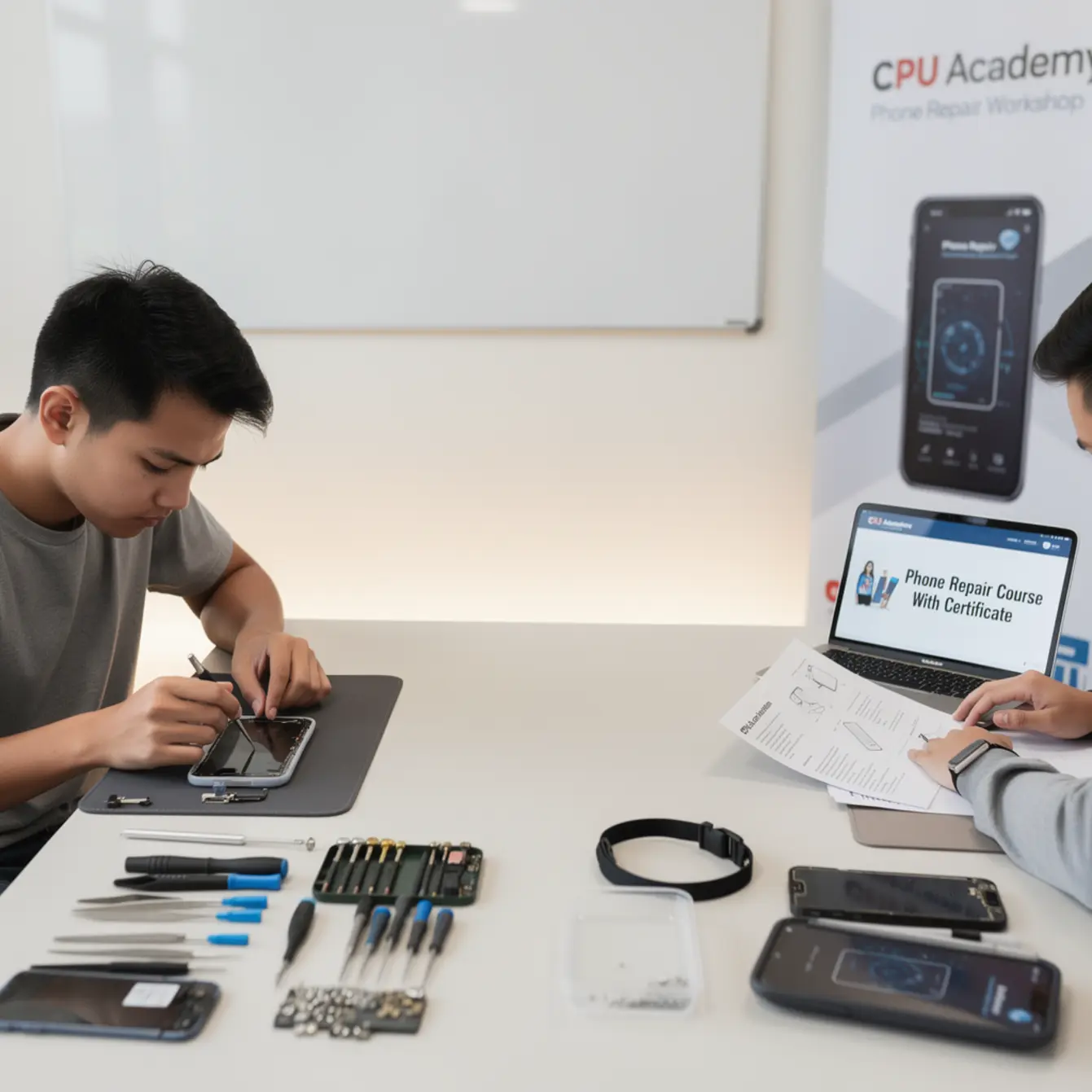
Quick answer: A phone repair course with a certificate teaches you to diagnose, disassemble, and fix real smartphones — covering screens, batteries, charging ports, and basic board-level faults. The certificate proves you completed structured training. The real value comes from what the curriculum covers, whether you practice on actual devices, and whether the skills translate to paid work. This article walks you through exactly what to look for before you spend a dollar.
You’ve probably watched a dozen YouTube videos on phone repair and still feel like you’d crack a screen or short something out the moment you pick up a spudger for real. That fear is completely normal. It’s also the exact reason a structured phone repair course matters so much more than free clips.
There’s a real difference between watching someone else work a pry pick across a bench and actually following a structured lab path yourself, step by step, on a device in your own hands. One builds familiarity. The other builds muscle memory and judgment.
This guide is for people like Jay: someone who wants practical, paid-work-ready skills, not a binder full of theory. We’ll cover what a certificate actually means, what separates a course worth taking from one that wastes your time, and how to make a smart decision before you enroll anywhere. No invented stats. No fluff. Just a clear path forward.
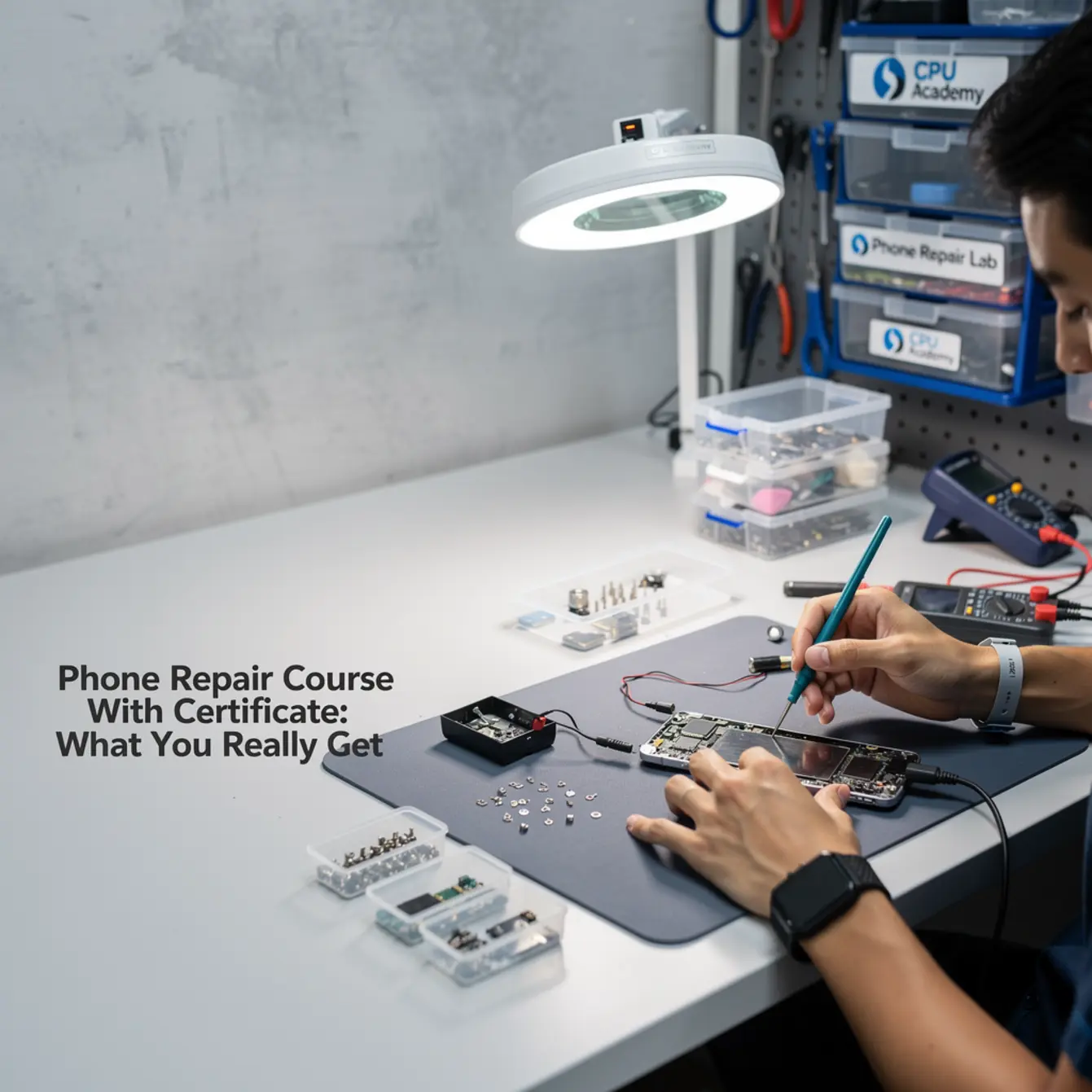
Quick answer: who should choose this phone repair course with certificate?
Consider a certified cell phone repair course if any of these fit your situation:
- You want to repair phones for friends, family, or paying customers and need real confidence before you start.
- You’re thinking about opening a small repair business or adding repair to an existing side hustle.
- You’ve watched videos but still feel shaky on the actual diagnosis steps.
- You want something on paper, a credential, that backs up your skill when a customer asks.
A certificate from a structured course signals that you followed a real curriculum, completed assignments, and showed you understood the material. It’s not a license, but it’s meaningful proof. CareerWise explains the difference between certificates and degrees clearly if you want more context on how credentials work in skilled trades.
Already repairing phones professionally and just need a narrow skill upgrade? A full course may be overkill. A focused module like schematic reading might serve you better. But for beginners building from zero, the full course is the right starting point.
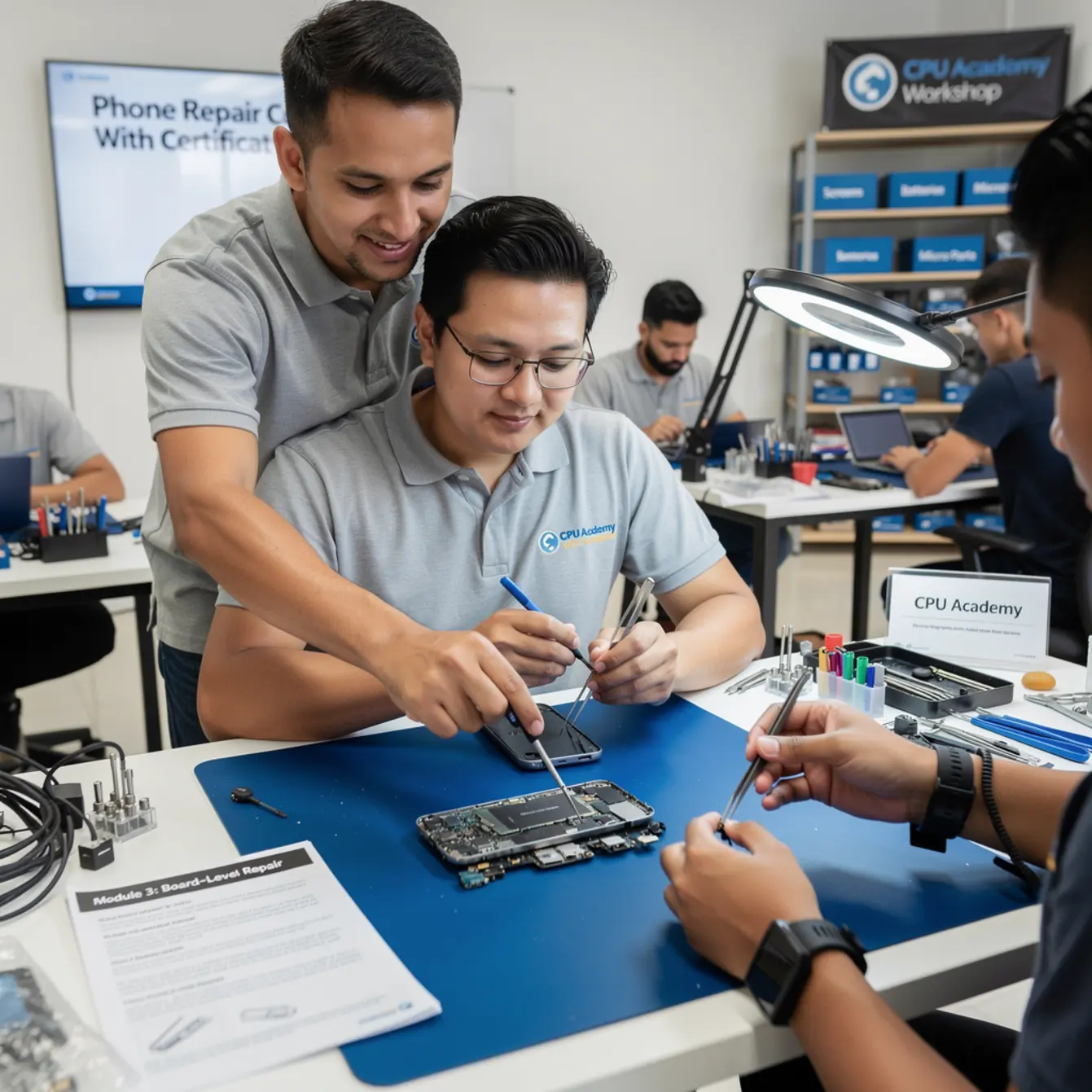
Who this is best for (and who should skip it)
Best fit
This type of training works best for complete beginners who want a repeatable process. If you’ve never opened a phone before, a course gives you the sequence: the right tools, the right order, and what to check when something goes wrong.
It also fits people who learn better with structure than with scattered search results. A mobile phone repair course puts information in order, so you’re not jumping between a Reddit thread and a 2017 video covering a model you don’t even own.
Side-hustlers doing two to five repairs a week are a strong match too. You need to work quickly and confidently, and that comes from repetition built on solid fundamentals, not guesswork.
Who should probably skip it
If you’ve already repaired fifty-plus phones and just want to learn micro-soldering or board-level diagnostics, a general beginner course will probably feel slow. Look for a module-level option focused on schematics or advanced diagnosis instead.
And if you have zero interest in repair as a skill or income source and just want to fix one personal phone, a step-by-step guide for your specific model is faster and cheaper.
Case example: learning under pressure
Picture Marcus, a 24-year-old in Ohio who watched tutorials for months but kept hesitating at his workbench. He broke one screen during practice, not because he lacked talent, but because he skipped the disassembly sequence and forced a clip instead of releasing it properly.
A structured cell phone repair training program covers exactly that sequence. The course didn’t just teach him to replace screens. It taught him to slow down, read the device, and follow a diagnostic flow before touching a single screw. That shift in approach is what turns a shaky beginner into someone customers actually trust.
His first successful repair, a straightforward screen swap he completed clean and on the first try, wasn’t luck. It was the outcome of following the lab path from start to finish.
(This is a representative learning scenario, not a verified student testimonial.)
What to compare before you buy or enroll
Not all courses are equal. Before you put down money or time, compare these six things side by side.
| Factor | What to look for | Red flag |
|---|---|---|
| Curriculum depth | Covers disassembly, diagnosis, component-level faults, and common models | Only covers one phone brand or one repair type |
| Real-device practice | Exercises on actual or practice devices; not just slide decks | No hands-on component; purely theory-based videos |
| Certificate type | Tied to course completion with verifiable criteria | Certificate issued for just watching videos with no assessment |
| Instructor support | Q&A access, community, or direct feedback on repairs | No way to ask questions; no feedback loop |
| Time-to-skill | Clear module timeline; realistic pacing for a working adult | No structure; no guidance on how long each section takes |
| Job/income path | Explains how to move from training to first paid repair | Stops at theory; never connects skill to earning |
Cost
Price matters, but the real question is cost per usable skill. A course that costs more but takes you from zero to paying repairs faster can be far cheaper in practice than a bargain option that leaves you guessing at every step.
Check what’s included. Some courses bundle tools or launch kits; others are curriculum only. Know what you’re actually buying before you commit.
Refund policy
A fair refund window tells you something about how confident the course creator is in their own product. Look for clear terms before you commit, especially for an online phone repair course, where you can’t preview the lab feel in advance.
Real-device practice
This is the single biggest differentiator between a course that builds real skill and one that doesn’t. The difference between watching clips and following a structured lab path is exactly this: one gives you information, the other gives you trained hands.
If you can’t practice on actual components, you’re building memorization, not repair confidence. And memorization alone will not stop you from snapping a flex cable at the worst possible moment.
Common mistakes beginners make
Even motivated learners hit the same walls. Here’s what to watch for and how to sidestep each one before it costs you.
- Starting with the wrong device. Don’t practice on your daily driver. Use an inexpensive practice phone so a mistake doesn’t cost you a functional device or real money.
- Skipping the diagnosis step. Most beginners jump straight to disassembly. Working technicians diagnose first: what exactly is wrong, and what’s the safest fix path?
- Buying cheap tools. A spudger that bends or a pry pick that slips can crack a display. Tools are part of your kit. Invest in quality ones once and they’ll last for years.
- Treating the certificate as the goal. The certificate is proof. The skill is the point. Focus your energy on mastering each module, not just finishing it and moving on.
- Avoiding schematics. Many beginners feel intimidated by schematic diagrams. Once you know how to read one, your diagnostic speed jumps fast. It’s worth the learning curve. CPU Academy’s phone schematic diagram course is a focused option if you want to build that skill on its own.
- Never doing a practice repair end-to-end. Reading modules is not the same as completing a full repair. Put yourself through one, from first screw to final function test, on a practice device before you take a paid job.
CPU Academy fit: when our course is the smarter choice
CPU Academy is the right next step for readers who want to stop guessing and build phone repair skills in a practical, confidence-first way.
The Online Phone Repair Course & Certification at CPU Academy is built for the exact scenario this article has been describing: a beginner or early-intermediate learner who wants real-device skills backed by schematic-level understanding, not just a collection of how-to clips.
What makes this the right fit
The course follows a structured learning path, not a random playlist. You move through disassembly, diagnosis, component repair, and testing in a sequence that mirrors how a working technician actually approaches a device sitting on the bench in front of them.
It covers the faults you’ll actually see on the job: dead screens, bad charging ports, battery drain, water damage starting points, and boot failures. Those are the repairs customers bring in most often, and knowing them cold is what gets you repeat business.
The certificate connection
Finishing the course earns you a phone repair certification tied to real curriculum milestones, not just a watch-time badge. That matters when you’re explaining your background to a first customer or adding credentials to a local repair listing.
Beyond the basics
Want to go further after the core course? CPU Academy has focused resources for that too. The phone screen replacement course drills into the most common paid repair request technicians see. And if you want to build a business around your new skills, the 30-day launch kit gives you a structured path from trained technician to first paying customer.
When CPU Academy is specifically the right call
- You’re starting from zero and want a linear, step-by-step path with no gaps.
- You want schematic-backed diagnosis skills, not just mechanical how-tos.
- You want to move from training to income, not just a certificate sitting on a shelf.
- You prefer online learning you can pace around a job or a family schedule.
If this article matches what you want to learn, jump into CPU Academy’s Online Phone Repair Course & Certification to see the exact training path, modules, and next step.
FAQ + next step
Is a phone repair course certificate worth it for a beginner?
Yes, if the course behind the certificate is genuinely skills-based. A certificate from a course that covers diagnosis, real-device practice, and repair workflow gives you credibility with customers and a confidence baseline before you charge for work. A certificate that just requires clicking through slides is worth considerably less. Vet the curriculum, not just the credential.
How long does it take to complete a cell phone repair training program online?
This varies by course and how much time you put in each week. Many self-paced cell phone repair course online options are designed for working adults and can be completed in a few weeks at a consistent pace. The more important question is time-to-first-repair, not just course completion. A good course builds your skills fast enough that you’re doing practice repairs before you’ve finished every module.
Do I need expensive tools to start a mobile phone repair course?
No. A basic starter kit covers most common repairs: precision screwdrivers, a pry pick set, plastic spudgers, suction cups, tweezers, and an anti-static mat. You don’t need advanced soldering equipment to start. Check whether your course recommends a specific tool list. Some include guidance or bundles that help you avoid buying gear you won’t use yet.
Can I make money after completing a phone repair course?
Yes, many technicians start earning from repairs quickly after building core skills. Screen replacements, battery swaps, and charging port fixes are in constant demand. Your income depends on your volume, local pricing, and how you market yourself. A course that also covers the business side, including pricing, customer communication, and sourcing parts, gives you a much faster route to actual earnings than skills alone.
What’s the best next step after reading this?
Go review the course page directly. Check the module breakdown and see if the curriculum matches the skills gap you’ve identified. If you’re a beginner who wants hands-on, structured cell phone repair course training with a real certificate at the end, the CPU Academy course is a strong fit. Open the course page, read through what’s covered, and decide from there. No pressure, just a clear look at what you’d actually learn.