Most parents hit the same wall. They like the idea of their teenager learning phone repair, but they’re not sure if a phone repair course is worth it — or whether their kid will crack open a perfectly good device, get frustrated, and walk away after an hour.
That concern is completely fair. Out there right now you’ve got scattered video playlists, pricey in-person programs, and one-page PDFs all claiming to teach the exact same thing. The gap between them matters enormously when you’re starting from zero.
This guide cuts through that noise. You’ll see who this path actually suits, what to look at before spending a dollar, the mistakes beginners make almost every single time, and when a structured course gets teens to real skills faster than going it alone.
Updated for US learners. Written for parents and teenagers exploring repair as a practical, income-ready skill.
If this article matches what you want to learn, jump into CPU Academy’s Online Phone Repair Course & Certification to see the exact training path, modules, and next step.

Quick answer: who should choose this phone repair course for teenagers?
A phone repair course is the right starting point for any teenager who wants to fix devices with their hands, understand how smartphones actually work, and potentially earn money from a real skill — not just collect a certificate that sits in a drawer.
It’s a genuine fit if your teen:
- Likes taking things apart (or has already done it)
- Wants a side income or a head start on a trade career
- Learns better by doing than by reading textbooks
- Has access to a practice device, even a busted one
It’s probably not the right fit if they want a purely passive hobby or have zero interest in troubleshooting. Repair work rewards patience. It also rewards curiosity. Both can be developed over time — but that baseline curiosity helps a lot right at the beginning.
According to the BLS career planning guide for high school students, technical trades and hands-on vocational paths are among the strongest early-career options for high schoolers who want practical, income-ready skills before or alongside a four-year degree.
Who this is best for (and who should skip it)
Let’s make this concrete. Here are the two types of teenagers who tend to do well with cell phone repair training — and one type who usually struggles.
Best fit: the tinkerer
This teen has already cracked open a game controller, swapped out a laptop key, or watched a teardown video just because it was interesting. They don’t need to be convinced that hardware is cool. They just need structure so they stop breaking things randomly and start fixing them on purpose.
Best fit: the entrepreneur
This teen sees the business angle right away. Their friends crack screens constantly. They’ve already thought about charging $40 to fix one. A mobile phone repair course turns that instinct into a real, marketable capability — backed by the diagnostic knowledge to handle whatever walks through the door.
Who should wait
If your teenager has no patience for slow, careful work and genuinely hates debugging anything, repair will frustrate them fast. That’s not a failure — it’s useful information. There are plenty of other tech paths worth exploring. This one rewards people who like solving puzzles one deliberate step at a time.
What to compare before you buy or enroll
Not every cell phone repair course covers the same ground. Before spending anything, run through this checklist.
| What to check | What good looks like | Red flag |
|---|---|---|
| Real-device practice | Covers hands-on technique with actual components | Theory only, no physical workflow |
| Schematics included | Teaches you to read circuit diagrams | Skips diagrams entirely |
| Certification or credential | Clear completion credential you can show clients | No credential or a vague badge |
| Support access | Instructor or community help when you’re stuck | No feedback loop, no one to ask |
| Job path clarity | Addresses freelance, shop, or business launch | Stops at skill, ignores application |
| Time to first skill | Clear milestones; can do basic repairs early | No milestones, jumps straight to advanced |
| Refund or access policy | Transparent access terms or refund window | No policy stated before purchase |
Cost perspective
An online phone repair course will almost always run cheaper than an in-person program. That matters when a teenager is still testing the waters. But the cheapest option often drops schematics and support entirely — and those two things are what separate someone who can fix their own phone from someone who can fix other people’s phones and charge for it.
Time-to-skill reality
Most beginners with consistent practice can pull off a clean screen replacement within a few weeks of starting. Charging port repair and battery swaps usually come next. Board-level diagnosis takes longer, but those earlier wins build real momentum — and that momentum matters more than most people expect when you’re just getting going.
Common mistakes beginners make
- Starting on a working phone. Use a broken practice device first. Craigslist and eBay are full of cracked-screen phones for a few dollars. Your first teardown should not cost you anything that matters.
- Skipping the tools list. Using the wrong screwdriver strips those tiny screws in seconds. The right spudger or iSesamo costs almost nothing — but skipping it can ruin an entire repair.
- Watching without doing. Watching a clip makes it look easy. The first time your hands actually do it is always a different experience. Pause the video, replicate the step, then move forward.
- No anti-static mat. Static discharge can kill a logic board quietly. A basic mat and wrist strap are cheap insurance that most beginners skip and later regret.
- Ignoring schematics. Teens who skip circuit diagrams hit a hard wall the first time symptoms don’t point to an obvious broken part. Learning to read a schematic early clears that wall before it ever appears.
The difference between watching clips and following a structured lab path shows up fast. With random videos, there’s no progression, no schematic foundation, and no one to ask when something goes sideways on the workbench. A structured path gives you all three.
Picture a 16-year-old who picks up a $6 cracked-screen iPhone from a local buy-sell group. He clears a corner of his bedroom desk, lays out a magnetic parts mat, and works through a structured course from the first lesson. He learns the teardown sequence, swaps the screen with a part from a parts supplier, and photographs every step. By his third repair — still on practice phones — he’s fast enough and confident enough to fix a neighbor’s phone for $35. That first successful repair took about six weeks of consistent weekend sessions. No in-person class, no waiting for a semester to begin.
This is a representative example of how beginner-to-paid progress typically looks with structured, hands-on training. Individual results vary based on time invested and access to practice devices.
That pattern is common, not exceptional. Structure matters more than raw talent here. The teens who stall are almost always the ones piecing together random YouTube videos with no order, no real progression, and no schematic foundation underneath it all.
If you want a guided version of this instead of doing it alone, the next move is Online Phone Repair Course & Certification.
CPU Academy fit: when our course is the smarter choice
CPU Academy is the right next step for anyone who wants to stop guessing and learn phone repair in a practical, confidence-building way — not just follow along with whatever video pops up next.
Here’s the specific situation where it fits best:
- Your teenager is a complete beginner with no repair background and no tools yet
- You want more than screen swaps — you want diagnostic thinking built in from the start
- You want schematic reading covered, not quietly dropped
- You want a clear path toward real work — freelance jobs, a repair side hustle, or eventually a shop role
The phone repair course at CPU Academy is built for exactly this learner. It starts with foundational safety and tool knowledge, moves through hands-on repair technique, and builds toward the diagnostic skills that make someone genuinely employable — not just capable of copying a video someone else made.
Next, if your teen finishes the core course and wants to push further, two natural follow-on steps are already inside CPU Academy’s catalog. The Phone Schematic Diagram course goes deep on reading circuit boards — the skill that separates part-swappers from real technicians. The Phone Screen Replacement course gives focused, step-by-step practice on the most common repair job in any shop anywhere.
For teens who want to turn their repair skill into a business quickly, CPU Academy also offers a 30-Day Launch Kit built specifically around taking that first repair skill to paying customers.
None of these require prior experience. All of them build on each other in a logical order — which is exactly what a pile of random YouTube clips can never give you.
- Week 1–2: Tools, safety, anti-static basics, device anatomy
- Week 3–4: First teardown on a practice device; screen removal and replacement
- Week 5–6: Battery and charging port repair; intro to diagnostic thinking
- Week 7–8: Schematic reading fundamentals; board-level fault identification
- Week 9+: First paid repair; refine speed and build a repeatable process
FAQ + next step
How do I start if my teenager has never touched a phone repair tool?
Start with a broken practice phone, not a working one. Pick up a basic tool kit — pentalobe screwdriver, spudger, suction cup, anti-static mat. Then follow a structured course from the very first lesson rather than jumping straight to videos on specific repairs. Foundation first, speed later. That order makes everything easier.
What tools do I actually need to get started?
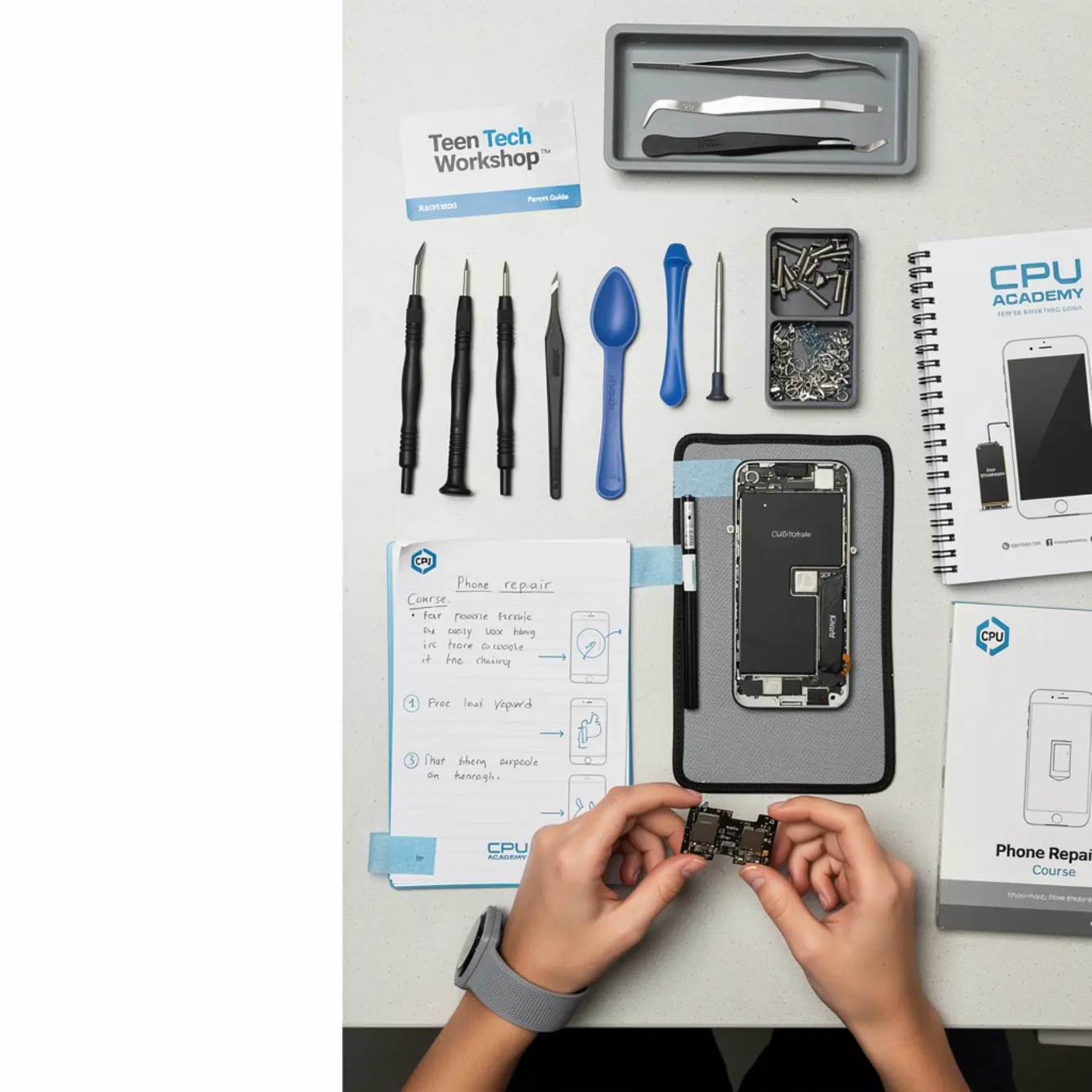
The core starter kit: pentalobe and Phillips screwdrivers matched to the device brand, a plastic spudger set, a suction cup handle, an anti-static mat, and a parts tray or magnetic mat to corral the screws. Don’t buy a massive kit on day one. Start with the basics and add tools as specific repairs call for them.
Can a teenager actually earn money from phone repair?
Yes, and often sooner than parents expect. Screen replacement is the most common repair request out there, and many teens land their first paid job within a few weeks of finishing their first module. Starting with friends, family, and neighbors keeps the pressure low. A 30-day business launch structure can turn those early jobs into a repeatable process.
Is an online phone repair course effective compared to in-person training?
A cell phone repair course online can be just as effective as in-person training — sometimes more so, because learners can pause, rewatch, and practice at their own pace without falling behind a class. The key is choosing one that includes real-device technique, schematic coverage, and some form of instructor or community support. Passive video playlists with no structure are what to avoid.
What comes first in a good repair course — theory or hands-on work?
A small amount of theory up front — tools, safety, and device anatomy — and then hands-on practice as fast as possible. The best courses don’t front-load hours of lecture before you touch anything. They get you to your first teardown quickly, then layer diagnostic knowledge alongside the physical work as you go.
Do I need to read schematics as a beginner?
Not on day one, but yes within the first few months. Teenagers who skip schematics can still handle common part swaps just fine — but they hit a wall the first time a repair doesn’t match an obvious broken component. Learning to read circuit diagrams early makes everything else faster and a lot less frustrating. CPU Academy’s dedicated schematic diagram course covers this in a way that’s genuinely beginner-friendly.
Ready to turn this into a real skill?
This guide gives you the decision framework. The actual training is one step away. If you want the real course page behind this article, open CPU Academy’s Online Phone Repair Course & Certification now and turn this topic into a concrete next step.
A structured phone repair course gives teenagers a skill they can use right away — not just a credential to frame on a wall.