By CPU Academy Editorial Team |
Quick answer: A phone repair certification proves to customers and employers that you know what you are doing. WISE (Wireless Industry Service Excellence) is an industry-recognized credential from CTIA. A course certificate is issued by the training provider after you complete their curriculum. Neither is automatically better — the right choice depends on where you want to work, how fast you need income, and how hands-on the training actually is. Most beginners benefit most from practical, skills-based training first, then layer in credentials as needed.
You have probably watched a few YouTube videos, maybe cracked open an old phone to see what is inside, and now you are wondering whether you should get a real certification before going further. The fear is real: What if you spend money on the wrong course? What if you break a customer’s phone because you learned from scattered tutorials? What if the certificate you earn means nothing to anyone who might hire you?
Those are smart fears. They mean you are taking this seriously. This article cuts through the noise and gives you a practical map so you can make a clear decision about your next step in phone repair training.
—
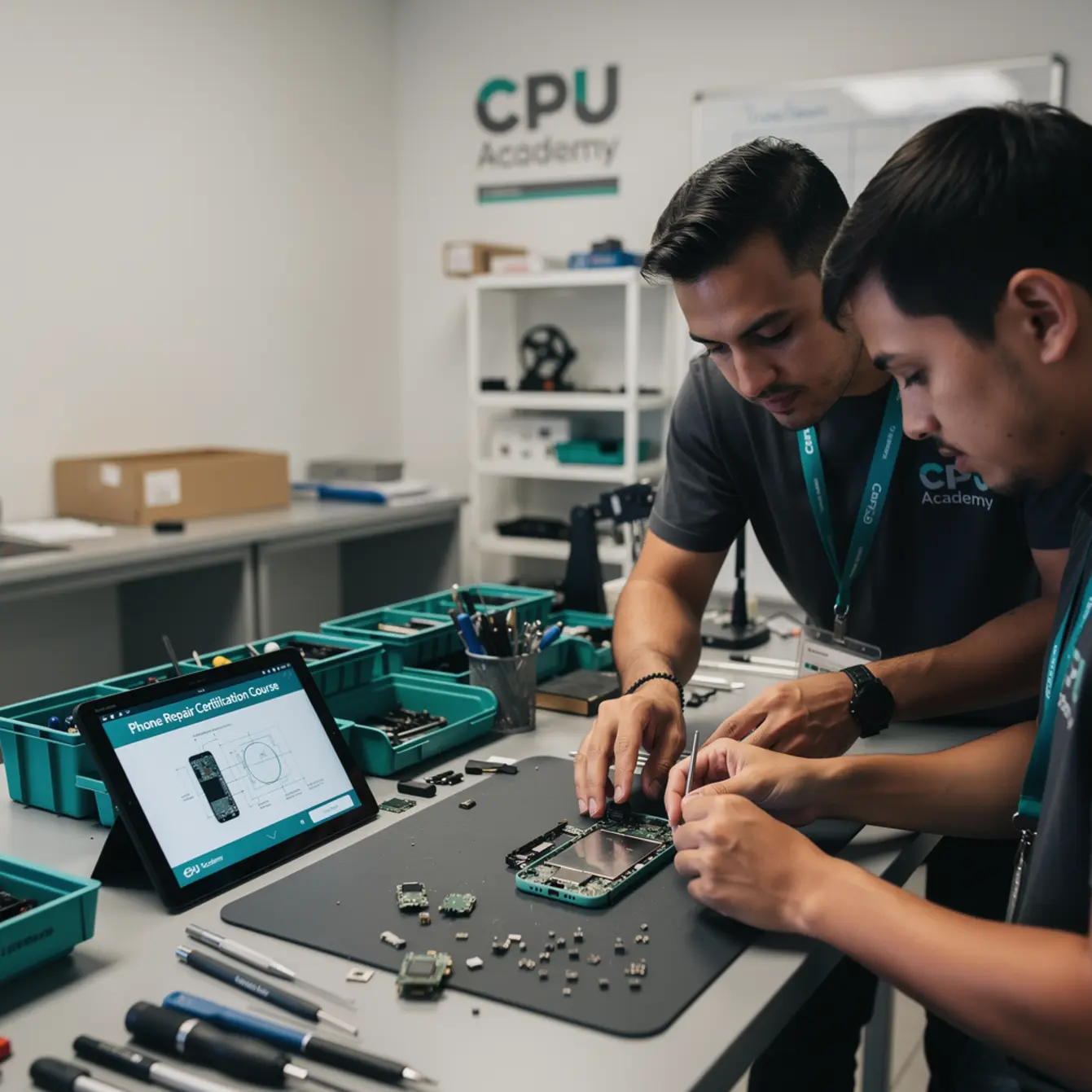
Quick answer: who should choose which phone repair certification?
If you are aiming for a job at a carrier store, authorized repair center, or corporate repair chain, WISE certification can carry real weight because some employers in those settings recognize it. If you are planning to freelance, open your own shop, or just build a side income fixing phones, a strong course certificate backed by real skills and practical labs is often the more direct route to paid work.
The honest truth: most customers do not ask to see your credentials. They ask, “Can you fix my phone today, and will it stay fixed?” Your skill level answers that question, not the logo on your certificate.
| Factor | WISE Certification (CTIA) | Course Certificate (e.g., CPU Academy) |
|---|---|---|
| Who issues it | CTIA (wireless industry group) | Training provider |
| Best fit | Carrier stores, authorized centers | Freelancers, shop owners, side-income builders |
| Practical labs | Depends on prep course you choose | Varies by provider — look for real-device work |
| Speed to first paid repair | Slower — requires exam prep + testing | Faster when labs are built-in |
| Employer recognition | Strong in carrier/OEM environment | Strong when paired with demonstrated skill |
| Ongoing support | Limited post-exam | Depends heavily on provider |
| Schematic / board-level content | Not core to exam | Varies — look for explicit schematic training |
Still comparing options? See exactly what CPU Academy includes inside the Online Phone Repair Course & Certification and decide with the real curriculum, support, and enrollment details.
—
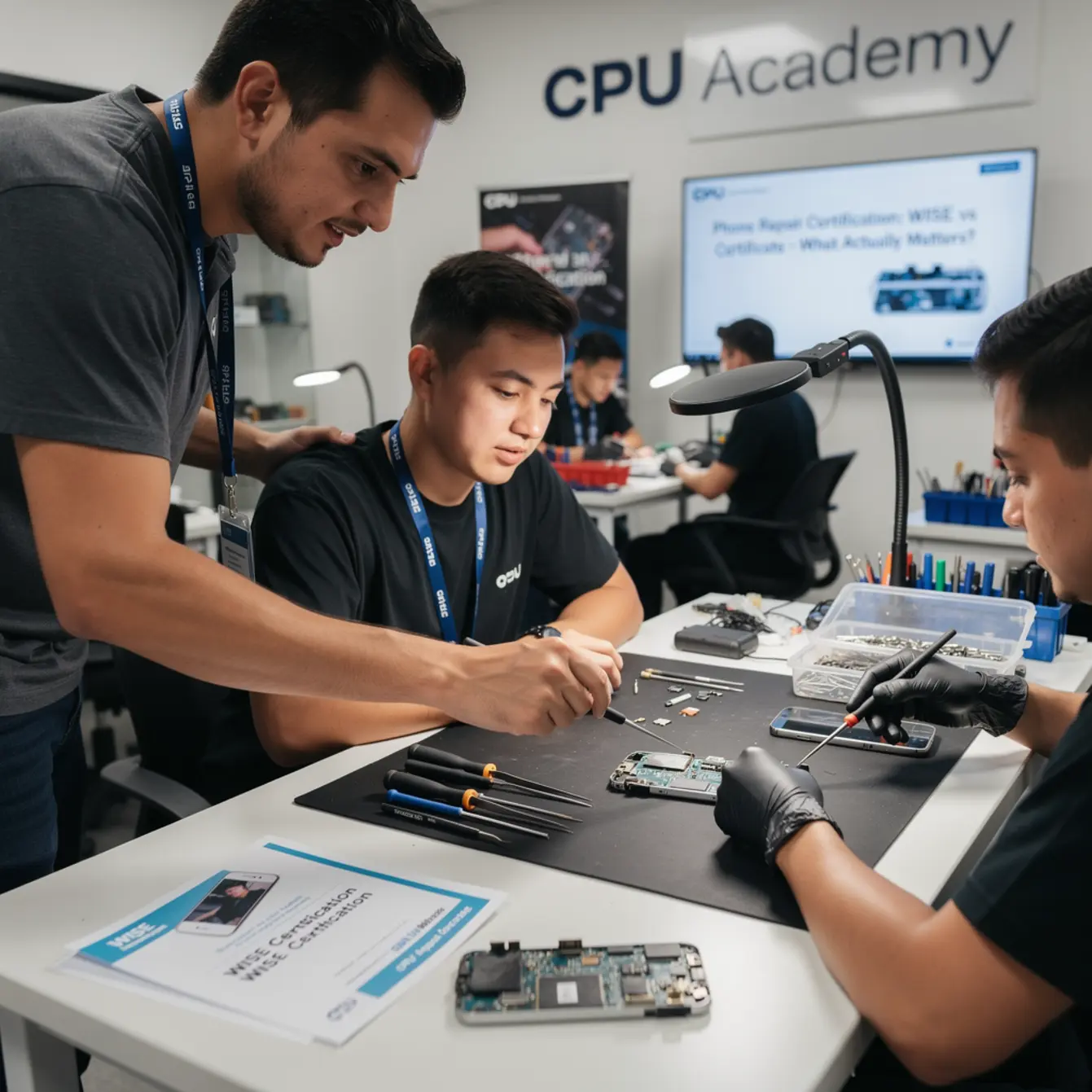
Who this is best for (and who should skip it)
Who benefits from WISE certification
WISE is the right move if you already have some repair experience and want to work for a carrier-affiliated store or a company that explicitly lists WISE as a hiring requirement. The CTIA WISE certification program standards describe a credential designed for wireless retail and service professionals in those settings.
If that is your exact career path, WISE makes sense. Just know that the certification itself does not teach you how to repair phones — you need to build that skill separately through a phone repair course.
Who benefits from a course certificate
A course certificate is the stronger starting point if you are brand new, want to build income fast, or plan to work independently. The certificate proves you completed structured training. More importantly, the training itself gives you the ability to actually fix devices.
Freelancers and shop owners rarely get asked for WISE. They get asked, “Can you fix my screen today?” Practical skill closes that deal.
✅ Best for:
- Complete beginners building from zero
- Side-income or freelance goal
- Learners who want real-device practice
- People who need income before a long exam process
- Anyone planning to open a local repair shop
⚠️ Think twice if:
- Your target employer specifically requires WISE
- You want corporate retail tech support roles
- You need the CTIA credential for a contract bid
- You are already skilled and just need the exam credential
—
What to compare before you buy or enroll in any phone repair certification path
Most people compare price first and regret it later. Here is the order that actually matters.
Real-device practice
Does the training walk you through actual repair steps on real phones — screen replacements, charging port swaps, battery changes — or is it all slides and theory? Theory without hands-on work produces technicians who freeze the first time a fragile flex cable fights back.
Look for courses that include step-by-step labs, not just concept videos. CPU Academy’s phone screen replacement course is an example of the kind of focused, device-specific lab work that actually builds confidence.
Schematic and diagnostic training
Replacing parts is entry-level work. Reading a schematic diagram to diagnose a board-level fault is mid-to-advanced work — and it is where the real money is. If a course does not mention schematics at all, you will hit a ceiling fast.
If you want to go deeper on this, dedicated phone schematic diagram training is one of the skills that separates average technicians from the ones customers keep calling back.
Cost and what is actually included
Cheaper is not always cheaper. A low-priced course with no support, no labs, and no path to income will cost you more in lost time than a slightly higher-priced course that gets you to your first paid repair in weeks.
Look at what is inside: video lessons, downloadable resources, community access, instructor support, and whether the certificate has any context behind it.
Instructor support
Can you ask questions when you get stuck? Repair work throws curveballs constantly. A course with zero support means you are back to Googling at 11pm hoping for the right answer.
Time-to-skill
How long before you can take your first paid repair? Some paths take months of exam prep. Others get you to a working first repair in a few weeks. Match this to your financial timeline, not just your learning preference.
Job or income path
Does the course or certification connect to anything real — a job board, a business-launch kit, or a community of working technicians? Or does it end when the final video plays?
Refund policy
What happens if the course is not what you expected? Check this before you buy. A clear, fair refund policy is a signal that the provider stands behind the product.
📋 Quick checklist before you enroll in any mobile phone repair course:
- ☐ Includes hands-on or step-by-step repair labs
- ☐ Covers diagnosis, not just part replacement
- ☐ Mentions schematic or board-level training (or links to it)
- ☐ Has a visible instructor or support channel
- ☐ Shows a real curriculum — not just a topic list
- ☐ Has a fair refund policy in writing
- ☐ Connects to a realistic income or job path
If you want the option built for practical, real-device learning rather than scattered theory, start here: Online Phone Repair Course & Certification.
—
Common mistakes beginners make
Most of these come from moving too fast or comparing the wrong things.
Mistake 1: Choosing based on price alone. The cheapest cell phone repair course online is not the same as the most efficient one. A $29 course that leaves you confused after lesson 3 is more expensive than a structured course that gets you to a real repair quickly.
Mistake 2: Confusing credential with skill. A certificate with a nice logo means little if you cannot diagnose a dead phone. Employers and customers care most about results. Build the skill first, then stack credentials as your career grows.
Mistake 3: Skipping schematic training entirely. Most beginners avoid schematics because they look intimidating. But without them, you cannot diagnose charging issues, backlight faults, or audio problems that are not solved by swapping a part. This is the gap between a technician who charges $40 and one who charges $150.
Mistake 4: Learning only from free videos. Free content is scattered by nature. It teaches you individual tricks, not a system. You end up with islands of knowledge that do not connect into a reliable repair workflow.
Mistake 5: Waiting for the “perfect” certification before starting. Jay — the beginner reading this right now — you do not need a wall full of credentials to take your first paid repair. You need enough skill to fix a cracked screen cleanly and communicate clearly with a customer. That comes from structured, practical training. The credentials follow from there.
Real scenario: Marcus was a warehouse worker in Ohio who spent three months collecting YouTube tutorials on phone repair before finding a structured online phone repair course. He had watched dozens of screen replacement videos but had never actually done one successfully because each video skipped different steps. When he enrolled in a structured cell phone repair course online that walked him through the full process with schematic context, he completed his first successful screen replacement in week two. By week six, he had completed three paid repairs for neighbors. The credential mattered less than the structured path. His first business review said, “He knew what he was doing.”
—
CPU Academy fit: when our course is the smarter choice
CPU Academy is the stronger fit when the buyer wants practical labs, schematic-based diagnosis, and a clearer beginner-to-income path than a more generic or theory-heavy option.
Specifically, this is the right match if:
- You are starting from zero and want structure, not a pile of videos to sort through yourself
- You want to understand why a repair works, not just copy steps blindly
- You are aiming for freelance income or a local shop, not a carrier corporate role
- You want schematic and diagnostic training included or available as a next step
- You need a realistic, week-by-week path from “no experience” to “first paid job”
The curriculum is built around real-device repair workflows. You learn screen replacement, component-level diagnosis, and how to use schematics — the same skills a professional technician uses daily. It is a structured cell phone repair course designed for people who want to actually fix phones, not just pass a multiple-choice exam.
For learners who also want to start or grow a repair business from the ground up, the 30-Day Phone Repair Business Launch Kit is a natural companion — it focuses on the income side once your repair skills are solid.
Where CPU Academy is not the only answer: if your specific employer requires WISE as a condition of hiring, you will need to sit the WISE exam regardless. In that case, use a course like this to build your actual repair skill, then use WISE prep materials to pass the exam. The two are not in conflict — they serve different purposes.
Verdict callout: If practical skill, schematic knowledge, and a direct income path matter more to you than a carrier-industry exam credential, CPU Academy’s structured path is the more efficient first step. You can always add WISE later. You cannot skip learning how to actually repair phones.
Ready to stop researching and start building the skill? Go to CPU Academy’s Online Phone Repair Course & Certification and see the exact course page, pricing, and enrollment path now.
—
FAQ + next step
Which is better for beginners — WISE or a course certificate?
For most beginners, a structured course certificate is the better starting point. It teaches you the repair skills you actually need to do the work. WISE is an exam-based credential that tests knowledge — it assumes you already have some skill and industry context. Build the skill first through a good mobile phone repair course, then consider WISE if your target employer requires it.
What is the difference between WISE and a regular phone repair certificate?
WISE is an industry-recognized credential issued by CTIA, a wireless industry group. It is designed for professionals working in carrier and authorized service environments and requires passing an exam. A phone repair certificate from a training provider like CPU Academy shows that you completed a specific curriculum and can demonstrate practical repair skills. One is an industry exam credential; the other is a training completion credential backed by what you learned and practiced.
Which gives better support during learning?
Support during learning depends entirely on the provider, not the credential type. WISE is an exam — the support around it depends on which prep resources you use. A quality online phone repair course should include instructor access, a community, or a direct way to ask questions when you are stuck. Always check the support model before enrolling in any course.
Which one is worth the money?
Value depends on your goal. If your goal is a carrier-affiliated job that lists WISE as a requirement, then WISE is worth the investment. If your goal is freelance income, a side business, or building real-world repair skills from scratch, a well-structured course that includes practical labs and schematic training will return value faster. The question to ask is: “Which one gets me to my first paid repair sooner?”
Do I need any prior experience to start a phone repair course online?
No prior experience is required for a beginner-friendly cell phone repair course online. A good course starts with tools, safety, and basic phone anatomy before moving into repair procedures. You do not need an electronics background — you need patience, the right course structure, and a willingness to practice on real devices.
How long does it take to complete a phone repair course and start earning?
It varies by course and how much time you put in each week. Many learners in structured programs complete enough practical training to do their first paid repair within four to eight weeks of consistent effort. Your speed depends on the depth of the course, how much you practice, and which repairs you target first. Simple repairs like screen replacements have a much shorter learning curve than board-level diagnostics.
Is a phone repair certification worth it in 2025?
Yes — but the type of certification matters. A phone repair certification from a structured, skills-based training program is worth it because it represents real learning, not just a badge. An industry exam credential like WISE is worth it if your specific career path calls for it. Either way, the most important investment is in learning how to actually repair phones reliably. The credential validates the skill — it does not replace it.
Your next step
You now have a clear map of what each path offers and where each one fits. The last question is simple: what is your goal?
If you want to freelance, fix phones for income, or eventually open your own shop, start with skills — structured, practical, schematic-aware training from a real phone repair course you can trust. That is what a good phone repair certification path looks like for most beginners in the US right now.
Ready to stop researching and start building the skill? Go to CPU Academy’s Online Phone Repair Course & Certification and see the exact course page, pricing, and enrollment path now.