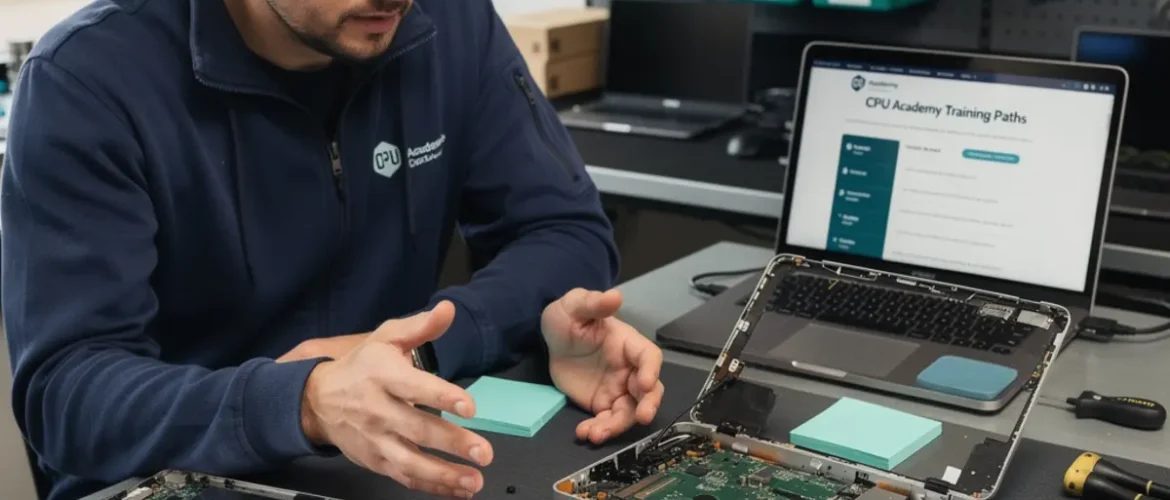
Quick answer: If you have a local shop you trust and a real mentorship lined up, in-person training can work just fine. But for most US beginners, a structured online phone repair course costs less, moves faster, and gives you access to better instructional material — including schematic-based diagnosis — than the average local option. The right choice really does come down to your budget, your schedule, and how you learn best. Read on and you’ll know which one fits you by the end.
By the CPU Academy Editorial Team
You want to learn phone repair. You’ve watched a handful of YouTube clips, maybe dug through a forum thread or two, and now you’re stuck between two paths: track down a phone repair course near me at a local shop or community college, or sign up for something online. The worry makes sense — what if you spend real money on the wrong thing, pick up sloppy habits, and end up snapping more flex cables than you fix?
That worry is worth taking seriously. Plenty of beginners burn weeks on random tutorials that never add up to an actual skill. This article is here to give you a clearer picture. We’ll compare both options honestly, walk through what really matters when you’re choosing, and help you land somewhere you won’t regret.
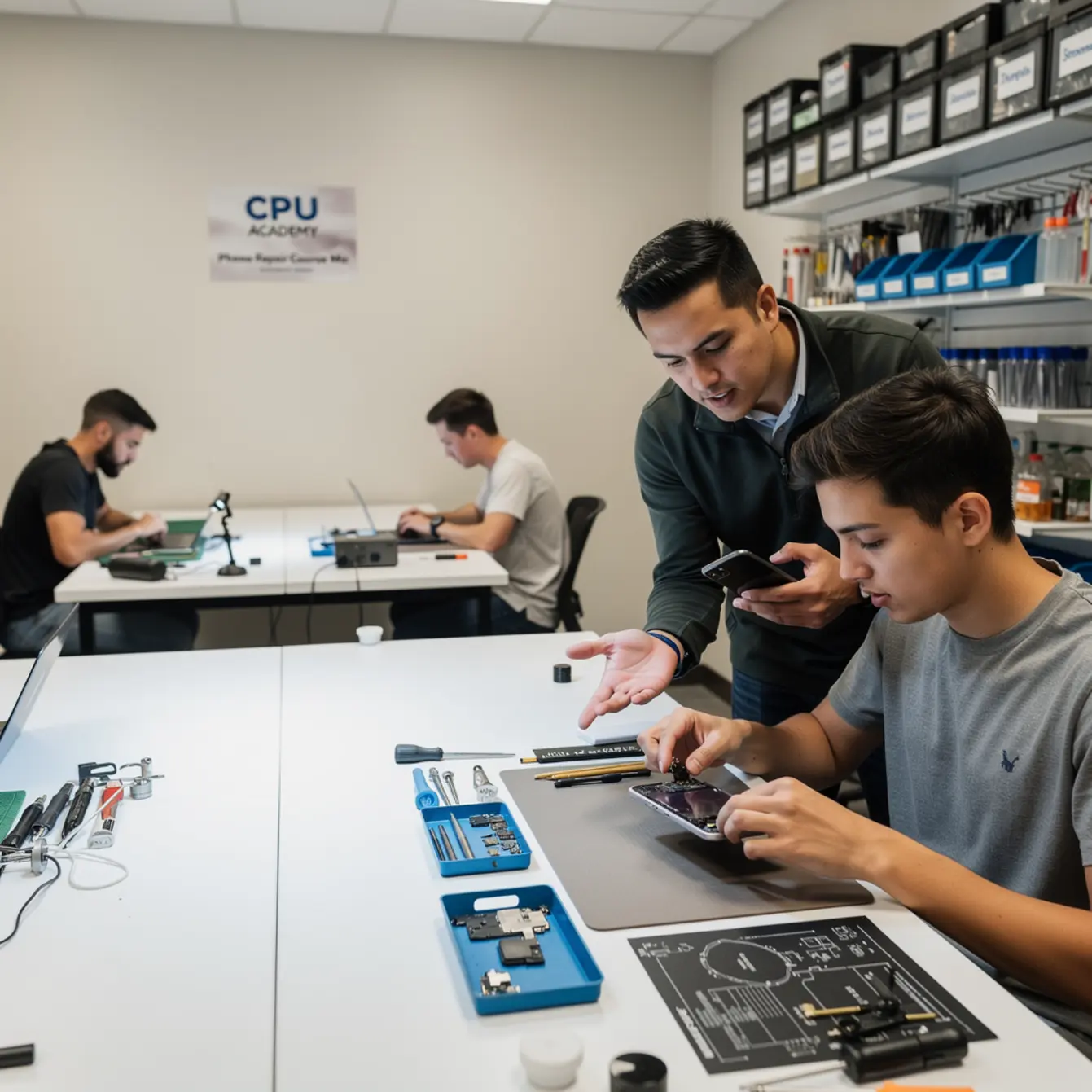
Quick answer: who should choose a phone repair course near me vs online?
Online wins for most beginners in the US. Local options can pay off when you already have a mentor relationship or a solid vocational program in your city — but those are genuinely hard to find, wildly inconsistent in quality, and often more expensive per hour of actual instruction than you’d expect.
The deeper issue is structure. Most “near me” options are pretty informal — a shop owner showing you the basics, or a one-day community college workshop where you watch someone else do most of the work. A well-built online program can give you video walkthroughs, schematics, and real device labs arranged in a sequence that actually builds on itself.
There are still situations where local makes sense, and we’ll cover both sides fairly. But most buyers searching for a phone repair course near me end up finding online the stronger fit once they look at the criteria that actually matter. More on those in a minute.
| Factor | Online Course | Local / Near Me Option |
|---|---|---|
| Cost | Generally lower; no commute or facility fees | Varies widely; community colleges can be affordable, shop apprenticeships unpredictable |
| Schedule flexibility | High — learn at your own pace | Fixed class times or shop availability |
| Curriculum quality | Depends on provider; structured programs include schematics, diagnostics, and labs | Depends heavily on the individual instructor |
| Real-device practice | You source practice devices (cheap on eBay); labs guided by video | Devices may be provided; but often limited repair types |
| Instructor support | Email, forum, or live Q&A (varies by platform) | In-person if available; can disappear if instructor is busy |
| Schematic / board-level training | Available in specialized online programs | Rare in entry-level local courses |
| Certification | Depends on the course; some offer completion certificates | Inconsistent; community colleges may offer credit |
| Best fit for | Self-starters, career changers, side-hustle builders | Those who need in-person accountability or already have a local mentor |
Still comparing options? See exactly what CPU Academy includes inside the Online Phone Repair Course & Certification and decide with the real curriculum, support, and enrollment details in front of you.
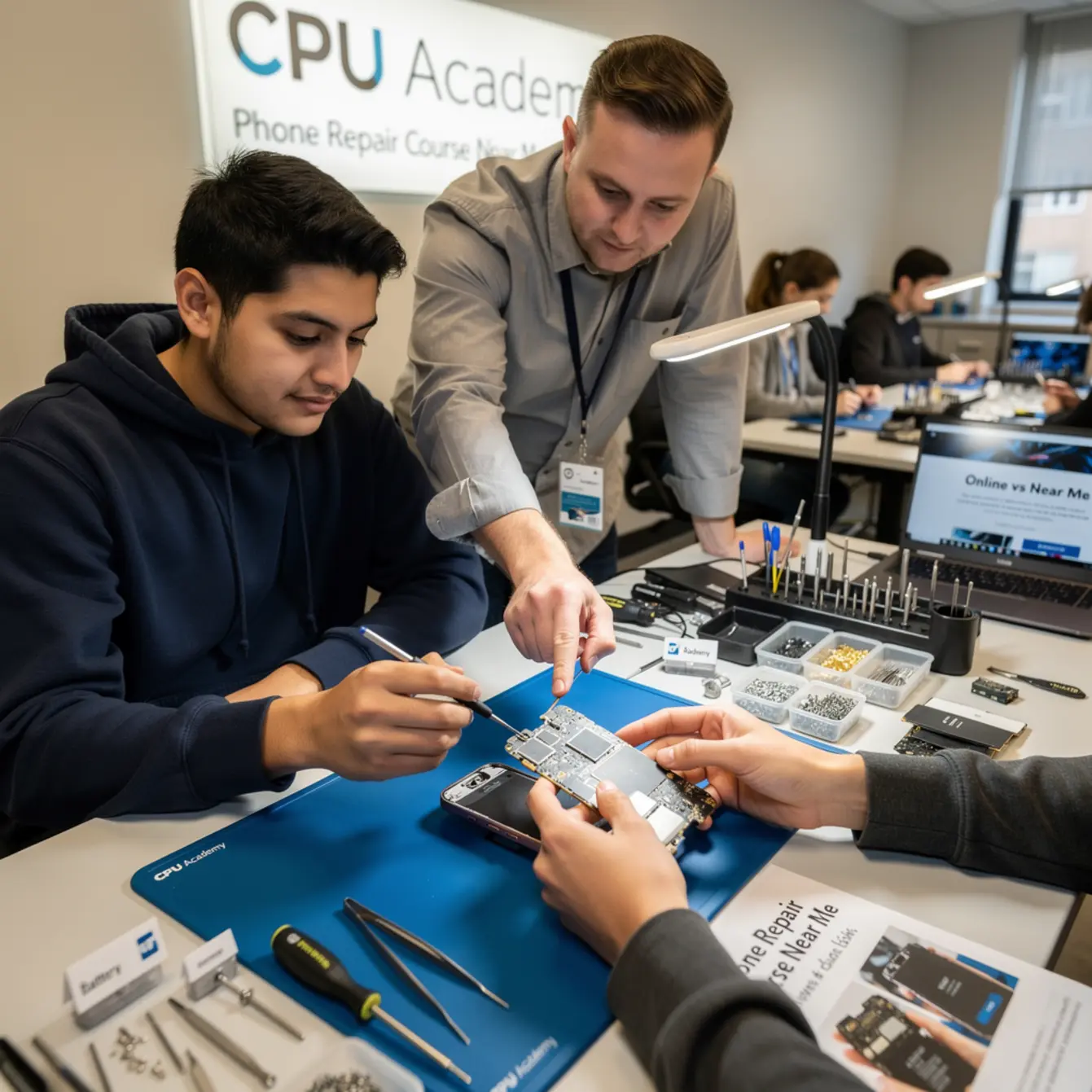
Who this is best for (and who should skip it)
An online cell phone repair course is the right move if you match most of this list. Read through it honestly.
✅ You’re a good fit for online phone repair training if you:
- Work a day job and need to study evenings or weekends
- Don’t have a reputable local school or mentor nearby
- Want to build side income or launch your own repair business
- Learn well from structured video walkthroughs you can pause and rewatch
- Want schematic-based diagnosis, not just swap-and-hope repairs
- Are willing to grab a few cheap practice phones and work on them at your own bench
⚠️ Consider a local option instead if you:
- Struggle with self-directed learning and genuinely need someone in the room with you
- Have access to a proven vocational program with real lab equipment and a solid instructor
- Are pursuing a formal trade credential that requires logged in-person hours
- Already have a job offer from a shop that provides its own on-the-job training
Neither path is wrong by default. The real mistake is grabbing whichever one shows up first without thinking through how you actually learn best.
What to compare before you buy or enroll
Most buyers zero in on price and completely miss the stuff that actually determines whether they finish the course and land paying work. Here are the criteria that matter, and most buyers get criterion three wrong.
Cost and total investment
Look past the enrollment fee. Add up practice devices, tools, and any materials the course expects you to have. Online courses usually look cheaper upfront — and they usually are — but confirm what’s bundled in. A course that costs a bit more but includes a detailed tool list and a practice framework might be the smarter spend overall.
Real-device practice
This is where most people get it wrong. There is a real difference between watching clips on a screen and following a structured lab path where you actually open a device, trace a fault, and put it back together. Watching someone else do a repair is useful for orientation. Doing it yourself on a real phone — with a spudger in your hand and the right steps in front of you — is where the skill actually forms.
Before you enroll anywhere, ask one question: does this course walk me through fixing a real device, or does it stay in theory? A solid mobile phone repair course should have you opening, diagnosing, and reassembling actual phones from early on.
Schematic and diagnostic training
Most entry-level courses skip this entirely, and that’s a serious gap. If all you know is how to swap a screen, you’ll hit a wall fast. When a phone won’t charge or randomly reboots, you need to read a schematic diagram and trace the fault to its source. Look for a course that covers this skill early rather than tacking it on as an afterthought. CPU Academy’s Phone Schematic Diagram course goes deep on exactly this.
Support and instructor access
Picture this: it’s 11pm, you’ve got a dead phone on your bench, and you have no idea why the screen won’t power on after a battery swap. What then? Check whether the course offers a community forum, email support, or live sessions. Async support is completely fine as long as it’s actually responsive. No support at all is a red flag worth walking away from.
Certification
A completion certificate can matter when you’re applying for a shop job or building trust with your first customers. But confirm what the certificate actually represents. Does it just mean you watched the videos, or does it require you to demonstrate real competency?
Ask that question before you hand over your credit card.
Time to skill
How long before you can confidently take a paid repair job? Some courses are built around fast, practical wins. Others drag on for months before you ever touch a real device. If your goal is income, prioritize a course that gets you to your first successful repair quickly — not one that front-loads two months of slides before anything practical happens.
Refund policy
Keep this one simple. If the course offers no trial period or refund window at all, that’s a risk you’re absorbing entirely. Any provider confident in their material should back it up with some kind of money-back guarantee.
Job and income path
The BLS occupational outlook for installation and repair careers shows steady, ongoing demand in the repair sector. But demand alone doesn’t pay your bills — you need a clear path from trained to paid. Ask whether the course gives you a business framework alongside the repair skill, or just the technical knowledge with no plan attached.
Common mistakes beginners make
These come up again and again. Getting familiar with them before you spend a dollar is genuinely worth your time.
Mistake 1: Starting with YouTube only. Free clips can supplement what you’re learning, but they’re not a curriculum. You’ll pick up scattered tips in no particular order, and the gaps will cost you the moment a real repair goes sideways.
Mistake 2: Enrolling based on price alone. The cheapest option is usually the thinnest. A $10 course with 20 unconnected videos isn’t a substitute for a program designed to take you from zero to a first paid repair job.
Mistake 3: Skipping schematic training. Beginners assume they can get by on mechanical repairs — swapping batteries, replacing screens. But the moment a customer brings in a logic board fault or a no-charge issue, you’re completely stuck. Get the schematic basics early, not later.
Mistake 4: Never practicing on real devices. You need broken phones in your hands. Buy three cracked-screen units on eBay for under $20 each and work through them before you take on a paying customer. That’s the difference between knowing the steps and actually having the skill.
Mistake 5: No plan for the first paid job. Training without a clear business goal leads to a folder full of notes and zero income. Whether you want to freelance on weekends, land a shop position, or set up your own bench — write that goal down before you pick a course. It changes which program makes sense for you.
Case example — Jay’s situation:
Jay is 28, works in retail, and wants to repair phones on weekends to build a side income. He searched for a phone repair course near me and found a one-day workshop at a local shop. It covered basic screen swaps but nothing about diagnostics, charging faults, or reading a schematic.
He also found a structured online program with video labs, schematic training, and an active community forum. He enrolled, grabbed three broken iPhones from eBay, and completed his first screen replacement inside week two. The first time that phone powered on after he’d replaced the display, it clicked. By week five he’d diagnosed a charging fault using a board schematic — something the one-day workshop never would have touched.
The local option wasn’t terrible. It just wasn’t built for where he wanted to go.
CPU Academy fit: when our course is the smarter choice
CPU Academy is the stronger fit when you want practical labs, schematic-based diagnosis, and a clearer beginner-to-income path than a generic or theory-heavy program gives you. That’s not a sales line — it’s a specific scenario, and it either matches your situation or it doesn’t.
Here’s when it makes sense for you specifically:
- You’re a beginner or intermediate learner who wants to move at a real pace
- You want to understand why a phone fails, not just which part to swap
- You’re building toward paid work — freelance, shop job, or your own operation
- You want lessons that build on each other in a logical sequence, not random clips
- You want schematic and screen replacement training bundled alongside core repair skills
The Online Phone Repair Course & Certification at CPU Academy is built around that exact learner. It pairs mechanical repair skills with diagnostic logic so you’re not stuck the moment a part swap doesn’t solve the problem.
Once you’ve finished the core course, CPU Academy also offers the Phone Screen Replacement course for focused screen-level work, and the 30-Day Launch Kit if you’re ready to turn your skill into a real business within a month.
CPU Academy won’t be the right fit if you need formal in-person certification for a specific employer, or if self-directed study genuinely doesn’t work for you. In those cases, look for a local vocational program in your city and vet it against the criteria in this article. But if you’re the type who can follow a structured plan and stay consistent — this is built for you.
If you want the option built for practical, real-device learning rather than scattered theory, start here: Online Phone Repair Course & Certification.
FAQ + next step
Which is better for beginners — online or near me?
For most US beginners, online is better. A structured online program gives you a repeatable sequence of lessons, schematic training, and lab practice you can pause and rewind as many times as you need. Local options vary too much in quality to recommend across the board unless you’ve vetted a specific program in your area and know what the curriculum actually covers.
What is the difference between a cell phone repair course and a mobile phone repair course?
They’re the same thing with different labels. “Cell phone,” “mobile phone,” and “smartphone” repair all mean servicing modern handheld devices. When you’re comparing programs, treat those terms as interchangeable and put your focus on the curriculum rather than whatever the course happens to be called.
Which option gives better instructor support?
It depends on the specific program. A local shop apprenticeship can give you great one-on-one access — if the instructor actually has time for you between paying customers. A well-built online course with an active community and reliable email support can be just as responsive, and you’re not competing with a shop floor for the instructor’s attention. Check what support is actually included before you commit to either option.
Which one is worth the money?
Value is about the outcome, not just the price tag. A course is worth the money if it gets you to your first paid repair quickly and gives you the diagnostic skills to handle problems beyond basic part swaps. Hold any course — online or local — to that standard before you pay for it.
Do I need tools before I start?
You’ll need a basic repair toolkit — opening picks, precision screwdrivers, spudgers, and an anti-static mat. All of it is inexpensive and easy to find online. A good course will tell you exactly what to buy before the first lab module starts. Don’t invest in expensive gear until you’ve finished the intro modules and have a clearer sense of where you’re headed.
Can I really find a decent phone repair course near me in the US?
Sometimes, yes. Community colleges in larger US cities occasionally run electronics repair programs. Some independent shops offer informal apprenticeships. But availability is patchy, and curriculum quality is hard to judge without actually sitting in the class first. If you find a strong local option, run it through the criteria in this article before you commit any money.
Ready to stop researching and start building the skill?
Go to CPU Academy’s Online Phone Repair Course & Certification and see the exact course page, pricing, and enrollment path now.
Whether you started by searching for a phone repair course near me or found this article through a comparison search — the next step is the same. Look at the curriculum, confirm it fits your goal, and enroll when you’re ready.