By the CPU Academy Editorial Team |
Quick Answer (40-word version)
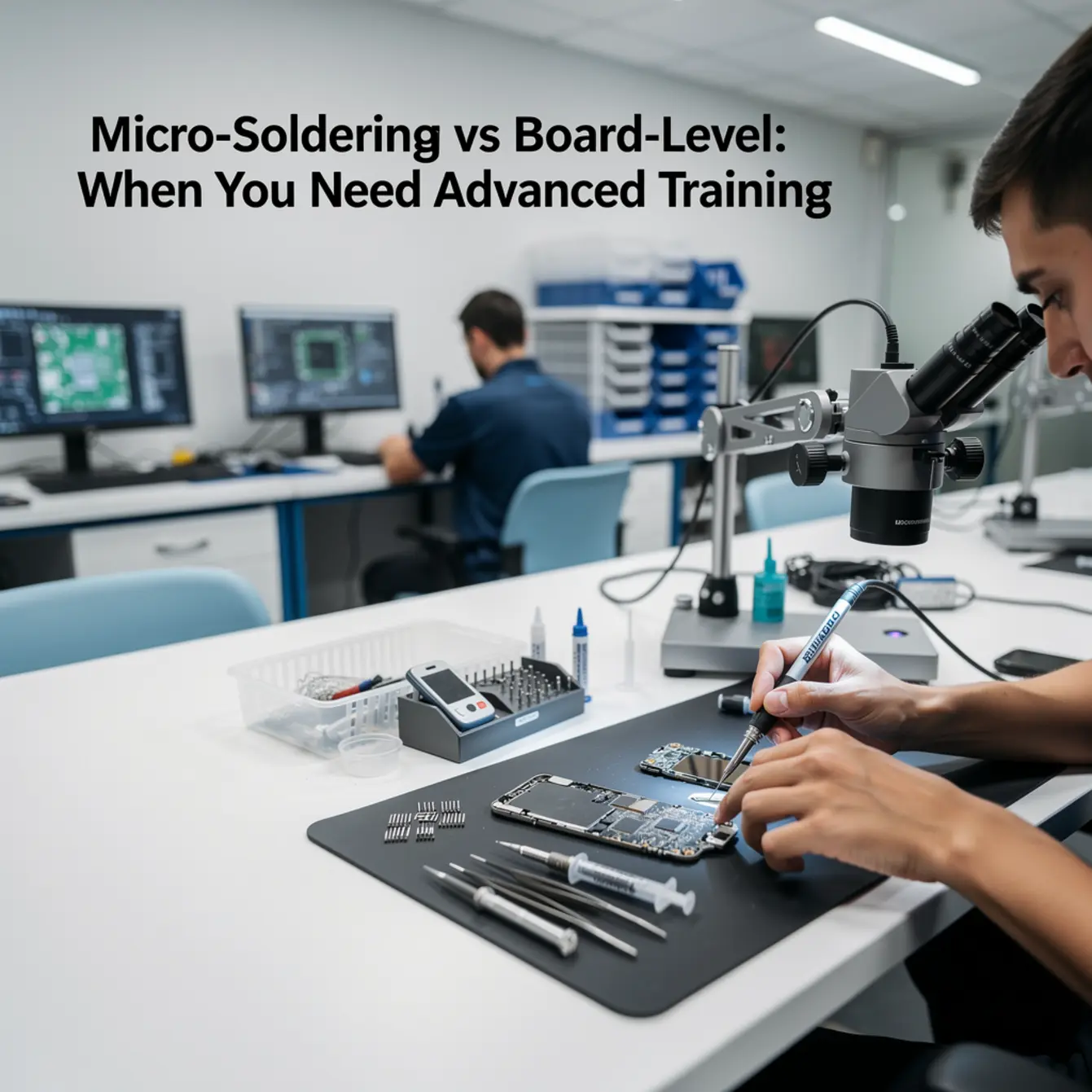
Micro-soldering trains you to rework tiny components directly on a circuit board. Board-level repair is the broader skill of diagnosing and fixing the whole logic board. Most beginners need board-level foundations first — micro-soldering becomes the advanced layer you add once you can read a schematic and trace a fault.
Here is the fear nobody talks about out loud: you spend money on a repair course, watch forty hours of videos, then sit in front of a real broken phone and have no idea where to start.
That feeling comes from a skills gap — usually the gap between knowing what micro-soldering looks like on YouTube and actually understanding when and why a board-level fix is needed. If you are shopping for a micro soldering training right now, this article will help you compare your options honestly and choose the right entry point.
We will cover the difference between micro-soldering and board-level repair, who each path actually suits, the criteria that matter most before you pay for anything, and when a structured course like CPU Academy’s Online Phone Repair Course & Certification is the smarter investment over piecing things together on your own.
Quick answer: who should choose micro-soldering training vs board-level?
Board-level repair is the foundation. Micro-soldering is a tool you reach for once that foundation is solid.
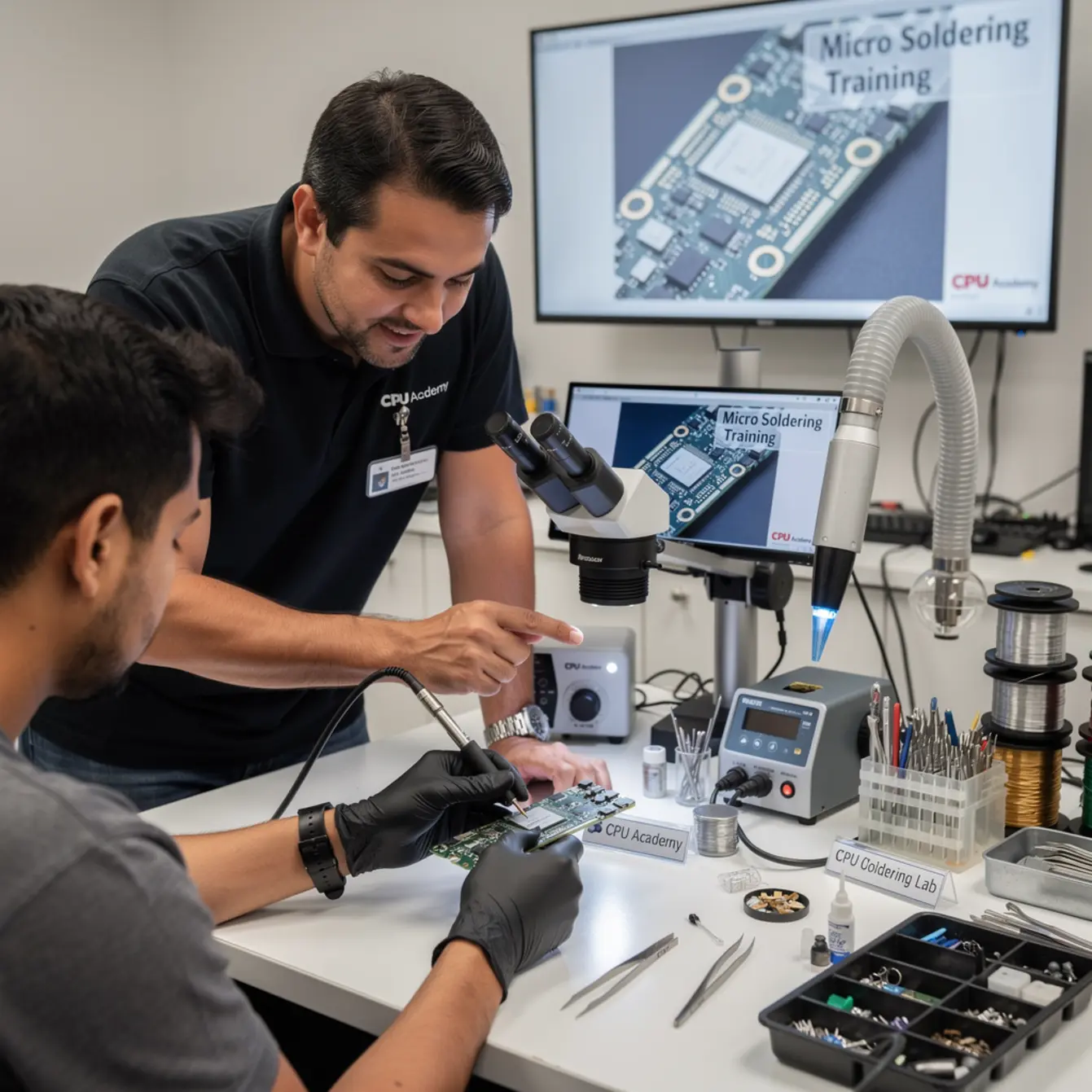
Board-level repair means you understand the whole logic board: how power flows, how to read a schematic diagram, and how to isolate a fault before you ever touch a soldering iron. Micro-soldering is one technique within that larger skill — it covers reworking tiny components like capacitors, resistors, or charging ICs under magnification.
If you skip board-level fundamentals and jump straight to micro-soldering, you end up moving components around without knowing whether that was actually the problem. That is how expensive boards get damaged twice.
Side-by-side: micro-soldering vs board-level repair at a glance
| Factor | Micro-Soldering Focus | Board-Level Repair Focus |
|---|---|---|
| Best fit for | Techs who already diagnose faults and want rework precision | Beginners building diagnosis-first, repair-second skills |
| Prerequisite knowledge | Strong — needs schematic reading + fault tracing first | Low to moderate — starts from first principles |
| Time to first paid job | Longer if diagnosis skills are missing | Faster path — common repairs become billable early |
| Tool cost | Higher — hot-air station, flux, microscope or strong loupe | Moderate — multimeter, opening tools, basic iron |
| Support needed | High — easy to damage boards without guided feedback | Moderate — structured course reduces trial-and-error |
| Real-device practice | Critical — no substitute for live board practice | Critical — screen swaps, charging ports, data recovery |
| Certification path | Industry bodies like IPC certification centers cover soldering standards | Course-based completion + optional IPC path after foundations |
Table reflects general industry patterns. Individual course content varies — always check the curriculum before enrolling.
Who this is best for (and who should skip it)
This section is direct. Most confusion comes from buyers assuming they need the most advanced option. They do not.
Who benefits from starting with board-level repair training
- You are new to phone repair and want a clear, step-by-step skill path
- You want to take paid jobs — screen replacements, charging port fixes, battery swaps — inside 90 days
- You have limited tool budget and want to build income before upgrading your bench
- You learn best when someone explains why a fault happens, not just which component to swap
- You want a cell phone repair course that covers multiple device types, not one narrow technique
Who can jump deeper into micro-soldering sooner
- You already complete basic phone repairs confidently and are ready for logic board work
- You have a background in electronics — you can read a simple schematic without help
- You work in a shop that regularly sends out board-level jobs and wants to bring that in-house
- You own or plan to buy a hot-air station, flux, and magnification equipment
Who should pause before enrolling in anything advanced
If you cannot yet identify why a phone will not charge (is it the port, the charging IC, the PMIC, or a line fault?), then a pure micro-soldering course will leave you with a skill you cannot deploy. Build your diagnostic logic first.
What to compare before you buy or enroll
Most buyers focus on price first. That is the wrong order. Here is a smarter checklist of what to evaluate before you hand over any money.
1. Cost and what it actually includes
Price only makes sense relative to scope. A cheaper course that skips schematic reading will cost you more in broken boards later. Ask: does the course include a tool list, practice exercises, and downloadable resources — or is it just video lectures?
2. Instructor support
Phone repair has too many variables for a purely passive learning model. Look for a course with a community, Q&A access, or instructor feedback. When you get stuck on a live fault, you need a real answer — not another video.
3. Certification and job path
Not every course leads to a recognized credential. Know whether a certificate from a given provider is useful for your goal — whether that is freelance repair, a shop job, or launching your own business. For electronics soldering standards specifically, the IPC certification center directory lists accredited programs worth checking alongside any phone repair training you take.
4. Time-to-skill and pace flexibility
Some buyers need to learn while working. Others want to finish fast. A mobile phone repair course with self-paced structure fits different lives than a fixed-schedule program. Check whether you can pause, rewatch, or accelerate without a penalty.
5. Real-device practice
This is the criterion most buyers underweight. Watching someone else solder does not transfer to your hands. The course structure should push you to work on actual devices — or at minimum give you a clear practice-device list and guided exercises.
6. Refund or trial policy
A provider confident in their curriculum usually offers some form of satisfaction guarantee or free preview content. If a course has no preview and no refund window, that is worth noting before you commit.
If you want the option built for practical, real-device learning rather than scattered theory, start here:
Common mistakes beginners make
These show up repeatedly when people jump into advanced repair work before they are ready.
Mistake 1: Buying tools before buying knowledge
A $200 hot-air station does not help you if you do not know which component is actually faulty. Diagnosis training comes first. Tools are second.
Mistake 2: Skipping schematic training entirely
Board-level faults are invisible without schematic diagrams. If your course does not teach you to read one, you are guessing. CPU Academy’s Phone Schematic Diagram course addresses exactly this gap — it is the kind of foundational layer that separates confident techs from those who swap parts and hope.
Mistake 3: Treating YouTube as a structured curriculum
YouTube has great clips but no logical progression. You end up with isolated tricks instead of connected skills. A structured cell phone repair course online builds on each lesson so nothing gets skipped.
Mistake 4: Avoiding screen repair because it feels “too basic”
Screen replacements are the most frequent paid job in any repair shop. Getting fast and clean at them builds income while you develop deeper skills. If you want to practice that specific area, the Phone Screen Replacement course is a focused way to lock that skill in early.
Mistake 5: Enrolling in an advanced course with no support access
When something goes wrong mid-repair and you have no one to ask, you either freeze or guess. Both outcomes waste time and sometimes damage hardware. Support matters — make it a dealbreaker criterion, not a nice-to-have.
Case example: Jay’s decision
Jay was a warehouse worker interested in phone repair as a side income. He found micro-soldering videos on YouTube and got excited — the technique looked impressive. But when he tried to replicate what he saw, he had no idea how to confirm the fault first or whether his iron temperature was even in the right range.
He paused, enrolled in a structured board-level online phone repair course, and spent his first month doing screen replacements and charging port fixes on practice devices. Within eight weeks he was charging $40–60 per job through word of mouth. Micro-soldering became a realistic next step — not the starting point.
Note: This is a representative composite example based on the learning path structure, not a named testimonial.
CPU Academy fit: when our course is the smarter choice
CPU Academy is the stronger fit when the buyer wants practical labs, schematic-based diagnosis, and a clearer beginner-to-income path than a more generic or theory-heavy option.
Here is when that specifically applies to you:
- You want real-device practice, not just passive video. The course structure is built around doing, not just watching.
- You need schematic-backed diagnosis. Understanding why a fault exists — not just replacing parts until something works — is baked into the curriculum.
- You want a path to income, not just a certificate to frame. The course covers the repair types that generate the most consistent paid work for independent techs.
- You want to avoid scattered, tutorial-hopping learning. A structured phone repair course with a logical module sequence saves you from the months of confusion that comes from assembling your own curriculum from random sources.
- You are a beginner or intermediate learner in the US who needs confidence before taking on paying customers — not just raw information.
When a different option might fit better
If you are already an experienced electronics technician with strong schematic skills and you only need a micro-soldering rework refresher, a narrow manufacturer training or local IPC-accredited workshop might be more efficient. CPU Academy’s core course is designed for the beginner-to-intermediate journey — if you are well past that, the fit changes.
For everyone else — especially buyers who fit Jay’s profile above — the structured, diagnosis-first approach is the cleaner path to paid work.
Still comparing options? See exactly what CPU Academy includes inside the Online Phone Repair Course & Certification and decide with the real curriculum, support details, and enrollment information.
FAQ + next step
Which is better for beginners — micro-soldering or board-level repair training?
Board-level repair training is the better starting point for most beginners. It teaches you to diagnose faults and understand how a device actually fails before you ever pick up a soldering iron. Micro-soldering is a precision technique that makes more sense once you have that diagnostic foundation in place. Jumping to micro-soldering first often leads to board damage and wasted repair attempts.
What is the difference between micro-soldering and board-level repair?
Board-level repair covers the full process of diagnosing and fixing a phone’s logic board — reading schematics, tracing power rails, using a multimeter, and identifying which component or line has failed. Micro-soldering is a specific skill within board-level repair: physically removing and replacing small components (like a charging IC or a capacitor) using a hot-air station or fine-tip iron under magnification. You need board-level understanding to know what to solder and why.
Which type of training gives better support for new learners?
Structured board-level courses generally offer better support pathways for new learners because they are designed for people building skills from scratch. Good courses include community access, Q&A, or instructor feedback — all of which matter more when you are learning to diagnose live faults for the first time. Narrow micro-soldering workshops tend to assume you already have context, so support is less beginner-oriented.
Which one is worth the money for someone who wants to earn from repairs?
For income-focused beginners, a comprehensive board-level phone repair course delivers more return on investment early on. Screen replacements, charging port repairs, and battery swaps make up the majority of real-world repair shop revenue. You can start charging for those repairs while you continue building toward advanced board work. A micro-soldering-only course does not give you that breadth.
Do I need an IPC certification to do phone repair professionally?
IPC certification is not required to work as a phone repair technician in most US contexts. It is an industry-recognized credential for electronics soldering standards, which some employers or contracts look for. Most working repair techs build their reputation through demonstrated skills and a portfolio of completed repairs. If you want to explore IPC standards, the IPC certification center directory lists accredited centers you can check after completing foundational training.
Can I take a phone repair course online and still get real practice?
Yes — if the course is designed around practical exercises rather than passive video watching. A good cell phone repair course online will include a clear tool and device list, step-by-step exercises on real hardware, and a way to get feedback when something does not go as expected. The key is choosing a course that pushes you to work on actual phones, not just watch repairs on a screen.
What should I learn before attempting micro-soldering on a customer’s phone?
Before working on any customer board, you should be able to: read a basic schematic diagram for the device, use a multimeter to check voltage and continuity on board lines, identify the fault before touching the board, and have practiced the same rework on a junk or donor board first. Rushing that sequence is how customer boards get destroyed and reputations get damaged.
Ready to stop researching and start building the skill?
The goal of this article was to cut through the noise around micro soldering training and give you a clearer starting point. Most beginners need board-level foundations before micro-soldering becomes useful — and the fastest path to paid repair work runs through practical, diagnosis-first learning, not scattered tutorials.
CPU Academy is built for exactly that buyer: someone who wants guided, real-device practice, schematic-based diagnosis, and a logical path from zero to first paid job — without wasting months on disconnected content.
If you are ready to move from research to action: go to CPU Academy’s Online Phone Repair Course & Certification and see the exact curriculum, support structure, and enrollment path now.
And if you want to launch your repair business in a structured 30-day window after completing the core training, the Phone Repair Course Launch Kit (30 Days) is the logical next step after your foundations are solid.