By CPU Academy Editorial Team |
Quick answer: Start with whatever phone is sitting broken on your workbench right now. In practice, most US beginners are better off learning iPhone first because parts are standardized, demand is high, and the learning path is well-mapped. Android knowledge broadens your earning potential later. The smarter question is not iPhone vs Android — it is finding a phone repair course that teaches real-device skills on both platforms so you are not locked into one market.
Here is the fear most beginners carry into their first search: What if I spend time and money on the wrong course, crack an expensive phone in my first practice session, and end up no closer to paid work than I was watching free YouTube clips? That fear is completely valid. The wrong starting point costs you real money, real time, and real confidence.
This article is written for people like Jay — someone who has decided to get serious about cell phone repair training but is standing at the fork between iPhone and Android. You will get a clear comparison, a decision table, and an honest look at what to check before you enroll anywhere. No fluff, no hype.
If you have not yet found a structured phone repair course to anchor your learning, bookmark this page. We point to one that covers both platforms with real-device labs later on.
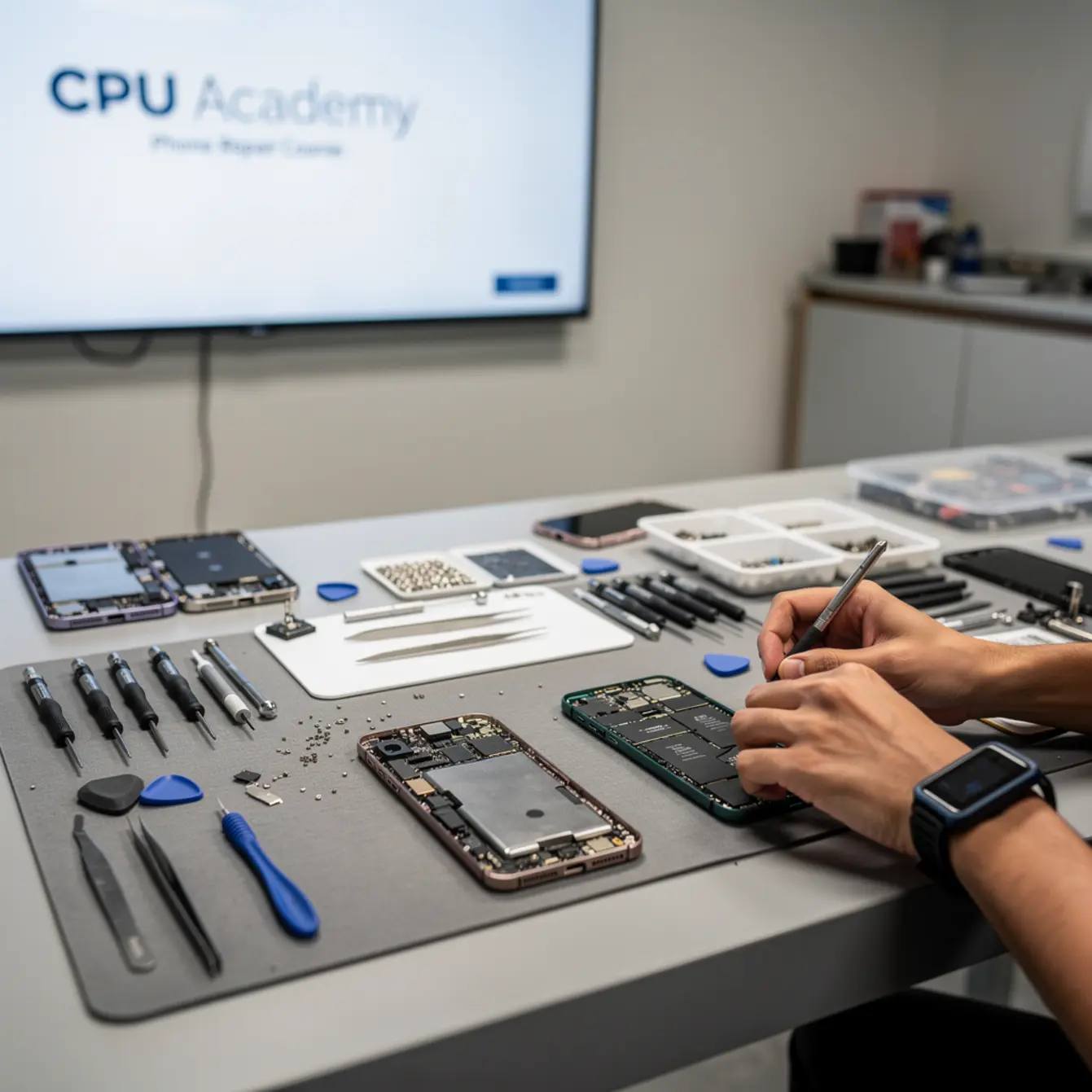
Quick answer: which phone repair course path fits you?
iPhone-focused training is the right first move for most US beginners. The US smartphone market skews heavily toward iPhone, which means more broken iPhones walk through repair shop doors per day than any other single model family. Parts are predictable. Repair steps are well-documented. Pricing at the counter is easier to explain to customers.
Android is the right first move if you already own an Android device to practice on, if your local market is Android-heavy, or if you are aiming at enterprise repair like fleet devices or rugged phones. The Android Developers platform overview shows just how many device makers operate under the Android umbrella. That variety is what makes Android repair broader but also a lot less standardized to learn from scratch.
The honest truth: a strong beginner program will cover both platforms. If a course ignores one entirely, you are building half a skill set.
Side-by-side: iPhone training vs Android training at a glance
| Criteria | iPhone-First Path | Android-First Path |
|---|---|---|
| Parts standardization | High — fewer model variations per generation | Low — hundreds of OEMs and models |
| US market demand | Very high in most regions | Moderate; varies by area |
| Learning curve | Steeper at first due to Apple security features | Variable — simpler phones exist; flagships are complex |
| Speed to first paid job | Faster in most US markets | Can be fast if local demand is there |
| Schematic complexity | Complex — requires board-level reading skills | Complex — varies by brand |
| Course availability | Many online options exist | Fewer structured options for pure Android |
| Best for | US beginners targeting walk-in shop volume | Technicians expanding an existing skill set |
Still comparing options? See exactly what CPU Academy includes inside the Online Phone Repair Course & Certification | CPU Academy and decide with the real curriculum, support, and enrollment details in front of you.
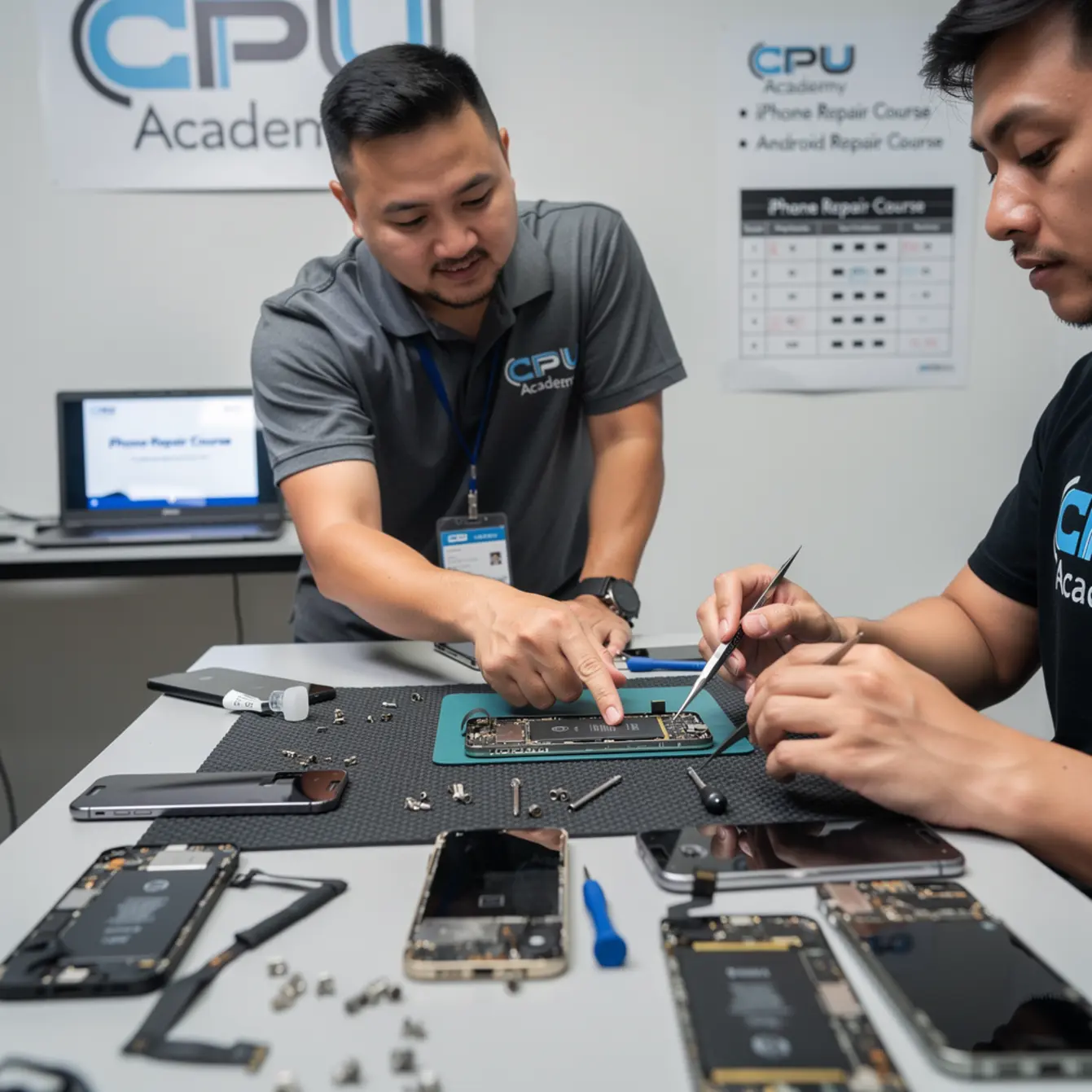
Who this is best for (and who should skip it)
Knowing your own starting point saves you from enrolling in the wrong level or the wrong focus. Here is a plain-language breakdown.
Start with an iPhone-focused mobile phone repair course if you:
- Live in a US market where iPhones are the dominant broken device coming through the door
- Want the most predictable practice path — same connector family, same form factor logic across generations
- Plan to open a walk-in repair shop or take jobs on the side
- Learn best with a structured, step-by-step sequence rather than jumping around topics
Start with Android if you:
- Already repair Android devices and want to go deeper on diagnosis
- Are in a market where budget Android phones dominate, like certain rural or lower-income zip codes
- Work in B2B device management or fleet repair
Skip both and do more research first if you:
- Are not yet sure repair is a real career path for you — try a free intro video or a single screen replacement tutorial before committing to a full course
- Want only software troubleshooting — hardware repair courses do not cover that in depth
What to compare before you buy or enroll
Most beginners focus on price alone. That is one of the fastest ways to waste money on weak training. Here are the criteria that actually matter — and most buyers get criterion three wrong.
Real-device practice vs theory-only content
A course that shows you diagrams but never walks you through a live disassembly leaves you guessing the moment you sit down at the bench. Look for courses with step-by-step device walkthroughs, not just slide decks.
The Phone Screen Replacement course at CPU Academy is a good example of focused, hands-on skill building around one of the most common repairs beginners face. It is the difference between watching clips and following a structured lab path — and that difference shows up the first time you do a repair without a tutorial open beside you.
Schematic and board-level diagnosis
Most phone failures are not simple part swaps. Water damage, charging faults, and no-power issues require you to read circuit diagrams and trace a problem logically. If a course skips this entirely, you will be stuck the moment a customer brings in something you have never seen a video for.
Check whether the curriculum covers board-level reading. This is where most online courses fall short, usually because it is harder to teach well. The Phone Schematic Diagram course is specifically built to fill that gap for learners who want to go beyond surface repairs.
Certification and proof of completion
A phone repair certification matters when you are showing a shop owner, a client, or honestly even yourself that you finished something real. Check whether the certification is tied to actual assessments or just auto-issued when you hit the last video. The former carries weight. The latter is mostly a PDF.
Support and community access
When you are stuck on a repair at 10 PM, a community forum or instructor Q&A can be the difference between a solved problem and a bricked device. Verify whether support is included in the price or costs extra before you hand over your card.
Time-to-skill and course structure
Self-paced is great for flexibility. But completely unstructured courses drag on and stall out. Look for a clear module sequence with estimated time per section. A beginner should be able to see a realistic path from lesson one to first paid repair without having to reverse-engineer the syllabus themselves.
Refund policy
A course confident in its own quality offers a clear refund window. If the policy is buried in fine print or missing entirely, take that as a yellow flag and ask directly before you enroll.
Job path and income clarity
Not every course tells you what to do with the skill once you have it. Look for training that addresses pricing your work, finding customers, or launching a repair side hustle. That context is what turns training into actual income.
✅ Pre-enrollment checklist — ask these before you buy any cell phone repair course online:
- Does it include real-device disassembly walkthroughs?
- Does it cover schematic or board-level diagnosis?
- Is certification tied to actual assessment?
- Is there instructor or community support included?
- Is the module sequence clearly mapped out?
- Is there a clear refund or satisfaction policy?
- Does it address the income side — not just the skill side?
If you want the option built for practical, real-device learning rather than scattered theory, start here: Online Phone Repair Course & Certification.
Common mistakes beginners make
These are the patterns that show up again and again from people who burned their first three months before finding a real path forward.
Mistake 1: Learning from scattered YouTube videos instead of a structured course. YouTube is genuinely useful for looking up a specific repair step. It is a poor substitute for a full cell phone repair course with a logical sequence. You end up with random knowledge, not transferable skill. The gap between watching clips and following a structured lab path is real, and you feel it the first time a repair goes sideways.
Mistake 2: Practicing on a device you cannot afford to damage. Your first practice phone should be a beater — something already broken that you picked up for a few dollars. Practicing on your daily driver is how beginners destroy their main phone and quit before they ever complete a successful repair.
Mistake 3: Skipping proper tools. Using the wrong screwdriver on a pentalobe screw strips it fast. A basic quality toolkit is not optional — it is part of your startup cost. Budget for it from day one, not after your first stripped screw.
Mistake 4: Choosing a course purely on price. The cheapest option often skips the hard parts like schematics, board-level diagnosis, or customer-facing skills. Your goal is income, not just the cheapest certificate you can hang on a wall.
Mistake 5: Ignoring the business side entirely. Repair skill without pricing, marketing, or basic customer communication keeps you a hobbyist. Look for training that bridges the gap from technician to earner. The Phone Repair Course Launch Kit (30 Days) is designed exactly for this — it helps learners take their skills from the bench to their first paying customer without guessing at every step.
Case example: Marcus, a 27-year-old in Atlanta, spent two months watching free repair content online before enrolling in a structured course. His self-reported problem: he could follow a tutorial step for step, but he could not diagnose a phone he had never seen a video for. Once he worked through a curriculum that included schematic reading and real-device lab work, he described being able to approach unfamiliar faults with a process rather than a guess. That shift — from copying steps to understanding why — is what separates a tech who gets stuck from one who gets paid. His first successful repair on a phone with no prior tutorial to reference was the moment he knew the training had actually worked.
CPU Academy fit: when our course is the smarter choice
CPU Academy is not the right fit for everyone, and we would rather say that plainly than oversell you into the wrong program.
It is the stronger fit when you want practical labs, schematic-based diagnosis, and a clearer beginner-to-income path than a more generic or theory-heavy option gives you. If you just want a quick surface-level overview of how phones work, there are faster and cheaper ways to get that. But if you want the skill to charge real money for real repairs, the depth matters more than the price tag.
Here is where CPU Academy specifically earns its place over scattered alternatives:
- Real-device focus: The curriculum is built around what you will actually face at the bench — not abstract theory padded out to look comprehensive on a sales page.
- Schematic coverage: Board-level diagnosis is built into the program. Most competing courses skip it because it is harder to teach well. We do not skip it.
- Income path support: The 30-day launch kit companion is built for learners who want to move from skill to income without having to figure out the business side from scratch.
- Structured sequence: Modules are ordered logically for beginners, so you are not jumping between unrelated topics and wondering what to tackle next.
CPU Academy does not position its training as a casual hobby resource. It is designed for people who want paid work at the end — whether that is a shop job, a repair side business, or eventually their own operation.
Ready to stop researching and start building the skill? Go to CPU Academy’s Online Phone Repair Course & Certification and see the exact course page, pricing, and enrollment path now.
Verdict: When to choose CPU Academy’s phone repair course
- ✅ You are a US beginner who wants to earn money from repairs, not just understand how phones work
- ✅ You want real-device practice, not slides-only content
- ✅ You need schematic reading skills built into the program
- ✅ You want a clear path from lesson one to first paid job
- ❌ You only want a surface overview with no intention of repairing for income
- ❌ You are already an advanced technician looking only for brand-specific deep dives
FAQ + next step
Which is better for beginners: an iPhone or Android repair course?
For most US beginners, starting with iPhone makes practical sense. iPhone repair demand is high across the country, parts are more standardized across generations, and the learning path is well-documented. Android broadens your skill set and earning potential but introduces a lot more model variation, which can be genuinely overwhelming at the start. That said, the best mobile phone repair course will introduce both platforms so you are not stuck turning away half your potential customers.
What is the difference between a cell phone repair course and a mobile phone repair course?
These terms are used interchangeably in the US market. Both refer to training that covers smartphone disassembly, component diagnosis, and physical repair. There is no meaningful technical distinction — “cell phone repair course” and “mobile phone repair course” describe the same category of training. Use whichever term your local market searches for.
Which gives better support: an online phone repair course or in-person training?
Support quality depends more on the provider than the format. A well-designed online phone repair course with instructor access, a community forum, and structured feedback can easily outperform a passive in-person class where you sit and watch someone else work. Before enrolling anywhere, check whether support is included in the price and how quickly questions actually get answered — not just what the sales page promises.
Which one is worth the money?
The course worth the money is the one that moves you from no skill to paid skill in the shortest honest timeline. Evaluate on real-device labs, schematic coverage, support access, and whether there is a business-side component included. A cheaper course that skips diagnosis skills will cost you more in missed repairs and frustrated customers than the price difference ever saved you.
Can I learn phone repair completely online?
Yes. A cell phone repair course online can teach you the knowledge and demonstrate the techniques clearly. Your practical skill develops when you apply those lessons on real devices at your own bench. The combination of strong online instruction plus hands-on practice at home is exactly how most successful self-taught technicians build their skills today. You do not need a classroom — you need a good course and a few practice phones.
Do I need a certification to start charging for repairs?
No formal licensing is required to repair phones in the US. A phone repair certification from a structured program does signal competence to customers and potential employers, though. It also functions as a real personal milestone. Completing a full course with actual assessment is a genuinely different experience from watching scattered videos, and your confidence at the bench will reflect that difference when a customer hands you their device.
Ready to make the move from watching to doing?
A structured phone repair course that covers real devices, schematic diagnosis, and the path to income is worth more than months of scattered tutorials. CPU Academy builds each module around what you will actually face at a real bench — not what looks impressive on a course outline.
Go to the Online Phone Repair Course & Certification at CPU Academy →