Quick Answer
To successfully start a phone repair business and scale it, hiring your first technician is the highest-leverage move you can make. Train them on your exact repair workflow, set measurable KPIs from day one, and follow a structured onboarding checklist — so quality stays consistent while your capacity doubles.
By the CPU Academy Editorial Team | Updated: June 2025
📋 What you’ll get from this guide
- The onboarding checklist we walk through at the bench
- Five training categories your first tech must cover
- The KPIs that actually tell you if they’re performing
- A real-world case example from a solo shop owner
- Common mistakes that stall new hires — and how to avoid them
You built the bench. You landed the customers. Now your repair queue is longer than your day. If that sounds familiar, this article is for you.
Hiring your first technician is the move that takes a phone repair business from a one-person hustle to a real operation. But get the training wrong, and you’ll spend more time fixing your tech’s mistakes than you save. Get it right, and your capacity can double without you touching every device.
This guide covers exactly what to teach, how to measure it, and when to know you’re ready. If you’re still building the foundation — your cell phone repair business plan, pricing structure, and service menu — CPU Academy’s Starting a Mobile Phone Repair Business course covers the full business layer before you ever post a job ad.

Hiring a technician is the right move when your repair queue exceeds what you can handle alone
Capacity signals that tell you it’s time
Don’t hire because it feels like the right season. Hire because the numbers say so. Here are the clearest signals:
- You’re turning away same-day customers more than twice a week
- Your average turnaround has slipped past the time you promised
- You’re working nights to catch up on jobs from the afternoon
- You’ve started skipping your own quality checks to save time
Any two of those together means you need another set of hands — not next month, but soon.
Readiness checklist before you post the job ad
Hiring someone before your shop systems are in place creates chaos. Run through this first:
- You have a written repair intake process (ticket number, IMEI log, customer sign-off)
- You have a phone repair pricing menu documented and visible
- You have a parts supplier relationship and reorder process
- You can explain your quality standard in plain English
- You know what a good day’s output actually looks like (how many jobs, what types)
If you can’t check all five, build those first. A new tech will only do what your system tells them to do.
Your first technician needs training in five core repair categories
Training a new tech without a structure leads to the same problem every time: they’re confident on the jobs they’ve seen, lost on everything else. Cover these five areas before they work unsupervised.
1. Hardware repairs (the bread and butter)
Start here. These are the jobs that fill most repair tickets in any mobile cell phone repair business:
- Screen replacement (LCD and OLED — different handling)
- Battery swap
- Charging port repair
- Camera module replacement
- Speaker and microphone replacement
Have your new tech complete each repair type at least three times with you watching before they handle it solo.
If you want to skip the knowledge gaps on hardware, CPU Academy’s phone repair course gives your hire a structured foundation covering the exact repairs your shop sees daily — so you’re not building a curriculum from scratch.
2. Software and firmware (commonly undertrained)
Shops lose money on software jobs because techs aren’t trained for them. Cover at minimum:
- Factory reset and data backup procedures
- Firmware flash and restore
- Boot loop diagnosis
- iCloud and Google account verification steps
For a deeper grounding, CPU Academy’s mobile phone software repair course walks through diagnostic and restore workflows in a format you can hand directly to a new hire.
3. Systematic fault diagnosis (before opening any device)
Good technicians diagnose before they touch a screw. Train your tech to ask: what is the customer’s symptom, what does the device tell us on startup, and what’s the most likely fault path?
A structured diagnostic protocol cuts wasted parts and repeat repairs. It also builds customer trust — you can explain what you found before you bill for it.
4. Customer intake and ticket management
This is where most first-time shop owners underinvest in training. A missed IMEI, no customer sign-off, or a lost ticket creates disputes you can’t win.
Walk your tech through every step of your intake form — in person, not just a handout. Then watch them run two or three intakes before you step back.
5. Post-repair quality control
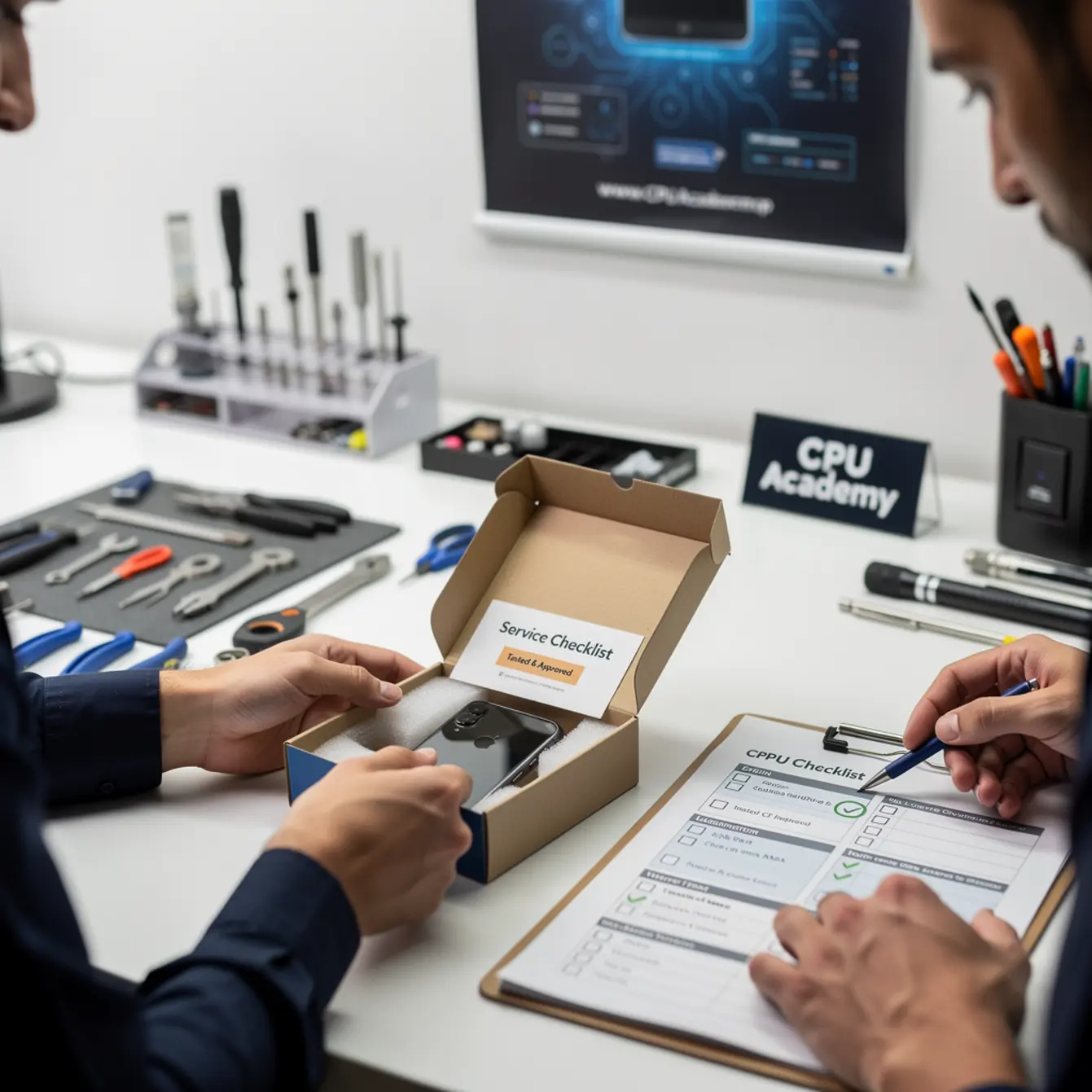
Every device that leaves your shop should pass a checklist before it’s handed back. Train your tech on:
- Testing all functions relevant to the repair type
- Checking for cosmetic issues introduced during repair
- Confirming device charges, connects to network, and powers normally
- Logging the job as complete with notes on what was found
This one habit alone reduces your comeback rate — the metric that quietly destroys shop reputation.
KPIs that tell you if your technician is actually performing
Measuring gut feeling doesn’t scale. These five KPIs give you data to coach from — not just impressions.
The five metrics that matter most
| KPI | What to measure | Why it matters |
|---|---|---|
| Repair completion rate | % of jobs finished same day vs. promised time | Measures workflow reliability |
| Comeback rate | Customer returns within 30 days for same fault | Core quality signal — catches training gaps fast |
| Average handle time | Minutes per repair type, tracked weekly | Identifies which job categories need more training |
| Revenue per technician | Gross revenue tied to their completed tickets per week | Financial accountability baseline |
| Customer satisfaction score | Simple 1–5 post-repair rating (SMS or paper card) | Early warning system for service quality issues |
Start tracking these in your first week. Even a basic spreadsheet beats no data at all. You’ll spot patterns fast — usually within 30 days, you’ll know exactly where a tech needs more coaching.
What this looks like in the real world
Case example: Marcus, a solo shop owner in the Midwest
Marcus ran a one-person phone repair business out of a retail strip unit for about 18 months. He was doing solid volume — mostly screen replacements and battery swaps — but he was capping out around noon every day and turning away walk-ins by mid-afternoon.
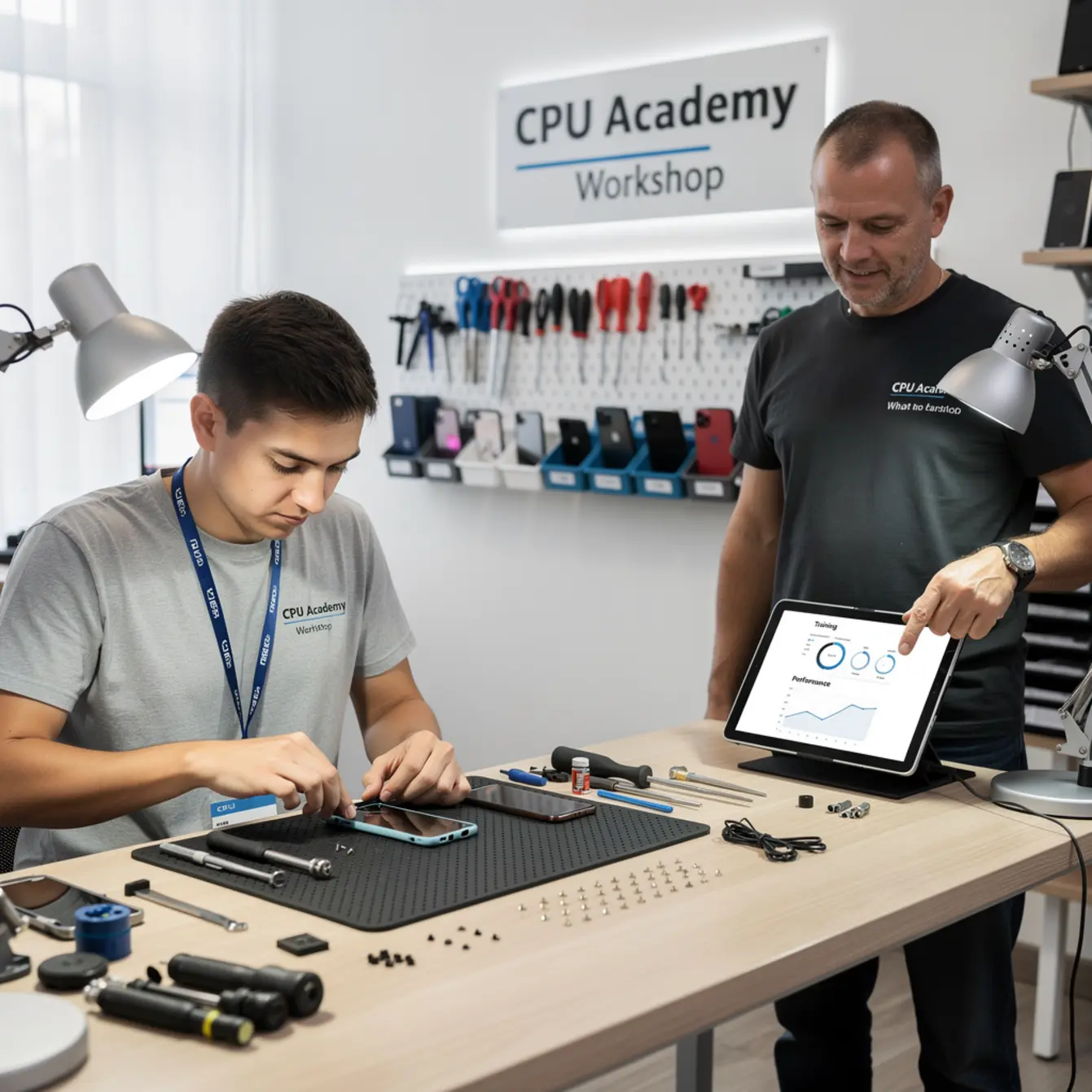
He hired a part-time tech with zero prior bench experience. Instead of throwing them at live repairs immediately, Marcus spent the first two weeks having the new hire shadow every intake, observe every repair, and run the post-repair checklist under supervision.
By week three, the new tech was handling basic screen replacements and battery swaps independently. Marcus tracked comeback rate weekly. In the first month, it stayed under 5% — which Marcus considered acceptable for a new hire.
By month two, the tech’s average handle time on screen replacements had dropped close to Marcus’s own pace. Revenue per week climbed because Marcus was now free to take on more complex jobs — charging ports, water damage assessments — while the new hire covered the high-volume basics.
The lesson: the two-week supervised ramp felt slow. The payoff came in month two and beyond.
Mistakes that kill profit or trust when you hire too fast
Rushing the hire because you’re overwhelmed
When you’re buried in repairs, hiring feels urgent. But a tech who isn’t properly trained creates rework — and rework costs you parts, time, and customer trust. Take the extra two to three weeks on onboarding. You’ll recover that time within the first month.
No written standard for what “good” looks like
If you haven’t written down what a completed repair looks like, your tech will make it up. Document your post-repair checklist before day one. One page is enough.
Skipping the legal and admin basics
Worker classification, payroll setup, and tax withholding aren’t optional. The SBA guide to hiring and managing employees covers the federal requirements clearly. Read it before you bring anyone on — not after.
Hiring a specialist when you need a generalist
A micro-soldering specialist is valuable. But if your daily ticket mix is 70% screens and batteries, a generalist tech keeps your queue moving. Match the hire to your actual repair volume, not your wishlist.
No KPIs in the first 30 days
You can’t coach what you don’t measure. Set up even a basic tracking sheet for comeback rate and completion rate before your tech’s first solo day. Review it weekly. It changes the conversation from “how do you feel things are going?” to “here’s what the numbers show.”
Technician onboarding checklist: First 30 days
📋 First 30-Day Onboarding Checklist
Week 1 — Shadow and absorb
- Shadow every customer intake (live, not video)
- Observe hardware repairs: screen, battery, charging port
- Learn to complete the repair ticket from start to sign-off
- Study parts labeling and storage system
- Review the phone repair pricing menu with the owner
Week 2 — Supervised bench work
- Complete 3 supervised screen replacements per device family
- Complete 3 supervised battery swaps
- Run post-repair checklist with owner present
- Log first solo intakes under observation
- Practice firmware restore on a test device
Week 3 — Supervised independence
- Handle basic repairs independently; owner reviews output daily
- Begin tracking: jobs completed, handle time, any comebacks
- Introduce software diagnostic workflow
- First feedback session: what’s fast, what needs work
Week 4 — Full operation with KPI review
- Full daily volume; owner spot-checks 20% of completed jobs
- Review comeback rate for weeks 1–4
- Review average handle time by repair type
- Customer satisfaction check (ask 10 customers for a rating)
- Identify the next training priority based on data
FAQ
What should I train my first phone repair technician on?
Start with five areas: hardware repairs (screen, battery, charging port), software and firmware, systematic fault diagnosis, customer intake, and post-repair quality control. Don’t skip any of them — each one prevents a different category of costly mistake.
How long does it take to train a beginner phone repair tech?
Expect two to four weeks of supervised bench work before a beginner tech can handle basic repairs — screens and batteries — independently. More complex repairs like charging ports or software jobs typically take longer to get right consistently.
How do I measure a phone repair technician’s performance?
Track five KPIs: repair completion rate (on-time vs. promised), comeback rate (same fault within 30 days), average handle time per repair type, revenue generated per week, and a simple customer satisfaction score. Review these weekly in the first month.
When should I hire my first technician for my phone repair business?
Hire when you’re regularly turning away same-day customers, your turnaround times are slipping past what you promised, or you’re working nights to catch up. Before posting a job ad, make sure you have a documented intake process, a pricing menu, and a clear quality standard already in place.
Should I hire a generalist or a specialist for my first tech role?
For most small shops, a generalist is the smarter first hire. They can handle a wider range of daily tickets — screens, batteries, ports — which keeps your queue moving. Specialists make sense later, once you have enough volume in a specific repair category to justify the narrower focus.
Do I need to use a structured training course, or can I train in-house?
You can train in-house, but knowledge gaps tend to compound quietly over time. A structured course gives your tech a documented skill baseline from the start — which is easier to verify, easier to build on, and repeatable when you hire the next person.
Your next step: build the business around the hire, not just the hire itself
Bringing on your first tech is a milestone. But it only pays off if the business underneath them is solid — your phone repair pricing menu is consistent, your phone repair marketing plan is bringing in steady volume, and your numbers tell you when to scale again.
A lot of solo shop owners get the hiring moment right and then realize their business model has gaps that the new capacity just exposed. Pricing that doesn’t cover labor costs. No system for tracking what each tech generates. No plan for what happens when volume doubles again.
That’s the gap that CPU Academy’s Starting a Mobile Phone Repair Business: The Complete Course is built to close. It walks you through staffing economics, pricing structure, service systems, and the full business layer that solo operators need before scaling. If you’re serious about turning repair skills into a real operation with fewer costly beginner mistakes, that’s the practical next step.
Ready to build the full business, not just the bench?
CPU Academy’s business course covers everything from your first hire’s economics to your phone repair marketing plan — in one structured path.
Open Starting a Mobile Phone Repair Business: The Complete Course →
And if you want to expand beyond phones once your team is running smoothly, CPU Academy’s laptop repairing course is a natural next service line that uses much of the same diagnostic thinking — and opens up a different customer segment entirely.
The goal was never to work harder alone. It was to build something that runs without you in every single job. Hiring your first tech — the right way — is how that starts.