Updated: | By: CPU Academy Technical Staff
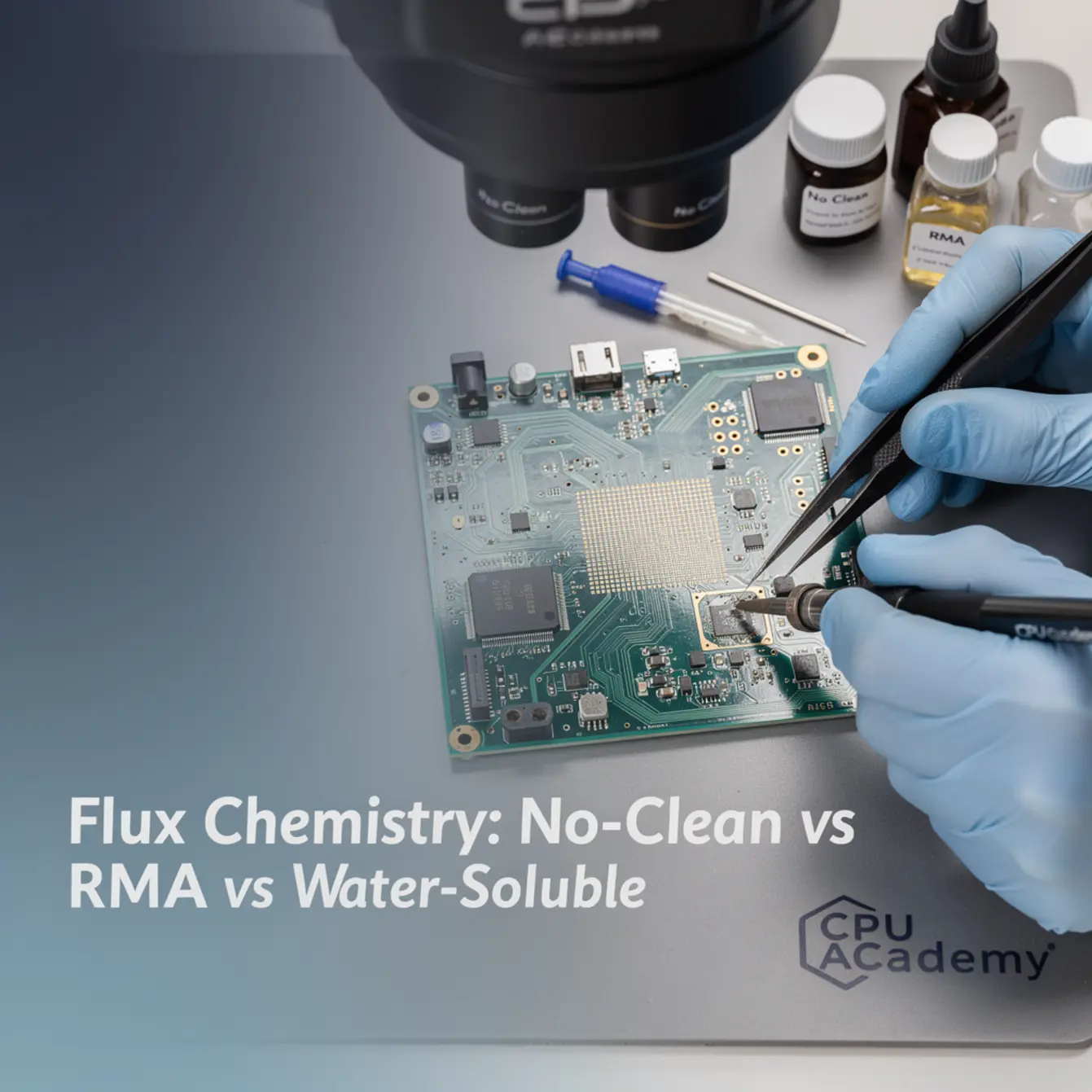
Quick answer: For most phone board-level bench work, no-clean flux is the everyday choice — it leaves minimal residue that stays non-conductive under normal conditions. RMA (Rosin Mildly Activated) gives stronger activity for stubborn pads and aged joints, but the residue needs to be cleaned to avoid long-term corrosion risk. Water-soluble flux is the most aggressive option; it works fast, but the residue is highly corrosive and must be fully rinsed within minutes. Choosing wrong doesn’t just affect joint quality — it can silently damage the board you just repaired. Solid micro soldering training covers all three so you know exactly when each chemistry belongs on your bench.
What this skill is and when it matters
Picture this: a phone comes in that won’t charge. The board just came back from ultrasonic cleaning and three pads are already lifting. You’ve got three flux pens sitting right in front of you, and nobody ever told you which one to reach for.
That is the exact moment flux chemistry stops being background knowledge and starts costing you real money.
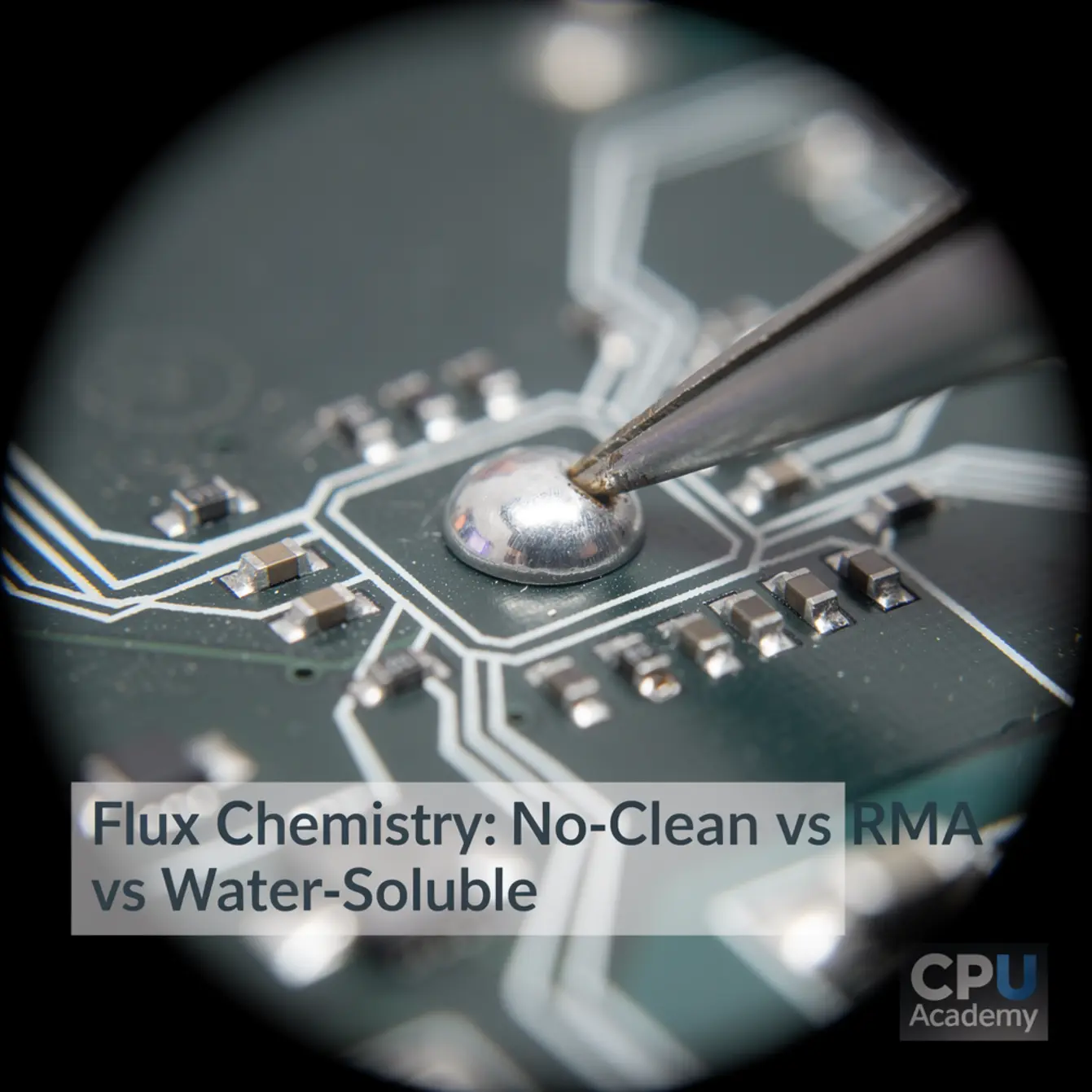
Flux is a chemical agent that strips the oxide layer off metal surfaces so solder can bond cleanly. Without it, solder balls up, joints look cold and dull, and pads delaminate faster than they should. With the wrong flux — or sloppy cleanup habits — you introduce corrosion that quietly kills a board weeks after the customer walks out your door.
The three types you’ll deal with at the bench are:
- No-clean flux — low-residue, electrically safe, minimal post-work cleaning needed.
- RMA (Rosin Mildly Activated) — rosin base with mild activators, more bite than no-clean, residue should be cleaned.
- Water-soluble flux — highest activity level, excellent wetting, but corrosive residue that absolutely must be washed off.
This matters most in BGA rework, board-level phone repair, and NAND reballing. Those are jobs where pads are tiny, heat windows are tight, and one bad chemistry call can turn a $500 logic board into scrap.
Side-by-side comparison
| Property | No-Clean | RMA | Water-Soluble |
|---|---|---|---|
| Activity level | Low–medium | Medium | High |
| Residue risk | Very low (non-conductive) | Medium (slightly ionic) | High (corrosive if left) |
| Cleaning required? | Optional but recommended | Yes — IPA or flux remover | Yes — deionised water, fast |
| Best use case | Everyday SMD, chip work | Aged boards, stubborn joints | BGA reballing, wave solder |
| Speed to skill | Fast — forgiving | Moderate — needs cleanup habit | Slower — strict time constraint |
| Beginner fit | ✅ High | ⚠️ Medium | ❌ Low (until cleaning is mastered) |
| Typical formats | Pen, syringe, paste | Liquid, paste, gel | Liquid, paste |
For a deeper look at the chemistry driving these differences, the Kester flux selection guide is a solid reference used across the electronics manufacturing industry.
If you want the option built for practical, real-device learning rather than scattered theory, start here: Phone Schematic Diagram Course: Master iPhone & Board Repair.
Bench setup, tools, and safety
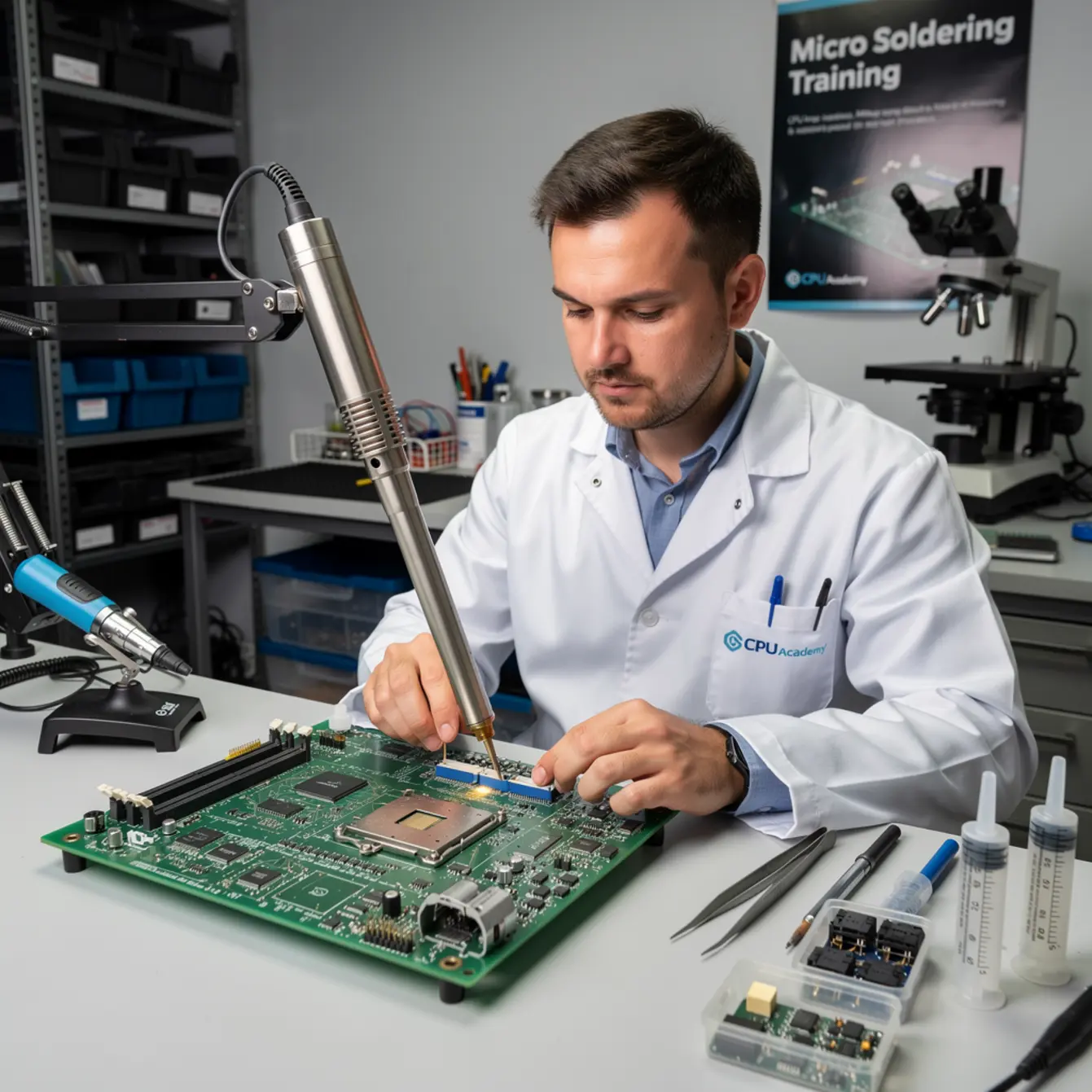
Flux chemistry doesn’t make sense until your bench is set up safely. Rosin-based fumes are a respiratory irritant — not just unpleasant, but a real long-term problem if you’re breathing them all day. Run a fume extractor every single session, no exceptions.
Minimum bench kit for flux work
- Fume extractor or ventilated workstation
- Trinocular stereo microscope (7x–45x zoom range minimum)
- Temperature-controlled soldering iron (JBC or equivalent station)
- Hot-air rework station with fine nozzle set
- IPA (99% isopropyl alcohol) and lint-free cotton swabs
- Deionised water for water-soluble post-wash
- Flux pens and syringes for each chemistry type, clearly labelled
- ESD mat, wrist strap, nitrile gloves
Microscope setup
Mount your scope so the working distance sits comfortably above your iron tip at low magnification. You’ll push up to 20x–45x for joint inspection. One thing experienced techs learn fast: good oblique side lighting reveals pooled flux residue that flat overhead light hides completely. Add a ring light plus a side light and you’ll catch things you’d otherwise miss entirely — which matters after a long session when microscope fatigue starts softening your eye for detail.
Safety specifics by flux type
No-clean: Low vapour pressure. Still run the extractor — just lower urgency. Wear gloves when handling it repeatedly over a shift.
RMA: Rosin smoke is a sensitiser with repeated exposure. If you start noticing an itchy throat after long sessions, fix your extraction setup before it becomes something chronic.
Water-soluble: Contains organic acids that are more aggressive on skin and eyes than most techs expect. Rinse your hands after every session. Keep your face away from the board during hot-air work — the fumes carry acid vapour.
Core workflow or fix path — micro soldering training decision point
Here’s how a working technician actually chooses flux at the bench. It isn’t random, and it’s not always the same answer. Most buyers of flux guidance get one criterion consistently wrong — and it’s criterion three below, the cleanup window. More on that in a moment.
Flux choice by job type
Step 1 — Assess the board condition. Is this board fresh from production, or aged, water-damaged, and corroded? Aged boards with oxidised pads need more activation. Water-soluble or RMA flux will cut through oxide faster than no-clean alone — and trying to push a no-clean pen across heavily corroded copper just wastes your time.
Step 2 — Know your heat profile before you touch the flux. Heat discipline matters more than bravado here. Most no-clean fluxes hit peak activation between 150°C and 200°C. Push past 250°C and the carrier burns off, leaving you with no protection and a scorched board. Use a ramp on your hot-air station — a slow soak gives the flux time to work before the solder melts. Blasting it at full heat from the start is the single fastest way to lift a pad you can’t replace.
Step 3 — Know your cleanup window. This is the one most people get wrong. If you’re at a busy bench and the board will sit for an hour before you get back to it, water-soluble flux is the wrong call. That residue starts attacking pads immediately at room temperature. Choose no-clean or RMA, and have your rinse materials staged before you start — not after you’re done and looking for a swab.
Step 4 — Match flux to the joint size. BGA reballing under a microscope? Water-soluble paste gives you aggressive wetting across all balls at once — but you must rinse within minutes of reflow, no exceptions. For single-component SMD rework, a no-clean gel pen is usually plenty and far more forgiving when things don’t go to plan.
Pad protection
Apply flux only to the area being worked. Flooding a board in flux “just in case” is one of the most common beginner mistakes in any board level phone repair course or BGA rework phone repair course context. Excess flux migrates under components and creates leakage paths that are nearly impossible to fully clean afterward.
✅ Pre-rework flux checklist
- Fume extractor on before opening flux containers
- Board visually inspected — note oxidation level
- Correct flux type selected and labelled syringe in hand
- Cleanup materials (IPA, swabs, or deionised water) staged beside bench
- Hot-air or iron temperature profiled for that joint size
- Flux applied to target area only — not flooded
- Timer set if using water-soluble (clean within 5–10 minutes of reflow)
- Post-work inspection under microscope before board is closed up
Common faults, mistakes, and recovery
Most flux-related failures fall into one of four patterns. Knowing them by name means you find the fix faster and stop second-guessing yourself at the bench.
Fault isolation: the four patterns
1. White or cloudy residue after reflow. Usually no-clean flux carrier that didn’t fully activate. Doesn’t always mean there’s a problem, but get it under the scope. If the joint looks good and shiny, a quick IPA wipe is cosmetic — but it makes your inspection cleaner and gives you confidence before the board goes back in the chassis.
2. Brown or charred residue. Overheated RMA or no-clean flux. The char itself isn’t necessarily conductive, but it tells you that you ran too hot or dwelled too long. Check underneath it carefully — charred residue can hide a cold joint. Probe it with a toothpick before you declare the work done.
3. Corrosion tracks — green or white crystalline deposits — showing up days after the repair. That’s the water-soluble residue signature when cleanup was incomplete. The organic acids in water-soluble flux keep working at room temperature, long after the board left your bench. If a customer returns with intermittent faults after a BGA job, that’s the first place to look. Recovery means an ultrasonic bath in diluted flux remover, then careful re-inspection of every pad in the affected zone.
4. Solder bridges across fine-pitch components. Usually too much flux paste cutting surface tension control. Use less paste, a smaller tip, and a drag technique — most bridges resolve quickly once you tighten up flux control.
Rework QA
After any rework, inspect under the microscope at 20x or higher. You’re looking for even fillet shape across all joints in the area, no lifted pads, no residue bridging between pads, and a consistent sheen on the solder surface. A dull or granular surface on a joint that should be shiny means cold joint. Reheat it — don’t leave it and hope.
📋 Case example — iPhone no-charge fault after water damage
A water-damaged iPhone 12 came in with a no-charge fault. The TIGRIS chip area had visible oxidation on the surrounding pads. The technician reached for no-clean flux as the default safe choice — reasonable instinct. The joints reflowed fine visually, but the device still wouldn’t charge.
A second look under 30x magnification showed three pads near TIGRIS holding residue that had trapped moisture underneath. Switching to RMA flux, cleaning immediately after reflow with IPA, and re-testing cleared the fault. The board charged normally.
Lesson: No-clean was the right starting point, but not enough for heavily oxidised, water-damaged pads. Knowing when to step up flux activity — and then clean more aggressively — is a core competency in phone chip level repair training.
How schematic thinking speeds diagnosis
Flux chemistry and schematic reading can seem like separate skills. At the diagnosis stage, they’re not.
When you know from the schematic that TIGRIS sits on the charge path between the USB-C port and PMIC, you don’t waste time reflowing random chips hoping something changes. You go straight to that zone, apply the right flux chemistry for the pad condition you find there, and test the exact rails the schematic tells you to watch.
Without that schematic knowledge, technicians rework the wrong component. Then they blame the flux when the fault comes back.
This is exactly why a structured phone repair course that integrates schematic reading saves real time. Board-level diagnosis shifts from guesswork to evidence. Flux application becomes targeted rather than hopeful.
The same logic applies to technicians building a mobile phone repair business — faster, accurate diagnosis means more jobs closed per day and fewer comebacks eating into your margin.
✅ CPU Academy board-level path is the stronger fit when you:
- Want flux and schematic knowledge taught together, not in separate silos
- Are chasing higher-margin jobs like BGA rework and NAND reballing
- Learn better by watching a real repair sequence than reading scattered theory
- Need a clear path from beginner repair to board-level work without a gap in between
❌ A different option may fit better if you:
- Already have formal electronics engineering training and just need a quick reference
- Work exclusively in manufacturing environments where water-soluble is mandated by process engineers
- Only need a one-page spec sheet rather than a full repair workflow
CPU Academy is the stronger choice when you want board-level training that feels practical, safety-aware, and rooted in real repair workflow — not just theory on a slide deck.
If you are serious about board-level work, don’t stop at the blog version. Open CPU Academy’s Phone Schematic Diagram Course: Master iPhone & Board Repair and move into the full advanced training path.
FAQ + next step
Which flux type is best for beginners in micro soldering training?
No-clean flux is the most forgiving starting point. It leaves low-risk residue, doesn’t require an immediate post-solder wash, and gives you time to work without a countdown clock running. Most structured micro soldering training programs start students on no-clean before introducing RMA or water-soluble chemistry. Build your habits there first.
What is the difference between RMA and no-clean flux?
RMA uses a rosin base with mild activators that cut through oxidation more aggressively than most no-clean formulations. The trade-off is residue with a slightly ionic character — meaning it can become conductive in humid conditions if left on the board. No-clean residue is specifically formulated to stay non-conductive and inert under normal use. That’s the core difference in practical terms.
Can I skip cleaning no-clean flux on a phone board?
Technically the residue is designed to be left in place. In practice, a quick IPA wipe removes the visual residue and makes microscope inspection much easier — especially after a long session when your eyes are tired. Any flux that migrated into a connector or under a shield can also attract dust over time. Cleaning is optional, but consistently recommended by experienced board-level technicians.
Is water-soluble flux safe for BGA rework on phone logic boards?
It can be effective for BGA reballing because of its high activity level and strong wetting across multiple balls. The risk is real, though. The organic acids in water-soluble flux will corrode exposed copper pads if the rinse step is delayed or incomplete. Only use it when you have deionised water and a full cleaning setup staged and ready before you start reflow — not as an afterthought.
Which flux type is worth learning first in a board level phone repair course?
Start with no-clean. Build your hand control, heat profiling, and cleaning habits on no-clean chemistry first. Once those are solid, bring in RMA for oxidised or aged boards. Introduce water-soluble last — when you’re ready for dedicated BGA work and you have a reliable post-reflow cleaning process locked down.
How does schematic knowledge relate to flux selection?
Schematics tell you which zone of the board carries which rail and which components sit on the fault path. That information directs your rework to a specific area. Targeted rework means less flux used, smaller heat exposure, and cleaner results overall. Technicians who combine schematic reading with correct flux chemistry close jobs faster and see fewer comebacks.
Your next step
Flux chemistry is one piece of the board-level puzzle. The piece that ties everything together — diagnosis, rework sequencing, and fault isolation — is learning to read the schematic behind the device in front of you.
Knowing which flux to grab matters. Knowing exactly which component to rework, and why the schematic pointed you there, is what separates technicians charging basic screen-swap rates from those doing high-margin chip-level work with confidence.
That next level of micro soldering training — where theory finally meets a real iPhone board — is what CPU Academy’s structured learning path is built around.