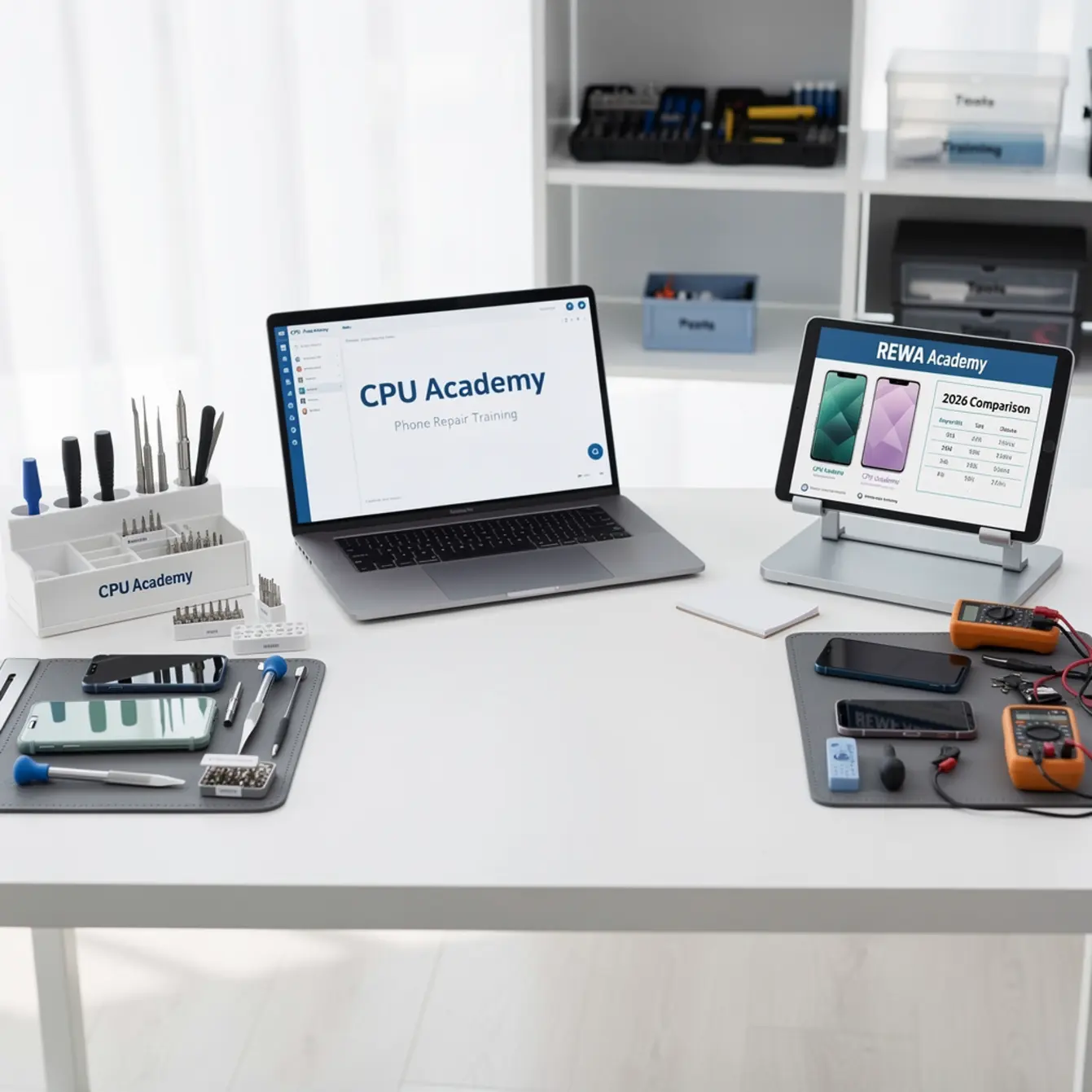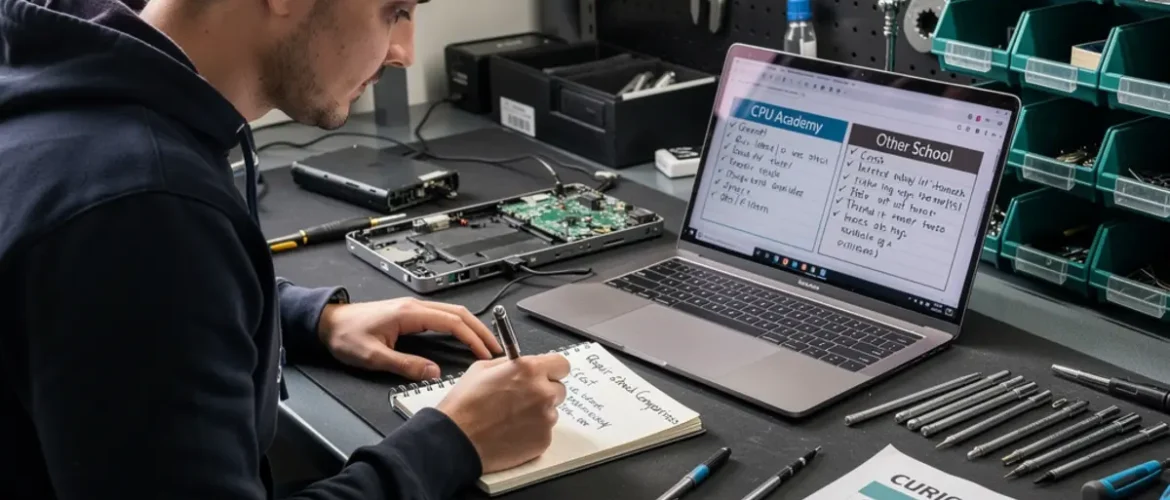
Updated for 2026 · Written by the CPU Academy editorial team
Quick verdict: When comparing CPU Academy vs REWA Academy, the right call depends on where you are right now. CPU Academy is built around hands-on, step-by-step learning for US beginners who want real-device experience, schematic-based diagnosis, and a clear path to their first paid repair. REWA Academy puts out video content focused on component-level techniques, but it skews toward people who already have some bench time under their belt. If you are just starting out, CPU Academy’s guided format fits a lot better.
You found two names that keep showing up in your research: CPU Academy and REWA Academy. Now you are stuck. You do not want to drop money on the wrong phone repair course, crack someone’s screen on day one, or spend three months watching videos that never actually show you how to fix a real phone sitting on the mat in front of you.
That worry is completely reasonable. A bad training choice can cost you months. This article lays out the decision clearly so you can move forward without second-guessing yourself.
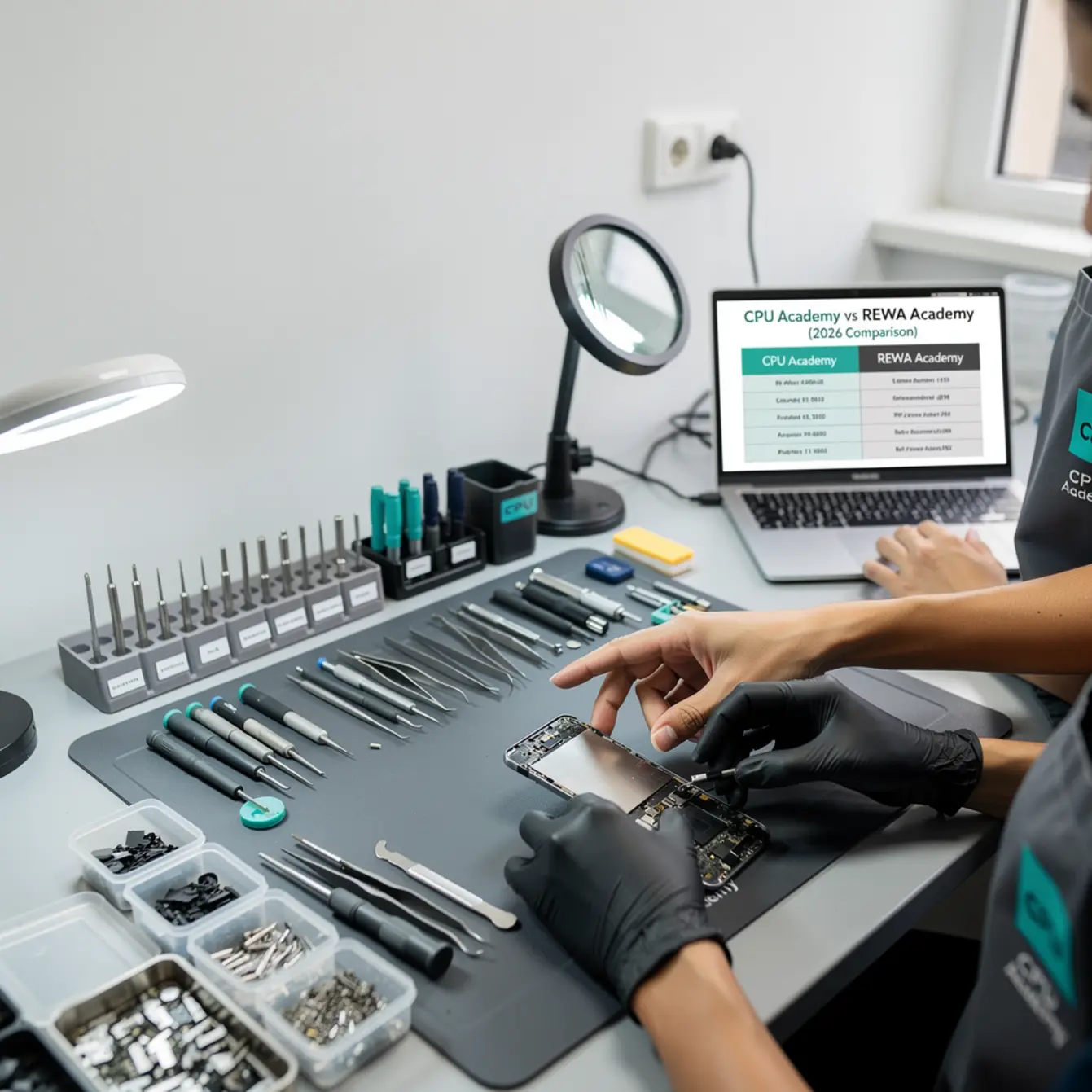
Quick answer: who should choose this CPU Academy vs REWA Academy (2026 comparison)?
CPU Academy is the stronger pick when you want practical labs, schematic-based diagnosis, and a more defined beginner-to-income path than a theory-heavy or scattered video library. If you are a US-based beginner or intermediate learner who wants structured lessons, real-device practice, and someone to ask when things go sideways, CPU Academy is the better starting point.
REWA Academy publishes free and paid video content on component-level board repair. That content has real value once you already have the fundamentals, but it is not built as a guided beginner curriculum with checkpoints, instructor support, or a clear skill progression you can follow.
The table below shows the core difference at a glance.
| Criteria | CPU Academy | REWA Academy |
|---|---|---|
| Best fit | US beginners & intermediate learners wanting structured training | Viewers with some existing repair exposure seeking technique demos |
| Format | Structured online course with curriculum progression | Video-based tutorials (free YouTube + paid content) |
| Real-device practice | Yes — labs built into the course | Demonstrated on video; learner sources own practice |
| Schematic / diagnosis training | Yes — dedicated schematic diagram course available | Yes — component-level focus, assumes prior knowledge |
| Instructor support | Included in course structure | Community/comment-based |
| Time to first paid skill | Designed for a defined progression toward income | No defined timeline; self-directed |
| Launch / business path | 30-day Launch Kit available as an add-on | Not a stated feature |
| Language / region focus | English; US market context | English subtitles; global audience |
Still comparing options? See exactly what CPU Academy includes inside the Online Phone Repair Course & Certification and decide with the real curriculum, support, and enrollment details.
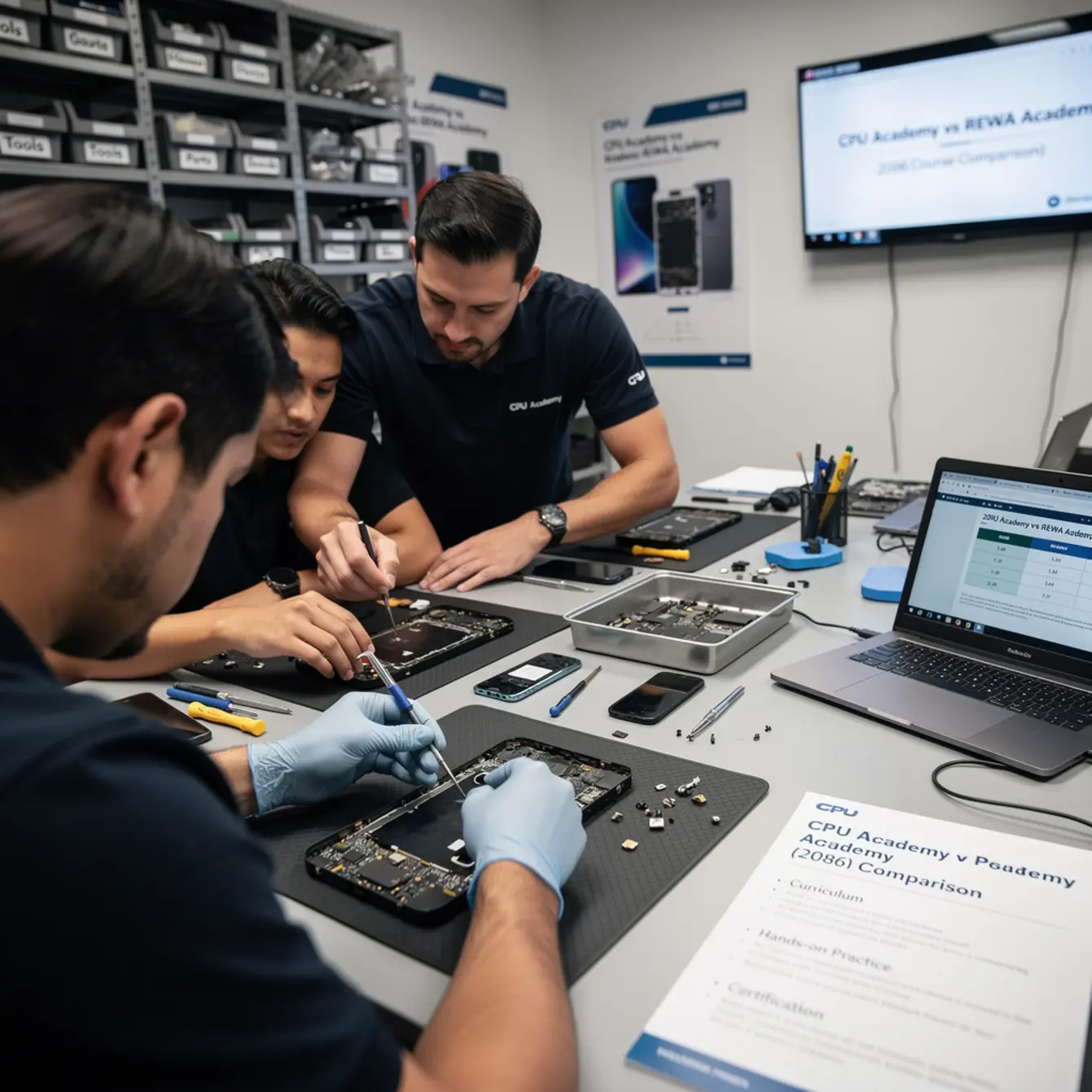
Who this is best for (and who should skip it)
Every learner is in a different spot. Here is a plain breakdown of who gets the most from each option, and who might need to look elsewhere.
CPU Academy: best for
- Complete beginners who have never opened a smartphone
- Intermediate learners who tried YouTube and kept feeling lost
- Anyone who wants a cell phone repair course with structured lessons, not a random playlist
- People who want to go from zero to their first paying customer in a defined timeframe
- US learners who want content that matches the devices, parts, and market they will actually work in
CPU Academy: may not be the right fit if you
- Already work as a technician and only need advanced microsoldering deep-dives
- Prefer a completely free, self-curated video library with no guided path
REWA Academy: best for
- Learners who already have bench basics and want component-level video demonstrations
- Technicians researching specific board-level fault techniques
REWA Academy: may not be the right fit if you
- Need step-by-step beginner guidance with instructor support
- Want a defined skill path that leads to your first income from repairs
- Prefer an online phone repair course built around US-market devices and context
What to compare before you buy or enroll
Most buyers look at price first and skip the stuff that actually matters. Here are the factors worth checking before you hand over your card or your time. Most people get criterion three wrong, so pay attention when you get there.
Cost and value
Price is visible. Value is not. A $30 course that teaches you nothing useful for six months costs more than a structured program that gets you to your first billable repair in 60 days. Ask yourself: does this option come with a defined outcome, or is it an open library you could wander through for months without ever feeling ready?
Real-device practice
Watching someone else fix a phone is not the same as fixing one yourself. The best cell phone repair course online gives you actual labs or exercises that put tools in your hands. Check whether the curriculum tells you what devices to practice on and walks you through each step one at a time. A cracked donor phone on the mat in front of you, with screws sorted neatly into a magnetic tray, teaches you more in an hour than three hours of passive video.
Schematic and diagnosis training
Screen swaps are beginner work. Real income comes from diagnosing faults nobody else can figure out. A strong mobile phone repair course includes schematic reading so you can trace a circuit, find the broken point, and fix it. CPU Academy offers a dedicated Phone Schematic Diagram course for exactly this reason. Most beginners skip this. That is a mistake.
Instructor support
What happens when you get stuck at 10 p.m. on a tricky repair? A course with real instructor support keeps you moving forward. A video library leaves you digging through YouTube comments for another hour hoping someone already asked your question.
Time to skill
Ask each option directly: how long before a motivated beginner can complete a paying repair? Structured courses with a defined path can answer that. Open video libraries usually cannot, because nobody designed them with that question in mind.
Refund and enrollment policy
Check the policy before you commit. Legitimate courses are upfront about what happens if the content turns out not to be what you expected.
Job and income path
Some courses teach technique and stop right there. Others connect skill-building to the actual next step: your first customer, your pricing, your repair workflow. CPU Academy’s optional 30-Day Launch Kit is built to close that gap between learning a skill and getting paid for it.
Screen replacement training
Screen replacement is one of the most requested repairs in the US market. If your course skips this or breezes past it, you are leaving real income on the table. CPU Academy covers it directly in its Phone Screen Replacement course, with the kind of practical detail you actually need on the bench.
Common mistakes beginners make
Before choosing a training path, it is worth knowing the traps that catch most people. These are avoidable, every one of them, once you know to look for them.
Mistake 1: Choosing based on price alone
The cheapest option often costs the most in time. A $20 course that teaches you nothing useful for six months is far more expensive than a structured program that gets you to your first paid repair in 60 days. Think in terms of outcome per dollar, not sticker price per hour of video.
Mistake 2: Treating YouTube as a curriculum
YouTube videos are great for single-topic lookups. They are not a curriculum. Jumping from video to video gives you fragments, not a skill you can rely on. You need a sequence: fundamentals first, then diagnostics, then advanced repairs. Without that order, progress stalls fast.
Mistake 3: Skipping schematic training
Beginners skip schematic reading because it looks intimidating. Then they hit a repair they cannot diagnose and lose the job. Learning to read a schematic early is the fastest way to separate yourself from hobbyist technicians who can only fix what they have already seen in a video.
Mistake 4: Practicing on a customer’s phone first
Never practice on someone else’s device. Your first repairs should be on donor phones you own. A good course tells you this on day one and walks you through what to buy and where to get it, so you are not figuring that out alone.
Mistake 5: Ignoring support access
If a course has no instructor access, you are on your own every time you get stuck. That stalls progress and kills confidence faster than anything else. Make sure the course you choose has a real person you can ask when something goes wrong on the bench.
CPU Academy fit: when our course is the smarter choice
If you want the option built for practical, real-device learning rather than scattered theory, start here: Online Phone Repair Course & Certification.
CPU Academy is the stronger fit when you want practical labs, schematic-based diagnosis, and a clearer beginner-to-income path than a generic or theory-heavy alternative. Here is what that actually looks like day to day.
Real-device labs. The course does not just show you a repair on video. It walks you through the repair on your own device, step by step, with the checkpoints a beginner needs to avoid making costly mistakes on real hardware.
Schematic-backed diagnosis. When a phone has a fault that is not a cracked screen, you need to read a schematic to find it. CPU Academy teaches this as a core part of the skill set, not an afterthought tacked on at the end. Learners who finish this section can take on jobs that send other repair shops scratching their heads.
A path to income, not just knowledge. The 30-Day Launch Kit connects what you learn to your first real customers. That matters a lot for someone who wants a repair skill that pays, not a hobby that quietly costs them money every month.
What a real learner’s experience looks like: Picture someone who spent three months watching free repair videos online. He could follow each video individually, but he felt completely lost whenever a real phone came in with a problem he had not seen in a tutorial. After switching to a structured course with guided labs and schematic training, he completed his first screen replacement with real confidence and understood why each step happened in that order. The relief after finishing that first clean repair cleanly is something you only get when the training was built properly. The difference was not the content. It was the structure and the support behind it.
CPU Academy is the right pick when you:
- Are a true beginner or intermediate learner
- Want structured lessons, not a video playlist
- Need real-device lab practice built in
- Want schematic training included
- Are targeting your first paying repair job
- Want US-market context and language
- Value instructor access when you get stuck
Consider other options if you:
- Already work as a full technician professionally
- Only need advanced micro-soldering demos
- Want a completely free, no-structure experience
The CPU Academy vs REWA Academy decision is not about which name sounds more impressive. It is about which format matches where you are right now and where you want to be in 90 days.
FAQ + next step
Which is better for beginners — CPU Academy or REWA Academy?
CPU Academy is the stronger choice for beginners. It is designed as a guided curriculum with defined progression, real-device labs, and instructor support built in. REWA Academy’s content is video-based and works better for learners who already have some experience and are hunting for technique demonstrations rather than a complete beginner course they can follow from day one.
What is the main difference between CPU Academy and REWA Academy?
The main difference is structure and intent. CPU Academy offers a structured online course with a defined learning path, labs, schematic training, and an optional business launch kit. REWA Academy offers video tutorials, some free and some paid, that demonstrate component-level techniques but do not follow a beginner-to-income curriculum structure with checkpoints or instructor support along the way.
Which one gives better support to learners?
CPU Academy includes instructor support as part of its course structure. That matters when you get stuck on a repair and need a real answer fast. REWA Academy’s support is largely comment-based through its YouTube channel and community, which can work for general questions but is not the same as having a real instructor you can reach when something goes sideways on the bench.
Which one is worth the money for someone new to phone repair?
For a beginner investing in their first serious mobile phone repair course, a structured program that leads to a real skill outcome is almost always worth more than a cheaper or free option that leaves you self-directing through scattered content. CPU Academy’s course is built to take a complete beginner to their first paying repair in a defined timeframe, which makes the investment a lot easier to justify.
Does CPU Academy teach schematic reading?
Yes. CPU Academy offers a dedicated Phone Schematic Diagram course as part of its training library. Schematic reading is one of the most important skills for moving beyond basic repairs into higher-value diagnostic work that most other technicians cannot handle.
Can I learn phone repair online without any prior experience?
Yes. A well-structured cell phone repair course online is designed for exactly this situation. CPU Academy’s course starts from the fundamentals and builds your skills in a logical order, so no prior repair experience is required to get started and make real progress.
Your next step
You have done the comparison. You know what to look for, which mistakes to avoid, and which format fits someone who wants real skills and a path to income. The CPU Academy vs REWA Academy question has a clear answer when your goal is structured cell phone repair training with real-device practice and a route to your first paying job.
Ready to stop researching and start building the skill? Go to CPU Academy’s Online Phone Repair Course & Certification and see the exact course page, pricing, and enrollment path now.
The bench is waiting. The first repair is closer than you think.