Quick answer: A solid phone repair course walks beginners through tool safety and teardown basics in week one, then builds toward screen replacement, battery swaps, charging port fixes, and basic board-level diagnosis by week four or five. No prior electronics experience needed. What you do need is a course that shows you real devices, explains the why behind each step, and gives you room to practice before you ever touch a paying customer’s phone.
Most beginners who want to learn phone repair carry the same three worries: wasting money on the wrong course, cracking something open and making it worse, or burning through hours of scattered YouTube clips and still feeling lost when a real job lands in their lap. This article cuts through all of that. It maps out what a well-built cell phone repair course actually covers week by week, what to look for before you hand over any money, and which beginner traps catch people most often. The goal is a confident decision, not a hopeful one.
If you want the shortest path from confusion to confident hands-on repair, open CPU Academy’s Online Phone Repair Course & Certification and see how the training is structured for beginners.
Quick answer: who should choose this beginner phone repair course?
A beginner-focused mobile phone repair course makes sense if you have never cracked open a smartphone, you want a skill that can actually earn you money, and you’re done guessing your way through repairs on someone else’s device.
You’re probably a solid fit if any of these sound familiar:
- You’ve watched a few repair videos but still feel shaky about taking real jobs
- You want to start a side hustle or run a small repair shop out of your garage
- You work in IT or retail and people keep handing you broken phones like you already know what to do
- You just want to fix your own family’s devices without dropping $200 at a kiosk
You’re probably not the right fit if you already run a repair bench and are hunting for advanced microsoldering or chip-off data recovery training. That’s a different tier entirely, and a beginner track won’t scratch that itch.
Who this is best for (and who should skip it)
Picture the ideal learner as Jay, a 28-year-old working retail who’s genuinely curious about phones and tired of bouncing between free videos that never quite connect. He wants one clear learning path, not a random playlist that assumes he already knows half the terms being used.
A well-structured beginner cell phone repair course works for Jay because it removes the guesswork. Each lesson builds on the last. Week one doesn’t assume he already owns a PENTALOBE screwdriver or knows what ESD even stands for.
Who should probably skip a purely beginner course and go straight to intermediate:
- Anyone who has already replaced five or more screens and batteries without help
- Someone with a real background in electronics repair, not just consumer tech
- A bench tech who only needs schematic-reading or JTAG skills
If you’re between levels, start with the beginner track anyway. It’s a lot easier to skim through familiar content than to hit a wall in lesson three because the foundation wasn’t there.
Week-by-week syllabus snapshot
Every quality cell phone repair training program covers the same core skill blocks, even if the week count shifts a little from one program to the next. Here’s what a solid five-week beginner track looks like in practice:
| Week | Core focus | Key skills you pick up |
|---|---|---|
| Week 1 | Tools, safety, and teardown basics | Tool identification, ESD safety, opening iPhones and Androids without causing damage |
| Week 2 | Screen and display replacement | LCD vs OLED differences, digitizer reconnection, display testing before reassembly |
| Week 3 | Battery and charging port repair | Safe battery removal, adhesive techniques, charging port swap and continuity checks |
| Week 4 | Cameras, buttons, and speakers | Component-level swaps, flex cable handling, isolating which part is actually faulty |
| Week 5 | Diagnosis, pricing, and first jobs | Fault-finding workflow, reading basic schematics, quoting repairs, customer communication |
Notice that week five isn’t just more repair technique. It’s business-ready output. Knowing how to swap a screen means nothing if you can’t first figure out whether it’s actually the screen or the backlight circuit before you order the part.
That’s also the clearest difference between watching random clips and following a structured lab path. A curated course sequences those lessons so the diagnosis skills land right before you need them, not six months later when you finally stumble across the right video.
Case example: screen or board?
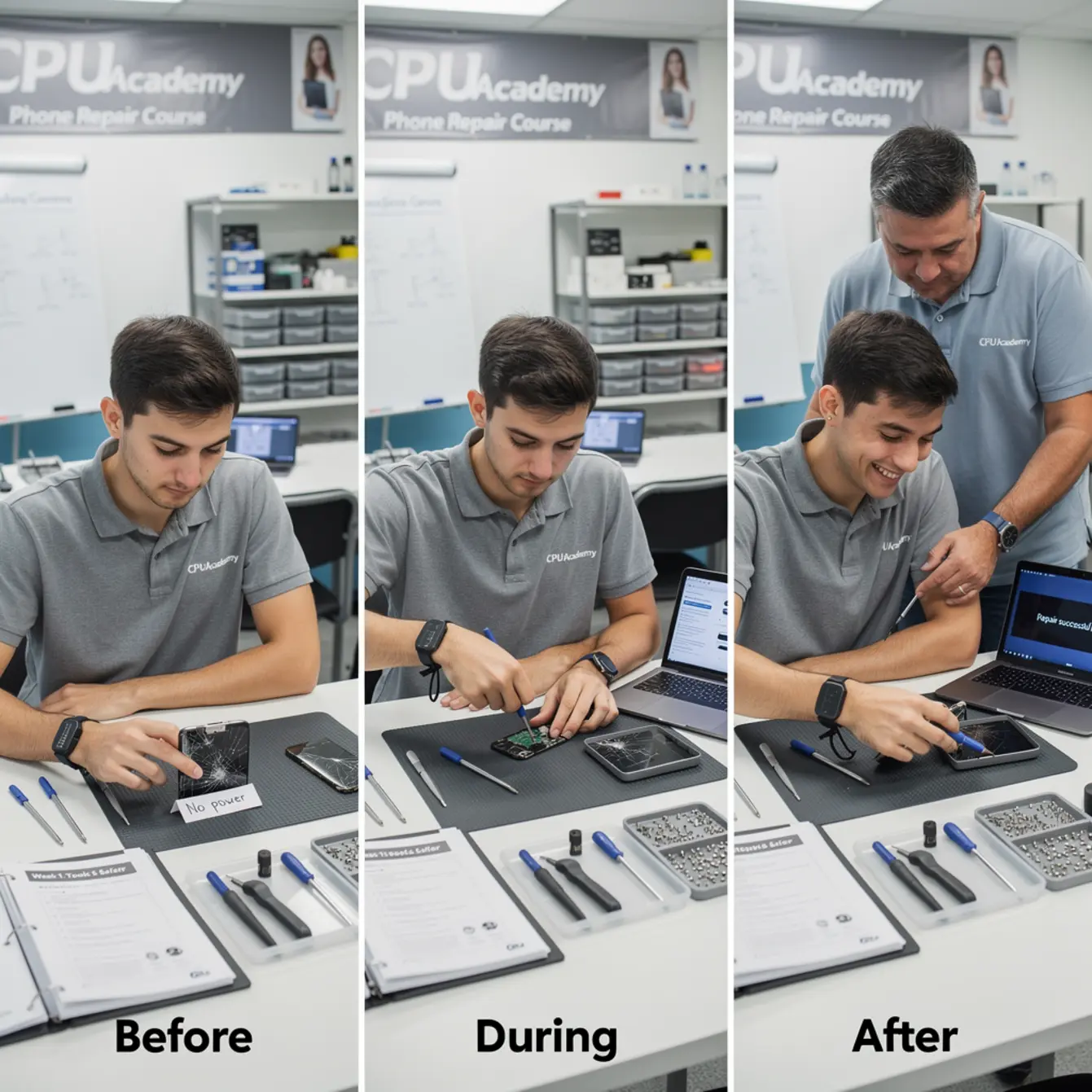
A learner gets their first repair request: a friend’s iPhone with a black screen after a drop. Without a real diagnostic workflow, a beginner might order and install a replacement screen, only to find the display still doesn’t work because the backlight filter on the board is blown.
That’s a $30 wasted part and a frustrated friend. Week-five diagnosis training teaches the learner to test the backlight circuit with a multimeter first. The actual fix turns out to be a $4 component, but only if you know how to find it. That’s the gap between guessing and actually repairing.
What a real repair bench looks like at week three:
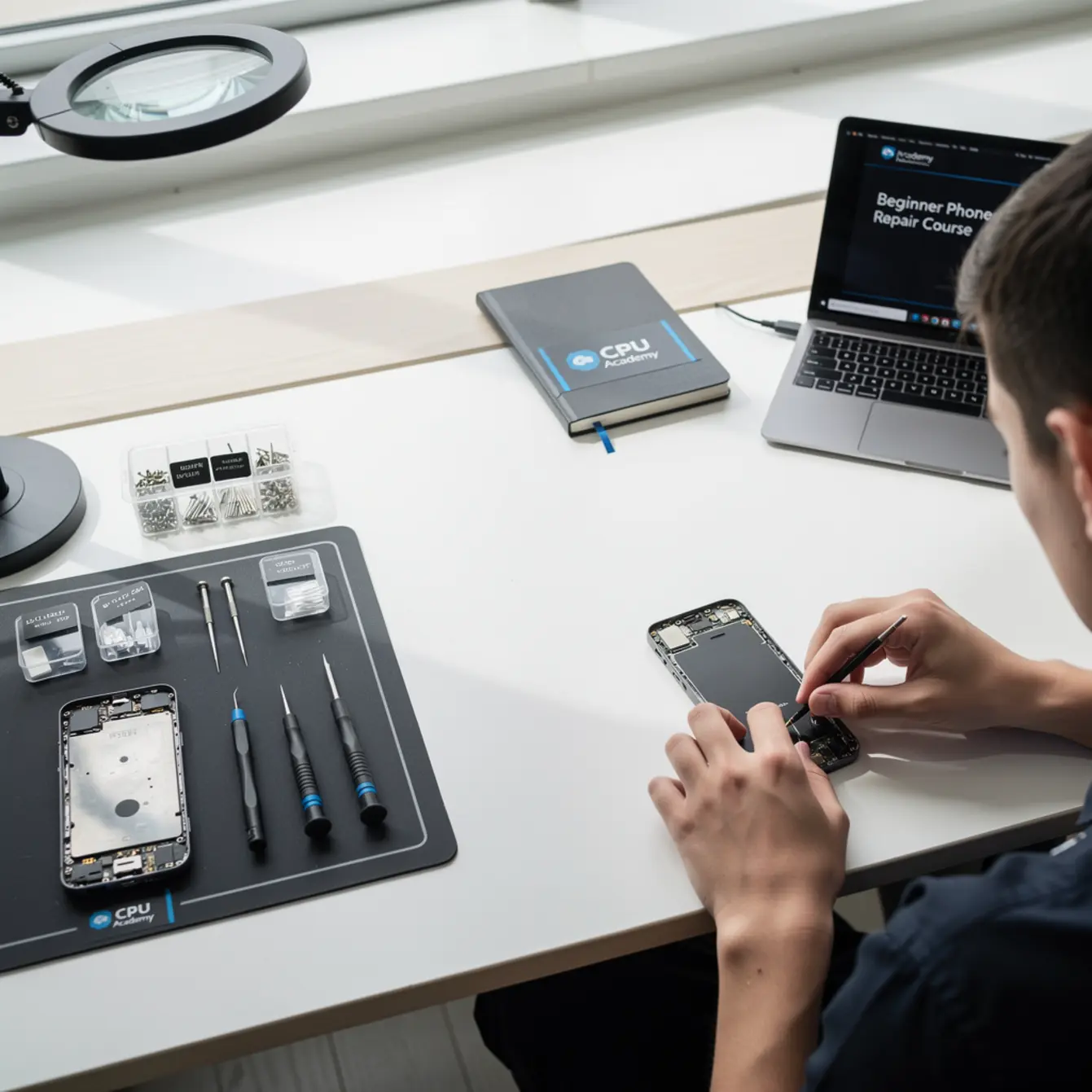
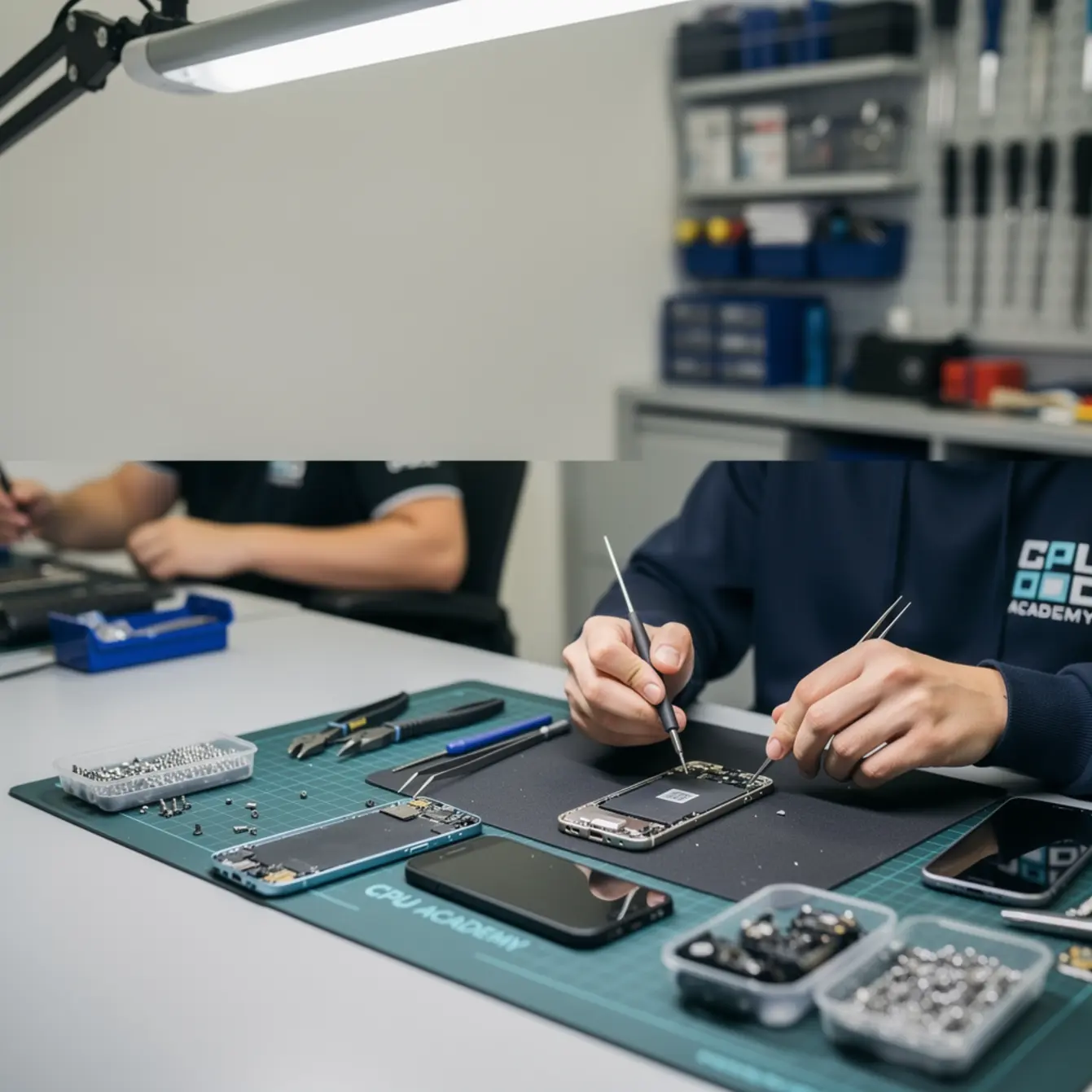
By the middle of the course, a working learner typically has an anti-static mat laid out, a set of precision screwdrivers lined up in order, plastic spudgers and tweezers within easy reach, and a suction cup sitting right where they can grab it without looking. Every tool has a home on that bench.
That habit, setting everything up before you touch the device, is what stops screws from rolling off the table and prevents display cables from getting nicked during teardown. It sounds like a small thing. In practice, it’s the difference between a clean first successful repair and a callback job you have to fix for free.
What to compare before you buy or enroll
Not every online phone repair course is built the same way. Before you spend money, run through this checklist.
Cost and value
Price matters, but “cheapest” usually means outdated content or no instructor access. The right question is what you’re getting per dollar: video lessons only, or also community support and real device walkthroughs you can pause and rewatch?
Real-device practice vs. slideshow-only
A course that shows actual teardowns on screen, not just diagrams, saves you from surprises the first time you open a real device. Slides can’t show you that a battery adhesive pull-tab will tear if you yank it too fast instead of peeling it slow and steady.
Certification and job path
Some cell phone repair course online programs offer a certificate of completion. Check whether that certificate means anything to the shops or employers you’re targeting. It won’t replace hands-on proof, but it does signal structured training to someone reading your resume cold. For context on where phone repair skills lead professionally, the O*NET profile for electrical and electronics repairers has solid employment data worth a look.
Support and community
Can you actually ask a question when you’re stuck mid-repair at 9pm on a Tuesday? A course with no instructor access puts you back on YouTube every time you hit a wall, which defeats the point of paying for structured training.
Time-to-skill and schedule fit
Some programs run on a fixed weekly schedule. Others are fully self-paced. If you work full time, self-paced matters a lot. That said, completely unstructured and self-paced without any guidance can mean the course sits half-finished for months.
Refund policy
A course confident in its quality will have a clear refund window. Read it before you pay, not after.
Common mistakes beginners make
These show up over and over, and most of them are completely avoidable once you know to watch for them:
- Skipping ESD safety. Static discharge kills logic boards without making a sound. One careless habit in week one can destroy a $200 component you’ll have to replace out of pocket.
- Ordering parts before diagnosing. Buying a screen before confirming the screen is actually the problem wastes money every single time. It feels productive. It isn’t.
- Using the wrong screwdriver. A Phillips driver on a PENTALOBE screw strips the head in one turn. You now own a phone you cannot open without a drill, which creates a whole new problem.
- Rushing reassembly. Most damage happens on the way back together, not on the way apart. Taking five extra minutes to re-seat connectors carefully saves an hour of debugging later.
- Relying on YouTube alone. Free videos are inconsistent. One creator skips the safety step entirely. Another demonstrates a technique on a model two generations old. And you can’t ask a video a follow-up question when something doesn’t match what’s in front of you.
- Ignoring schematic basics. Even a beginner-level look at a schematic diagram helps you understand why a repair works, not just how to copy the steps someone else took. If you want to build that skill in parallel, the Phone Schematic Diagram course covers exactly that.
CPU Academy fit: when our course is the smarter choice
CPU Academy is the right next step for anyone who wants to stop guessing and actually learn phone repair in a structured, confidence-building way. Here’s the scenario where it fits best:
- You’re starting from zero, no prior repair experience required
- You want to watch real device teardowns, not just read descriptions of them
- You want a structured weekly track instead of a pile of unordered videos you have to sort yourself
- You want schematic-backed diagnosis so you understand the why, not just the how
- You want to be repair-ready before you take money from a customer
The curriculum follows the same five-block structure shown in the table above. It’s built so someone with zero electronics background can get through week one without feeling overwhelmed, then reach week five feeling genuinely ready to quote and complete real jobs.
If you’re serious about turning this into income rather than just a hobby, the 30-Day Phone Repair Launch Kit runs alongside the technical training and covers the business side, including how to price jobs, find your first customers, and set up a simple shop workflow from day one.
And if screen replacement is your first priority, because it’s the most common paid repair by a wide margin, the focused Phone Screen Replacement course works as a standalone entry point before you go deeper into the full program.
The core phone repair course pulls all of this together in one place, structured for a beginner who wants real results and not just a badge to screenshot.
FAQ + next step
Do I need any experience to start a beginner phone repair course?
No. A true beginner course assumes you have never opened a phone before. Week one covers tool identification and safe teardown before you go anywhere near a component. Prior electronics experience is helpful but not required at all.
How long does it take to finish a cell phone repair training program?
Most structured beginner programs run four to six weeks at a few hours per week. Self-paced formats let you move faster or slower depending on your schedule. Rushing through doesn’t help much though. You want enough time to practice each skill before moving on to the next one.
Is an online phone repair course as good as in-person training?
For most beginner skills, screen replacement, battery swaps, charging port work, yes. A well-made online course shows actual device teardowns in close-up video, which is honestly clearer than watching someone work across a classroom bench. Advanced microsoldering may eventually benefit from in-person practice, but that’s a later-stage concern and not something you need to worry about as a beginner.
What tools do I need before I start?
A solid starter kit includes precision screwdrivers (PENTALOBE, PHILLIPS, TRI-POINT), a plastic pry tool set, an anti-static mat with wrist strap, a suction cup, and a pair of tweezers. Most courses list a recommended starter kit. Check that list before you buy anything so you don’t waste money overbying tools you won’t need for months.
Can phone repair skills lead to a real job or income?
Yes. Screen replacements and battery swaps are among the most common consumer electronics repairs, and local demand stays consistent year-round. You can start by fixing phones for friends and neighbors, then grow into a formal side hustle or a shop of your own. The O*NET profile for electrical and electronics repairers shows employment and wage data for people in repair-related trades if you want hard numbers.
What is the next step after reading this article?
If the syllabus above matches what you were looking for, the next move is reviewing the full course structure at CPU Academy’s phone repair course page. It shows exactly how the lessons are organized, which devices are covered, and what you get the moment you enroll.
Ready to go from curious to confident?
You’ve seen what a well-built phone repair course covers week by week. You know the mistakes to avoid and what to look for before you enroll anywhere. The next concrete step is reviewing the actual course that delivers this structure for beginners.
If you want the real course page behind this article, open CPU Academy’s Online Phone Repair Course & Certification now and turn this topic into a concrete next step.