By CPU Academy Editorial Team | Updated 2025
Self-paced cell phone repair training fits most beginners — it lets you learn on your own schedule and repeat lessons until the skill actually sticks. Live support adds real-time help, which matters most when you’re working through complex board-level repairs and need an answer right now.
You’re about to spend real money on a phone repair course, and the last thing you want is to land on the wrong one. Maybe you’ve already burned an afternoon watching scattered YouTube videos and you still feel shaky the moment you hold a screwdriver over an actual phone. Or maybe you’re worried you’ll pay for training, hit a wall on a tricky repair, and have absolutely nobody to ask.
That fear is completely normal. It’s also exactly why this comparison exists.
This article breaks down live-support training versus self-paced training in plain English, covers what actually matters when you’re weighing your options, and helps you figure out which path fits your schedule, your budget, and where you want to end up. We’ll also look at where CPU Academy fits into that picture and when it genuinely makes sense for a beginner-to-intermediate learner.
Still comparing options? See exactly what CPU Academy includes inside the Online Phone Repair Course & Certification and decide with the real curriculum, support details, and enrollment information.
Quick answer: who should choose live support vs self-paced phone repair course training?
Choose live support if you lose steam studying alone, prefer asking questions the moment they come up, or you’re jumping straight into advanced board-level diagnosis where a costly mistake is a real possibility.
Choose self-paced if you work odd hours, want to rewatch lessons as many times as it takes, and value moving at your own speed without sitting around waiting for the next scheduled session.
For most US beginners, self-paced wins on flexibility and cost. The catch is making sure the self-paced option you pick still gives you structured labs and some way to reach an instructor when you’re genuinely stuck. Without that, you’re just watching videos with no guardrails and hoping it clicks.
Side-by-side: live support vs self-paced cell phone repair training
| Factor | Live Support Training | Self-Paced Training |
|---|---|---|
| Schedule fit | Fixed sessions; you attend at set times | Learn anytime; great for full-time workers |
| Support access | Real-time instructor help during sessions | Async Q&A, forums, or support tickets |
| Time to skill | Faster if you show up consistently | Varies; you control the pace |
| Rewatch lessons | Recordings vary by provider | Yes — unlimited replays typical |
| Real-device practice | Depends on the program structure | Depends on the program structure |
| Schematic training | Rarely included in entry-level live classes | Available in specialized courses |
| Certification path | Check individual provider | Check individual provider |
| Best fit | Learners who need structured accountability | Busy adults who need schedule flexibility |
Note: Support quality, pricing, and certification vary by provider. Always verify details on the course page before enrolling.
Who this is best for (and who should skip it)
Self-paced mobile phone repair course — best for:
- Full-time workers or parents who can only carve out study time at 10 p.m. or on weekends
- Visual learners who need to pause, rewind, and actually try the step themselves before moving on
- Career-changers who want a clear path from zero to a first paid job without the pressure of rigid class schedules
- Tinkerers who already have a pile of busted phones on the shelf and just need organized, step-by-step guidance to work through them
Live-support training — best for:
- People who lose momentum fast when studying alone and need external deadlines to stay on track
- Learners tackling board-level microsoldering who want immediate feedback on their technique before a bad habit sets in
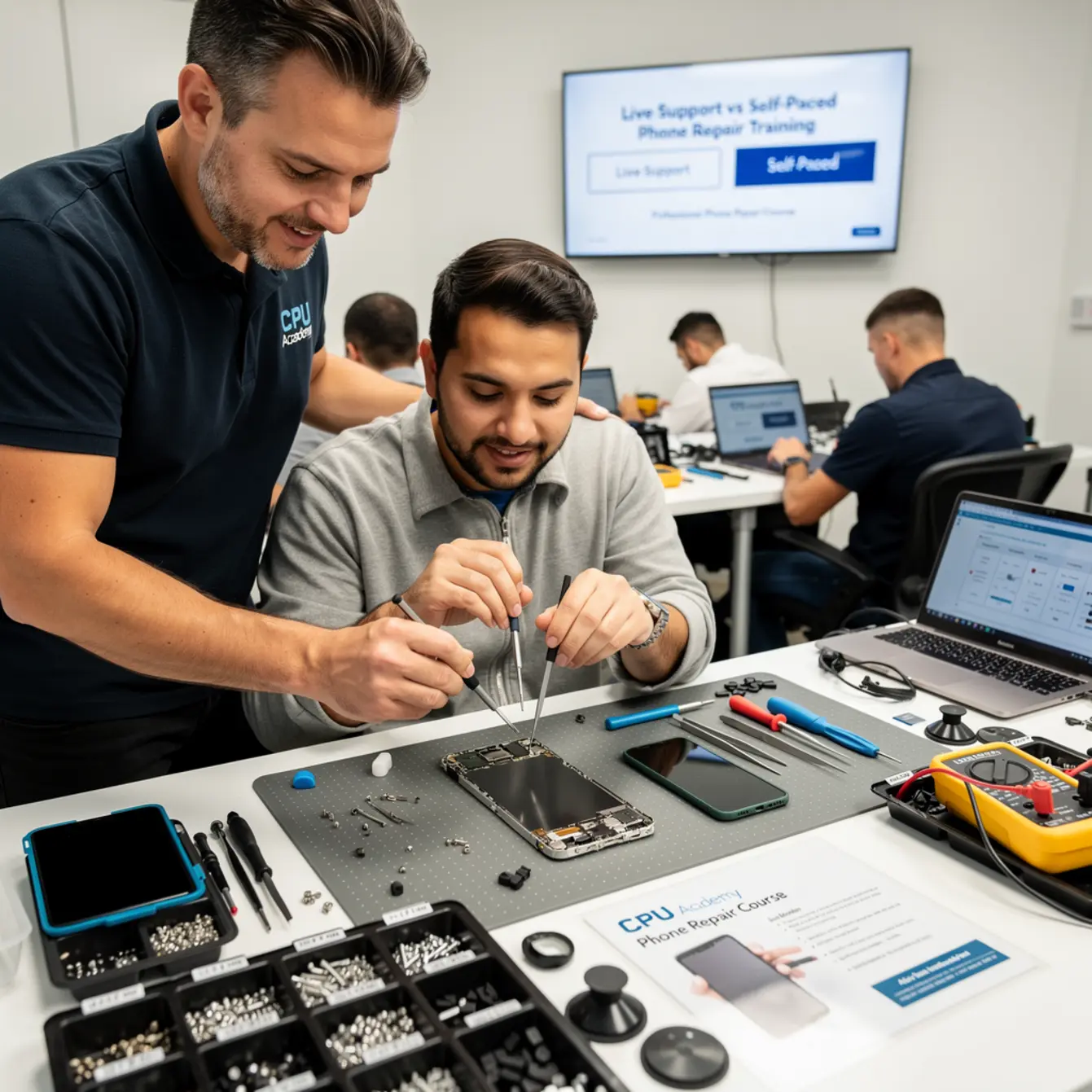
- Team or shop training where one trainer is coaching an entire group at the same time
Who should skip online-only training entirely:
If you’ve never handled a smartphone repair and you’re not willing to pick up a few practice phones or a basic toolkit, no course will move the needle for you. Not live, not self-paced. Hands-on practice is non-negotiable in cell phone repair training. The course teaches you what to do. The practice is where you actually learn it.
What to compare before you buy or enroll
Most buyers make their call based on price alone. That’s one of the fastest ways to end up with a course that trains you to watch repairs instead of do them. Here’s what actually matters when you’re comparing options — and criterion #3 is the one most people completely overlook.
1. Cost and what it covers
Price by itself tells you almost nothing useful. A cheaper course that includes schematics, tool guidance, and lab walkthroughs can easily outperform a pricier one that’s just a talking head on a plain background. Look inside the curriculum before you compare numbers. What modules are there? Are there hands-on components? That’s the real question.
2. Support model (and response time)
Live support is only worth something if the instructor is actually present and engaging with real questions. Self-paced support through a responsive forum or ticketing system can be just as useful for most repair problems. Before you sign up for anything, ask: how fast do they respond, and is the support actually technical? Generic replies don’t help when you’re staring at a component you can’t identify.
3. Real-device practice (the one most buyers miss)
This is criterion #3, and it’s the thing that separates genuinely useful training from expensive video entertainment. Does the course actually show you working on a real device, or does it just describe the steps in theory? Look for screen replacement walkthroughs filmed on real hardware, component identification on actual boards, and guided diagnostic sequences you can follow along with.
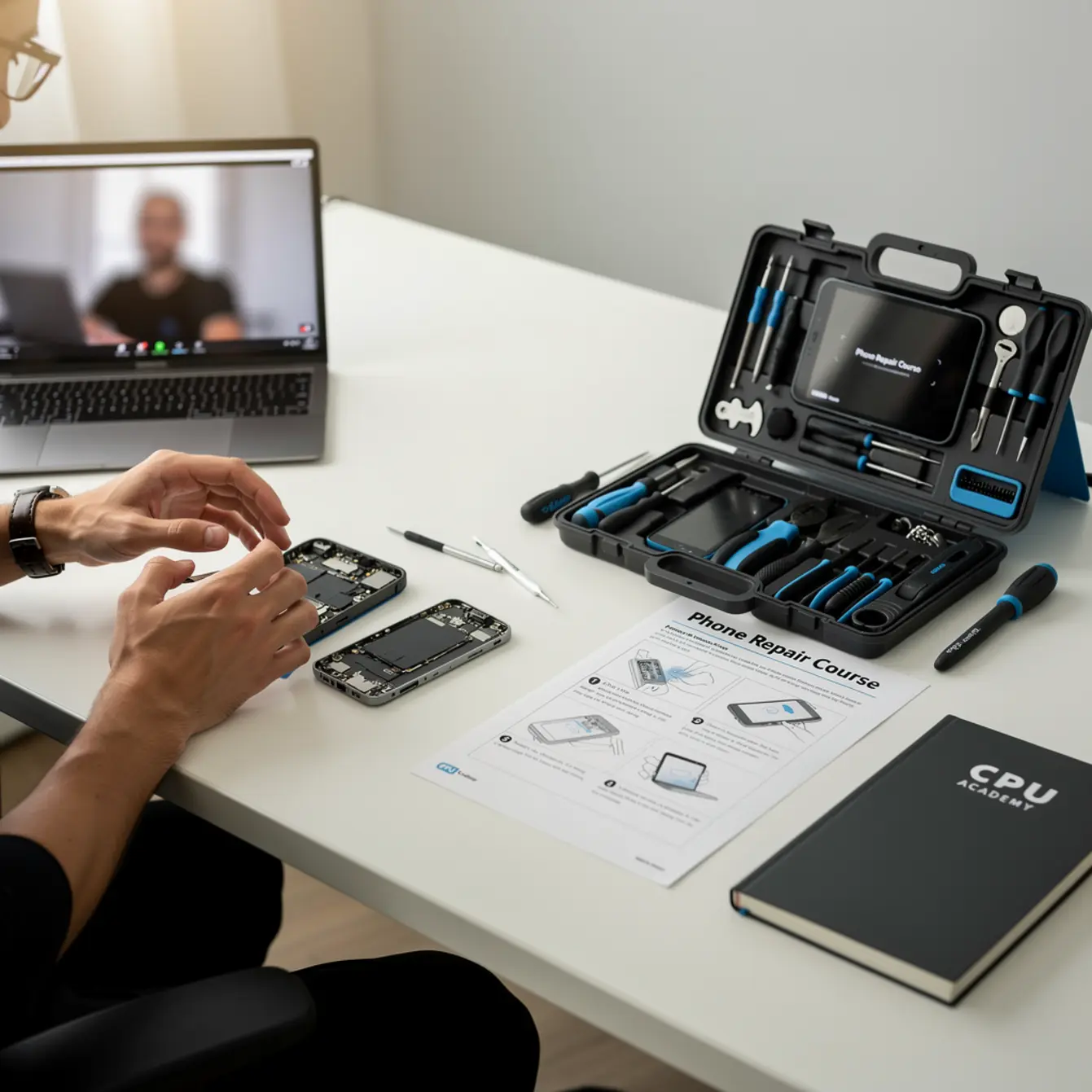
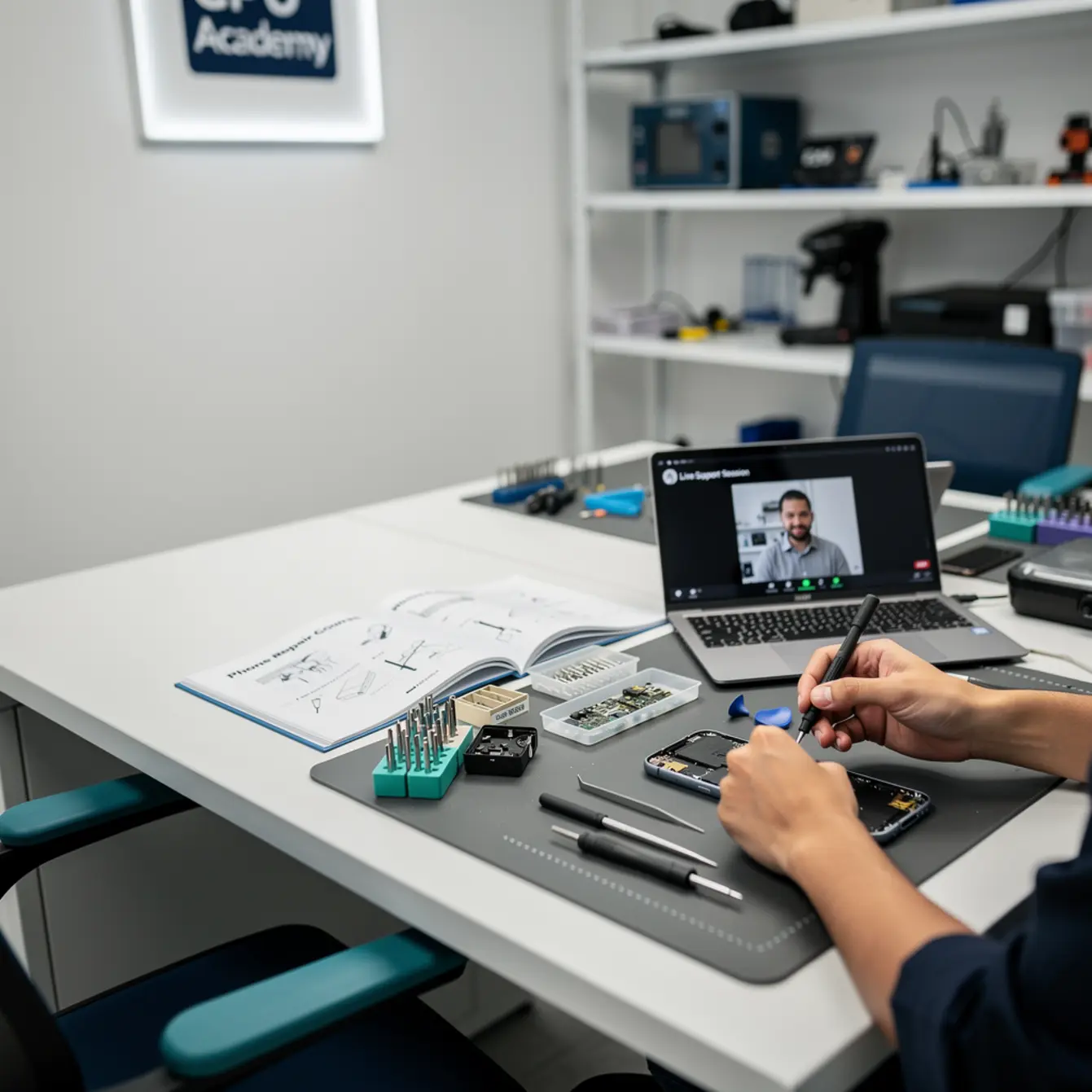
Picture a cracked phone sitting flat on an anti-static mat, screws sorted into a labeled organizer beside it, and the instructor’s hands moving through each step on camera. That’s the kind of session that actually builds confidence. If the course never shows a real phone opened up, move on.
4. Schematic and diagnostic training
Schematics are circuit diagrams that show you exactly how a phone’s components connect to each other. If you ever want to go past basic screen swaps and into charging port repair, water damage diagnosis, or board-level fixes, reading schematics is a skill you need. A course that skips this entirely caps your earning potential early on.
CPU Academy offers a dedicated Phone Schematic Diagram course as a natural next step for learners who want to push deeper into diagnostics once the core skills are solid.
5. Certification path
Not every phone repair certification carries the same weight. Check whether the credential comes from the course provider directly or from an independent body. Either way, documented proof of training helps when you’re pitching new clients or applying to a shop. Just verify what the certificate actually says before you commit to enrolling.
6. Time-to-skill and refund policy
How soon could you attempt a first paid repair after starting? That timeline varies a lot between programs. A course built around short, practical skill modules usually gets you to a billable repair faster than one organized by dense theory chapters. Also check the refund window. A provider that believes in what they’ve built won’t hide behind a no-refund policy.
7. Job or income path
Does the course treat you as a student, or as someone who’s actually going to go out and fix phones for money? Look for content that covers pricing your services, sourcing parts, and landing your first customers. That’s what separates cell phone repair training that builds a real skill from training that just gives you a certificate to hang on the wall.
If you want the option built for practical, real-device learning rather than scattered theory, start here: Online Phone Repair Course & Certification.
Common mistakes beginners make
These same mistakes show up over and over in beginner forums and repair communities. Dodging even one of them can save you weeks of frustration and wasted money.
- ☐ Picking a course based on price alone, not curriculum depth
- ☐ Enrolling without confirming whether the course includes real-device demonstrations
- ☐ Skipping the tool section and attempting repairs with the wrong screwdrivers
- ☐ Watching all the videos but never actually opening a practice phone
- ☐ Ignoring schematics because they “look complicated” — then getting stuck on every repair that isn’t obvious
- ☐ Not asking about support response time before enrolling in a self-paced program
- ☐ Choosing live training that conflicts with work hours and dropping out after two sessions
- ☐ Forgetting to ask: does this course show me how to get my first paid repair job?
Real-world example: Jay’s training decision
Jay works a 9-to-5 in logistics and wants to build a side income fixing phones on evenings and weekends. He found a live bootcamp that ran Tuesday and Thursday nights, but his shift ends at 7 p.m. and the class started at 6:30. He’d miss half of every session before he even got there.
He switched to a structured self-paced option with lab-style walkthroughs instead. He studied after his shift, rewatched the screen replacement module three times until it clicked, and by week four he completed his first clean repair on his roommate’s cracked phone. The relief of getting that display seated perfectly on the first try was enough to convince him he’d made the right call. The flexibility made the difference, not the format itself.
This example illustrates a common decision pattern. Individual results vary based on starting experience, practice time, and device availability.
CPU Academy fit: when our course is the smarter choice
CPU Academy is the stronger fit when you want practical labs, schematic-based diagnosis, and a more direct path from beginner to first income than a generic or theory-heavy program gives you.
The Online Phone Repair Course & Certification at CPU Academy is built for learners who:
- Need a structured, step-by-step curriculum they can follow without anyone pushing them along
- Want real-device walkthroughs on camera, not just slide decks and bullet points
- Are aiming to do a first paid repair within weeks, not months down the road
- Plan to go deeper into schematic diagnosis later (the sibling Phone Schematic Diagram course and the focused Phone Screen Replacement course slot in naturally as next steps once the core training is done)
It’s not the best fit if you genuinely need a live instructor physically in the room with you, or if you need a nationally accredited credential tied to a specific employer requirement. For broader guidance on what to look for in digital training programs, the U.S. Department of Education online learning resources page is a solid reference point.
Where CPU Academy stands out
The curriculum is built around the repairs that actually land on a real shop counter every day: cracked screens, battery swaps, charging port failures, and water damage triage. That focus is intentional. It reflects what a beginner actually needs to become profitable quickly, rather than padding the course with hardware theory that never translates to billable work.
The 30-Day Launch Kit is worth a look as well if you want a structured plan for turning your new skill into actual income once the core training wraps up.
Where to be honest with yourself
No self-paced course replaces physical practice. CPU Academy gives you the knowledge framework and the visual walkthroughs, but you still have to open real phones. Budget for a handful of inexpensive practice devices before you start and you’ll build confidence a lot faster than someone who only watches the lessons without touching anything.
FAQ + next step
Which is better for beginners — live support or self-paced phone repair training?
Self-paced is usually the better starting point for US beginners. It lets you rewatch lessons, work at your own pace, and practice without the pressure of keeping up with a class. The key is choosing a self-paced option with structured labs and some form of instructor access, not just a video library you’re left to navigate alone.
What is the main difference between live and self-paced cell phone repair training?
Live training runs on a fixed schedule with a real-time instructor you can ask questions during the session. Self-paced training lets you study on your own timeline using recorded lessons. Both formats can produce skilled technicians. The real difference is how much built-in structure and accountability comes with the format you choose.
Which option gives better support?
Live training gives you instant answers during sessions. Self-paced programs vary a lot — some offer fast, genuinely technical support through forums or ticketing, while others leave you completely on your own. Before you enroll in any self-paced program, ask directly how quickly technical questions get answered. If they can’t give you a clear answer, that tells you something.
Which one is worth the money for someone starting from zero?
Value comes from curriculum depth, not the price tag. A course worth paying for includes real-device demonstrations, a clear skill progression, and content that actually moves you toward a first paid repair, not just a certificate of completion. Read through the full curriculum in detail before you hand over any money.
Do I need a certification to start doing phone repairs?
No legal phone repair certification is required in most US states. That said, a documented course certificate helps build trust with customers and repair shops when you’re just getting started. More important than any certificate, though, is whether you can actually diagnose and fix the device sitting in front of you.
How long does it take to go from beginner to first paid repair?
It depends almost entirely on how consistently you study and how much you practice on real devices. Beginners who follow a structured online phone repair course and work through physical practice phones often pull off simple repairs, like screen replacements, within the first few weeks. More complex fixes take longer to feel confident with. Practice time matters more than anything else.
Ready to stop researching and start building the skill?
You now know what separates a useful phone repair course from one that just looks polished on a sales page. The format — live or self-paced — matters a lot less than the curriculum, the quality of the labs, and whether you can actually get help when you’re stuck on something.
For most US beginners who want flexibility, structured walkthroughs, and a clear path from their first repair to their first paying customer, a well-built online phone repair course fits far better than a rigid live schedule that may not even line up with when they’re free.
CPU Academy built its curriculum specifically for that kind of learner. If you want practical, real-device training rather than scattered theory, the next step is straightforward.
Ready to start? Go to CPU Academy’s course page and see the full curriculum, support details, and enrollment path now.