
Quick Answer: What Should a Phone Repair Shop’s Return Policy Include?
- A defined warranty window — commonly 30, 60, or 90 days
- Clear scope: what is covered (parts and labor) and what is not (physical damage after pickup)
- A written intake form signed before work starts
- A simple dispute step: inspect first, then re-repair or refund second
- Compliance awareness: review the FTC warranty law guide for business owners if you offer a written warranty in the US
A “comeback” in a repair shop means a customer walks back in claiming the repair you did either didn’t work or made something worse. It happens in every phone repair business — but how you handle it decides whether that customer tells five friends you’re great or leaves a one-star review.
This guide is for anyone who wants to start a phone repair business or is already running a mobile cell phone repair business and losing trust — and money — because returns and comebacks aren’t handled cleanly. A bad policy costs you your first 20 customers before you ever build real word-of-mouth.
If you’re building your cell phone repair business plan from scratch, CPU Academy’s Starting a Mobile Phone Repair Business: The Complete Course covers the operational decisions — including warranties — that most beginners skip until a comeback costs them a customer.
What you’ll get from this guide: A practical policy framework, a root-cause breakdown of why comebacks happen, a written intake form checklist, a real-world case example, and a clear action plan — all built around the realities of running a small repair shop in the US.

A Return Policy Is the Foundation Every Phone Repair Business Needs Before Its First Job
Before you look at a single broken screen, you need to know the difference between a comeback and a return — because the fix for each one is different.
Comeback: The customer returns claiming the original problem is still there, or a new problem appeared right after pickup. Example: a screen replacement that starts flickering two days later.
Return/Refund: The customer wants money back, usually because they feel the repair flat-out failed. Example: a battery swap that didn’t fix the power issue they originally described.
Your cell phone repair business plan should map out the resolution path for both before you open your doors. Here’s how those paths differ:
- Comeback path: Re-inspect the device, determine fault (technician error, part failure, or customer misuse after pickup), then re-repair or replace the part at no charge if it was the shop’s fault.
- Return/Refund path: Issue a refund only when a re-repair isn’t possible or the customer declines. A partial refund on labor — while refunding the part cost — is a defensible middle ground many shops use.
Neither path is weak. Both paths protect your revenue and your reputation — as long as they’re written down and the customer sees them before you start work.
Warranty Window Trade-offs at a Glance
| Policy Option | Customer Experience | Shop Risk |
|---|---|---|
| No written policy | Low trust, high dispute potential | High — no documented agreement to fall back on |
| 30-day parts + labor warranty | Clear expectation, low friction | Low-moderate — standard in the industry |
| 90-day warranty, parts only | Competitive differentiator | Moderate — labor is excluded, which limits exposure |
| Lifetime warranty on parts | Strong marketing advantage | High — abuse potential, hard to sustain for a new shop |
There’s no single “best” option here. Pick the window you can afford to stand behind and put it on every invoice, every intake form, and your phone repair pricing menu. Visibility is what makes a policy real.
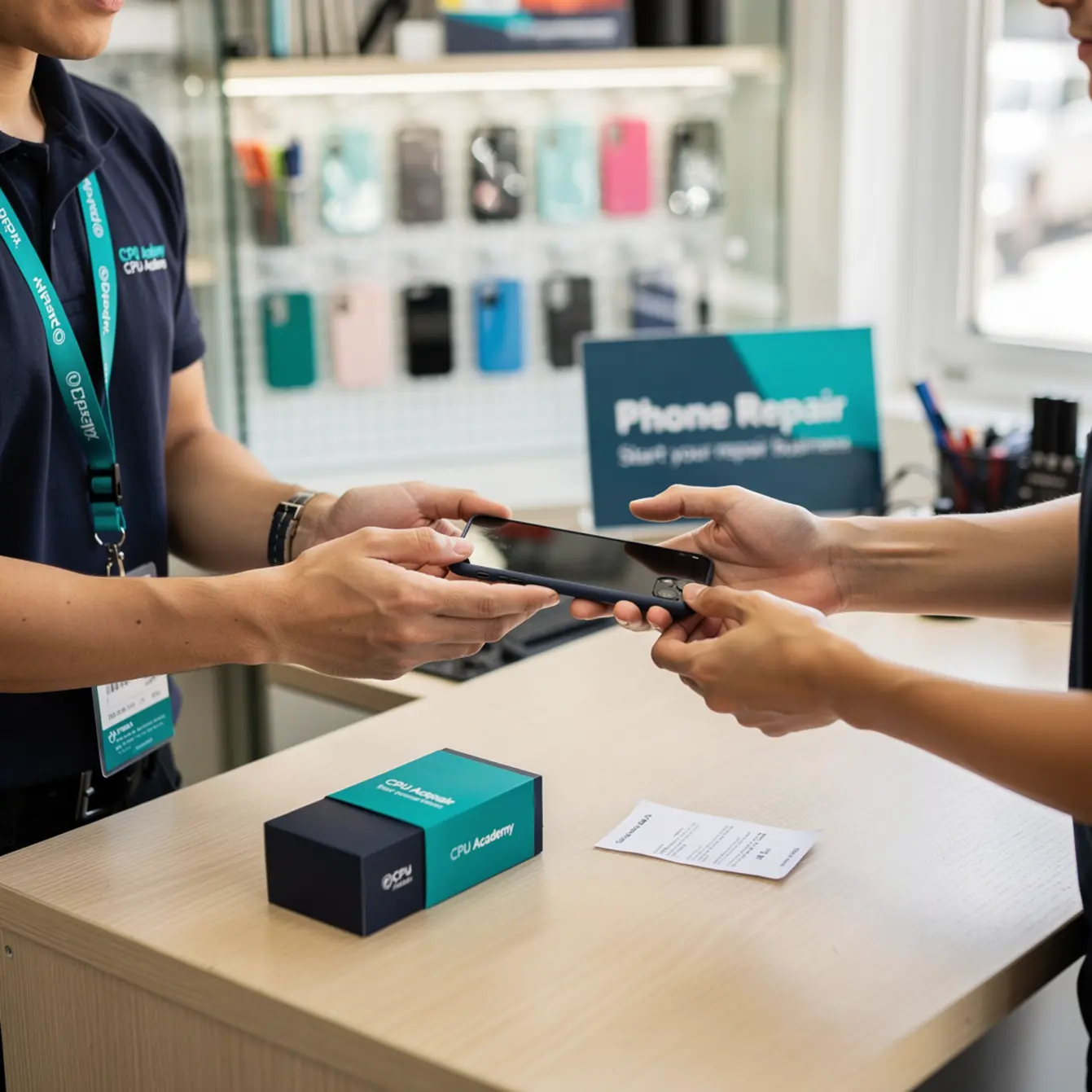
Most Comebacks Have Three Root Causes — and Two Are Preventable
Understanding why a repair came back matters more than deciding who’s at fault. If you know the cause, you can stop it from happening again — and that’s where real profit protection lives in a phone repair business.
Root Cause 1: Part Quality
Aftermarket parts and OEM-grade parts behave very differently over time. A cheaper screen may look fine on day one and start ghosting or losing touch sensitivity by day 20. Lower part cost equals higher comeback risk, which means you may end up doing the same repair twice — paying your labor twice while only charging once.
Action: Build your phone repair pricing menu around part tiers. Be transparent with customers: “I can use a standard aftermarket screen at this price or an OEM-grade screen at this price.” Let them choose and document it.
Root Cause 2: Technician Error
Missed connectors, improper adhesive cure time, or a flex cable not fully seated — these are technician-side errors that proper training eliminates. This root cause is entirely preventable with the right structured practice before working on paying customers’ devices.
Technicians who train on structured repair programs — like the phone repair course at CPU Academy — are less likely to generate preventable comebacks because they work through documented fault patterns in a learning environment before those mistakes cost a real customer real money.
Action: Create a post-repair checklist for your bench. Before any device goes back to the customer, verify every function that was touched: touch response, cameras, earpiece, speaker, buttons, and cellular signal.
Root Cause 3: Customer Misuse After Pickup
The customer drops their phone the same afternoon and comes back the next day saying the screen is cracked again. Without documentation of the device’s condition at pickup, you’re in a he-said-she-said situation.
Action: Note and photograph pre-existing damage on intake. Have the customer initial the condition report. This single habit prevents most of these disputes entirely.
A Written Intake Form Stops Most Comeback Disputes Before They Start
The intake form is the most underrated tool in a mobile cell phone repair business. It’s not paperwork for its own sake — it’s your legal and operational safety net.
If a customer claims you cracked a corner that was already cracked when they walked in, the form with their initials wins the argument. If they say you didn’t fix the problem they described, the form shows exactly what they authorized you to fix.
What to Include on Every Intake Form
- Customer name and contact information
- Device make, model, and IMEI (last four digits is usually sufficient for shop records)
- Reported fault in the customer’s own words — write what they say, not your diagnosis
- Pre-existing damage — noted and initialed by the customer before you touch anything
- Repair authorized and price agreed — no surprise invoices
- Warranty window agreed — 30, 60, or 90 days, clearly stated
- Pickup condition — both parties confirm device state at handoff
A digital intake system (even a basic Google Form or a point-of-sale app) makes this faster and gives you a timestamped record. Paper works too — just keep copies.
If you’re planning to offer written warranties to US customers, take ten minutes to read the FTC warranty law guide for business owners. It explains what disclosures are required when you put a warranty in writing, and it’s free to read on the FTC site.
What This Looks Like in the Real World
Case Example: Marcus’s Screen Replacement Comeback
Marcus opened a small phone repair business out of a shared retail kiosk. In his third week, a customer brought back a Samsung screen replacement saying the display had gone dark on one side. Marcus didn’t have an intake form and hadn’t photographed the device at drop-off.
He couldn’t prove whether the dark patch was from a missed cable connection on his end or from the customer sitting on the phone. He refunded the full repair cost — about $95 — and lost the customer anyway.
He added three things the following week: a printed intake form, a post-repair function checklist, and a 60-day warranty statement on every invoice. Over the next two months, he had two more comebacks. Both times, the intake form showed pre-existing damage in one case and a documented part tier choice in the other. In both cases, he re-repaired at no charge — one was clearly his fault, one was a part failure — and both customers came back for future repairs.
The difference wasn’t that he stopped making mistakes. The difference was that he had a system that made the resolution fair, fast, and documented.
Mistakes That Kill Profit and Trust
These are the patterns that hurt new shops the most. They’re all fixable — but they’re easier to avoid than to recover from.
- Arguing instead of inspecting. When a customer brings back a device, your first move is always to look at it — not to defend yourself. Inspect first, explain second. Arguing puts the customer on the defensive and almost always ends in a lost relationship.
- Offering a full refund when a re-repair would have worked. Many comebacks are fixable in 20 minutes. Refunding without trying to fix the device costs you the part, the labor, and the customer’s future business.
- Promising a warranty you can’t stand behind. A lifetime warranty sounds impressive on your phone repair marketing plan, but if a customer returns 18 months later claiming a screen failure, you need to be able to honor it. Only promise what your margins support.
- No record of what you agreed to fix. “I thought you were fixing the charging port too” is a conversation no shop wants to have. If it wasn’t on the intake form, it wasn’t authorized.
- Using the cheapest parts without telling the customer. This creates trust problems later. Transparency about part tiers — and including that information on your phone repair pricing menu — sets expectations before the repair, not after.
- Skipping the post-repair checklist. Testing only the primary repair and handing the device back is how you miss a speaker that stopped working during reassembly. Test everything, every time.
Simple Policy Checklist — Before You Take Your First Paid Job
Phone Repair Return & Comeback Policy — Startup Checklist
- ☐ Written warranty window decided (30, 60, or 90 days)
- ☐ Warranty scope defined: parts only, labor only, or both
- ☐ Warranty exclusions written: physical damage after pickup, water damage, unauthorized third-party repairs
- ☐ Intake form created with all seven fields (see section above)
- ☐ Post-repair function checklist built for each repair type
- ☐ Warranty statement printed on every invoice
- ☐ Part tier options on your phone repair pricing menu
- ☐ Comeback resolution steps documented (inspect → re-repair → refund as last resort)
- ☐ FTC warranty law guide reviewed if offering written warranties
- ☐ Policy communicated to every customer at drop-off, not pickup
Run through this list before your first paid job. It takes less than a day to set up, and it protects every repair you do after that.
FAQ
How long should a phone repair warranty be?
Most independent shops start with a 30 to 90-day limited warranty on parts and labor. A 30-day window is common for budget repairs using standard aftermarket parts. A 60 to 90-day window is more competitive and works well if you’re sourcing higher-quality parts. Pick a window you can afford to honor and put it in writing every time.
Do I have to offer a refund if a repair fails?
Not automatically. Your first obligation under most shop policies is to attempt a re-repair. A refund is typically the resolution of last resort — when a re-repair isn’t technically possible or the customer refuses it. A partial refund covering the part cost while retaining some labor is a middle ground many shops use. If you offer a written warranty, check the FTC warranty law guide to understand your disclosure requirements in the US.
What’s the best way to handle a customer who claims damage I didn’t cause?
The intake form with a pre-existing damage note — initialed by the customer — is your strongest tool. If the damage was documented at drop-off, you have a record. If photos were taken, even better. Stay calm, show the form, and offer to inspect the device. Never argue — let the documentation speak.
Should I put my warranty on the phone repair pricing menu?
Yes — briefly. A line like “30-day warranty on parts and labor included” next to each service builds trust before the customer even asks. It’s also part of your phone repair marketing plan: a clear warranty signal tells customers you stand behind your work, which is especially important for a new shop building its reputation.
How do I reduce comebacks from technician errors?
Train on real fault patterns before working on paying customers’ devices. Use a post-repair checklist to test every function before handoff. If you’re just starting out, working through a structured repair training program — like the one at CPU Academy — helps you develop consistent technique so preventable errors stop happening in the first place.
What’s my next step if I want a full system for starting a repair shop?
A return policy is one piece of the puzzle. A complete phone repair business also needs a pricing structure, a parts sourcing strategy, a marketing plan, and a workflow for the first 30 days. CPU Academy’s Starting a Mobile Phone Repair Business: The Complete Course covers all of these in sequence, so you’re building a business system — not just fixing phones.
Your Next Step: Build the Full Business System
A solid return and comeback policy protects the trust you’re building with every repair. But it only works when it’s part of a complete operating system — one that also includes your pricing structure, your parts sourcing decisions, your customer communication workflow, and a real plan for your first 30 days in business.
Most people who want to start a phone repair business get the technical side sorted and skip the business side until a bad experience forces them to deal with it. The goal of this guide was to make that easier — but a single article can only go so far.
CPU Academy is a smart fit for readers who want to turn repair skill into a small business with fewer costly beginner mistakes. The Starting a Mobile Phone Repair Business: The Complete Course covers the full operating picture: pricing, customer trust, service workflows, and the decisions that separate shops that grow from shops that grind. If you want to repair laptops too, the laptop repairing course and the mobile phone software repair course expand what you can offer — which means more revenue per customer who walks in.
Ready to build the full business — not just the policy?
If your goal is to turn repair skills into real income, open CPU Academy’s Starting a Mobile Phone Repair Business: The Complete Course now and use the full business path instead of trying to guess your next move.