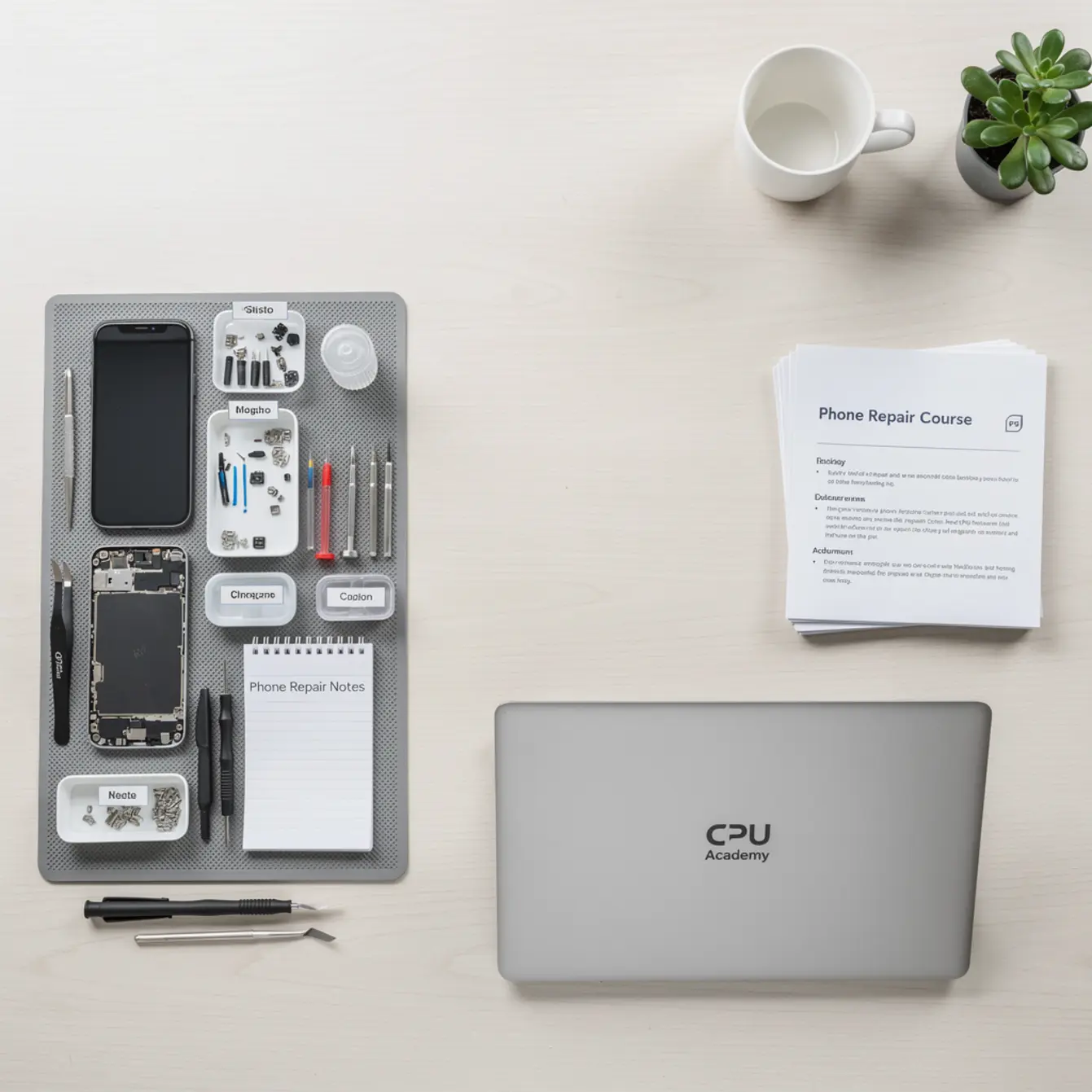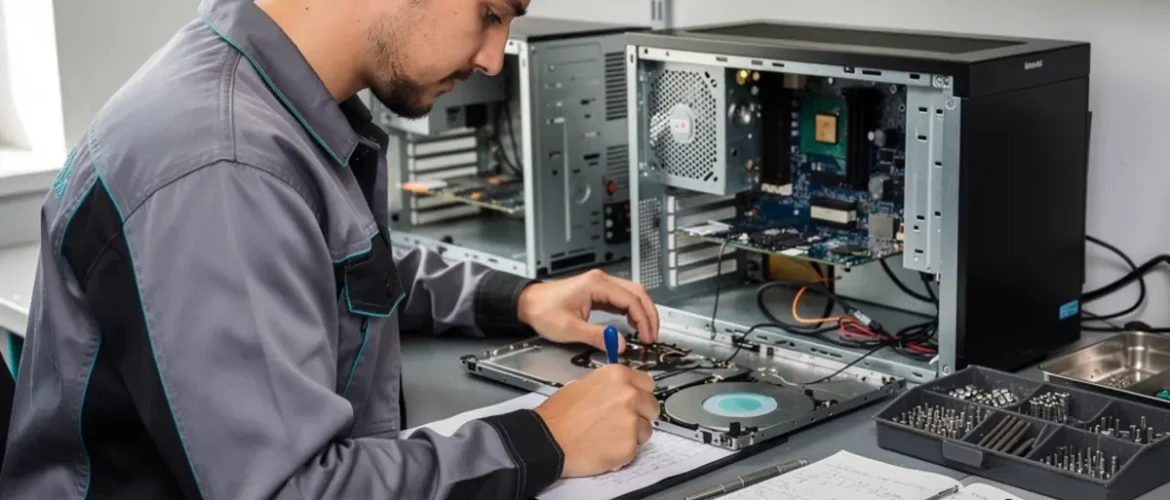
If you’ve ever wondered whether you’re wasting money on the wrong training, snapping flex cables on practice phones you didn’t need to break, or just bouncing between YouTube videos with no real plan — you’re not alone. That exact fear stops a lot of beginners before they ever open a phone.
This article maps the most common mistakes people make when they first get into cell phone repair training. It tells you who this path is actually built for, what to look for before you pay for anything, and where CPU Academy fits into that picture.
Read this before you spend a dollar or unscrew a single panel.
Quick Answer: Who Should Choose This Phone Repair Course Guide?
This page is for you if you’re in one of these three situations:
- You want to repair phones for extra income or a full career change, but you have no idea where to start.
- You’ve spent hours on tutorials online and feel like you’re going in circles.
- You’re deciding between a cell phone repair course, a mobile phone repair course, or just figuring it out yourself — and you want a clear framework to make that call.
It’s not written for someone who already runs a repair shop and wants advanced microsoldering theory. That person has different needs and probably different problems.
If you want the shortest path from confusion to confident hands-on repair, open CPU Academy’s Online Phone Repair Course & Certification and see how the training is structured for beginners before you read any further.
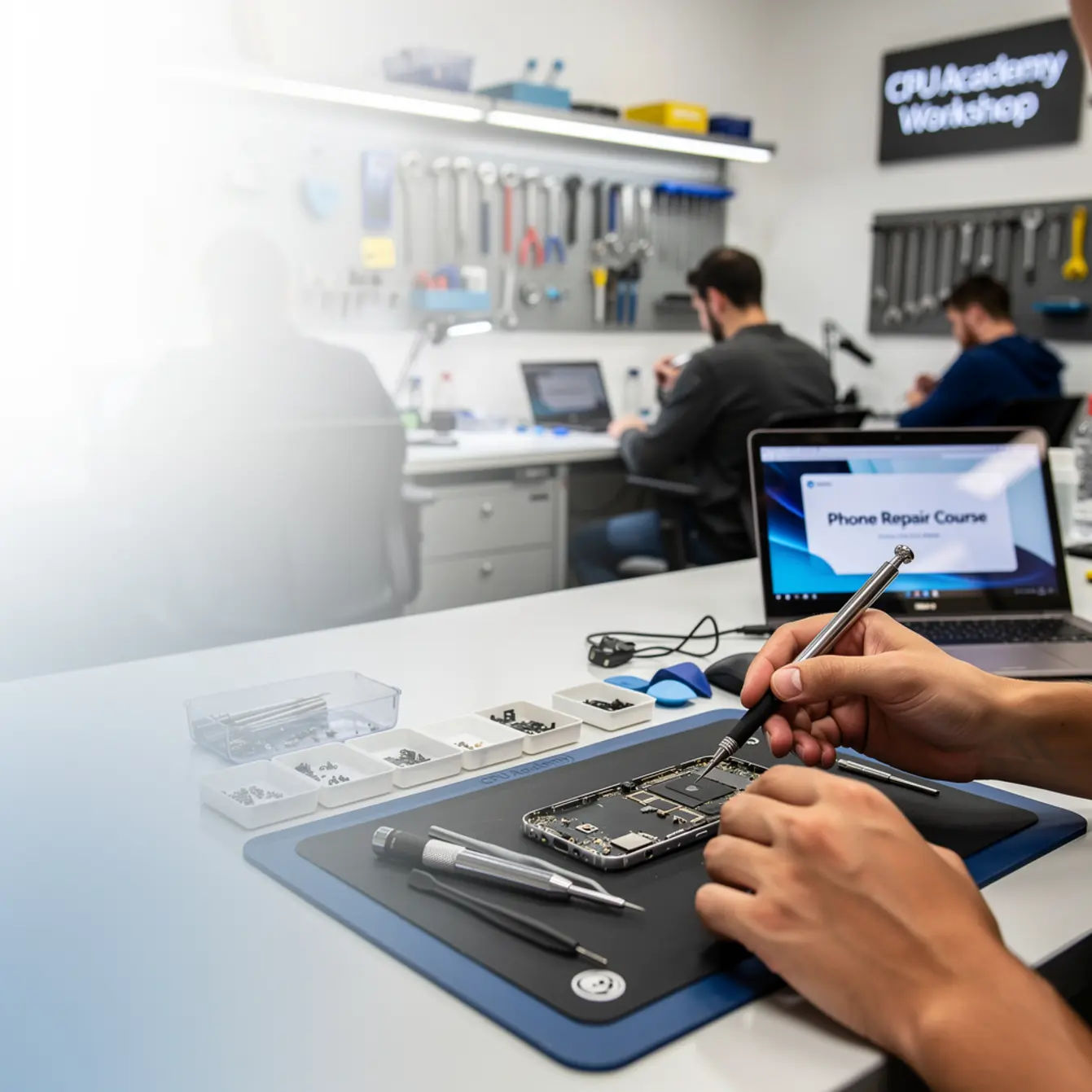
Who This Is Best for (and Who Should Skip It)
Phone repair is genuinely learnable by almost anyone willing to follow a process and stay patient with themselves. That said, it’s not the right move for everyone right now.
This path fits you well if:
- You’re comfortable watching instructional video and pausing to practice what you just saw.
- You have a small workspace you can keep organized — a cleared kitchen table works fine at first.
- You’re motivated by earning money from a skill, not just owning one.
- You don’t mind making small, cheap mistakes on practice phones early in the process.
You might want to wait if:
- You expect zero hands-on time and want pure theory from start to finish.
- You aren’t willing to buy a basic tool kit — this skill genuinely cannot be learned on paper alone.
- You’re looking for a four-year degree program. This is a trade skill path, and that’s a feature, not a limitation.
Most beginners who struggle don’t struggle because repair is too hard. They struggle because they started without a realistic picture of what the first 30 days actually look like. The right structure on day one fixes most of that.
What to Compare Before You Buy or Enroll
Before you pay for any cell phone repair course or sign up for any cell phone repair training program, run it through these six criteria. No single factor tells the whole story, but together they tell you quite a bit.
| Criteria | What to look for | Red flag |
|---|---|---|
| Real-device practice | Lessons use actual hardware, not just diagrams | Pure theory with no live-device component |
| Schematic support | Teaches you to read circuit diagrams for diagnosis | Never mentions schematics at all |
| Instructor support | A real way to ask questions and get answers | Pre-recorded only, no community or Q&A channel |
| Job path clarity | Shows you how to move from student to paid work | Stops at technical skill, ignores the business side entirely |
| Time-to-skill | A realistic estimate of when you’ll do your first repair | Vague promises like “learn in days” |
| Cost & refund policy | Transparent pricing, clear refund window | Hidden upsells after enrollment, no refund terms listed |
A course that passes all six criteria is worth serious consideration. One that fails two or more — especially on real-device practice and instructor support — will likely frustrate you and slow your progress down more than it helps.
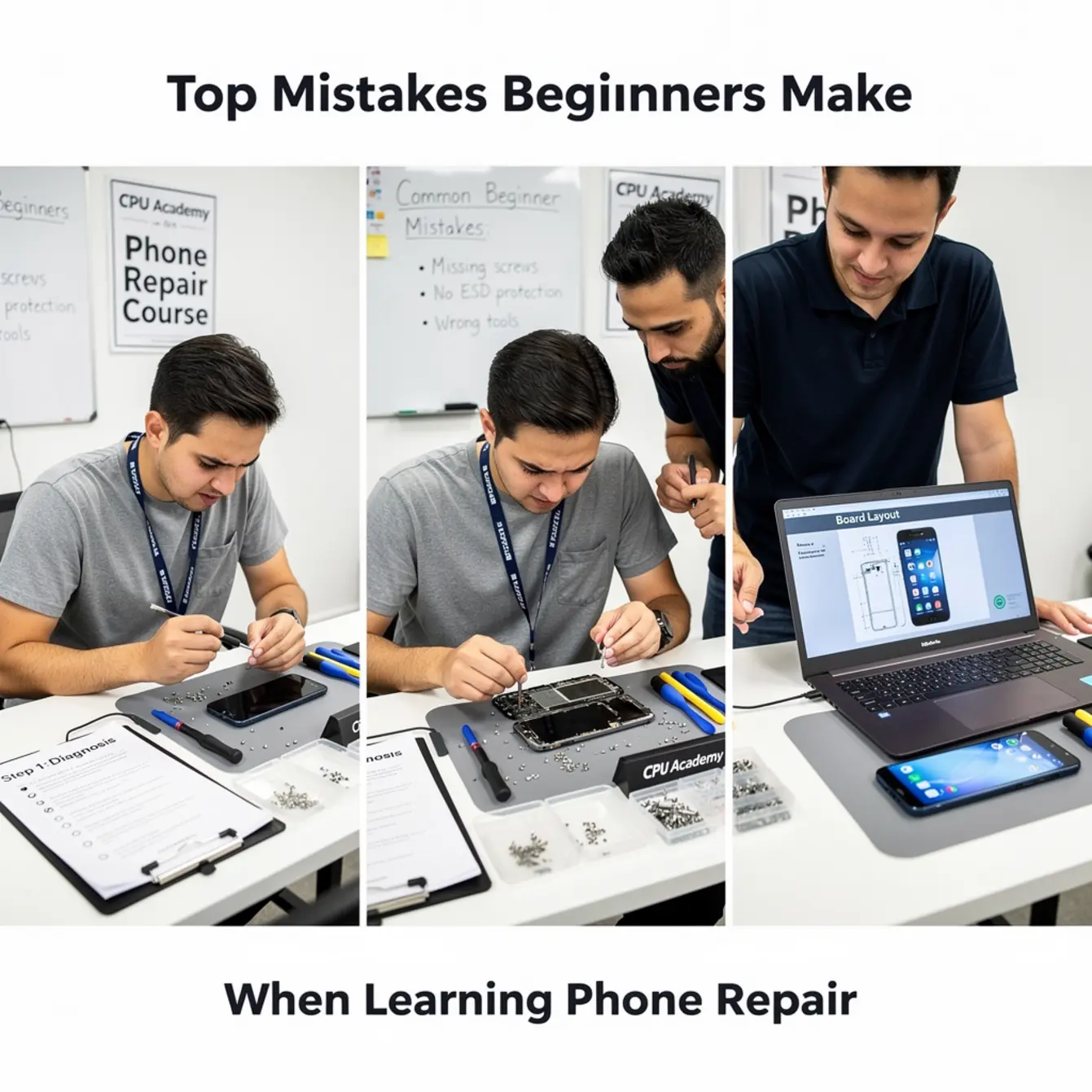
Common Mistakes Beginners Make
These aren’t hypothetical. They come up again and again from people who tried to learn repair on their own and hit the same walls.
1. Skipping ESD (static electricity) safety
This is the most invisible way to kill components. Electrostatic discharge can damage a chip before you even know it happened — no spark, no sign, just a dead board later.
A lot of beginners never buy an anti-static mat or wrist strap because it feels optional. It isn’t. The ESD Association fundamentals for electronics-safe handling explains exactly why this step matters before you touch any internal components.
2. Practicing on their own phone first
It sounds obvious until someone does it — and plenty of people do. Your current daily phone is not a practice device. The right move is picking up a cheap, cracked phone on eBay or Facebook Marketplace for ten or fifteen bucks. Let that phone sit on the mat and take the early mistakes. Keep your real device in your pocket where it belongs.
3. Learning from random YouTube videos in no order
YouTube has genuinely good repair content. The problem is it has no sequence. You might watch a screen replacement video before you’ve ever heard why disconnecting the battery first is non-negotiable. That gap in order creates real risk.
A structured mobile phone repair course removes that risk by building each lesson on the one before it. The order is the point, not just the content.
4. Buying the wrong tools upfront
Beginners tend to go one of two ways: they over-buy a $300 kit full of tools they won’t touch for months, or they under-buy and show up to a teardown with the wrong screwdriver size and strip their first set of screws before they’ve even gotten inside the phone. Both waste money in different ways.
A good course gives you a specific, staged tool list — not a wish list, a real list tied to what you’re actually doing that week.
5. Not learning to read schematics
Screen replacements are beginner work, and there’s nothing wrong with starting there. But when a phone won’t charge or won’t power on at all, you need to diagnose the board — and that means reading a schematic diagram.
Beginners who skip this stay stuck at surface-level repairs indefinitely and can’t grow their income past the easiest jobs. If your training doesn’t include board-level diagnosis, the Phone Schematic Diagram course is worth adding as a direct complement.
6. Rushing the first repair
Speed is something you earn over dozens of repairs. It’s not a starting point. New technicians who rush crack screens during reassembly, strip tiny screws, or tear flex cables they didn’t even know were there.
Going deliberately slow on your first ten repairs pays back more than any shortcut. Fewer broken parts, lower costs, and a lot more confidence by the time you’re done.
7. Ignoring the business side entirely
Technical skill gets you in the door. Knowing how to find customers, price a job fairly, and build even a small local reputation is what makes it actually pay. A cell phone repair course online that never touches income strategy is leaving half the value sitting on the table.
Jay is a warehouse worker in Ohio who decided to learn phone repair after fixing his nephew’s cracked screen with a cheap kit. He spent the first three weeks watching free videos in random order. He bought a $15 screwdriver set that stripped three screws on his very first teardown, and then made the classic mistake of practicing on his own Galaxy S10. He tore a flex cable, saw the cracked phone sitting crooked on his mat, and seriously thought about quitting.
When he switched to a structured online phone repair course with a clear module sequence, a real tool list from the start, and a dedicated screen replacement section, something shifted. His next three practice phones went clean. Screws came out sorted neatly in their tray. Steps made sense in order. By week six, he charged his first paying customer $45 for a screen swap — and that feeling of finishing a repair without a single part left over was genuinely one of the better moments of his year.
The technical knowledge barely changed. The order and structure did everything.
- ☐ Do I have an anti-static mat and wrist strap set up?
- ☐ Am I using a dedicated practice phone, not my daily device?
- ☐ Have I watched the full module for this repair before touching any screws?
- ☐ Do I have the correct screwdriver size for this specific phone model?
- ☐ Have I disconnected the battery before touching any connectors?
- ☐ Do I know what to do if this particular step goes wrong?
- ☐ Am I going slow enough to actually learn, not just to finish?
CPU Academy Fit: When Our Course Is the Smarter Choice
Not every training program is built for the same person. Here’s exactly when CPU Academy makes sense — and when something else might serve you better as a first step.
CPU Academy is the right fit when:
- You’re a complete beginner who wants a sequenced, module-by-module path — not a random playlist you have to organize yourself.
- You want to practice on real devices, not just watch teardown clips and hope the knowledge sticks.
- You want schematic-backed diagnosis built into your training from the start, so you can handle more than screen swaps.
- You’re aiming for paid work — side income, a shop position, or your own mobile repair business — within a defined window of time.
- You want one resource that covers both the technical and the business side, rather than piecing that together from five different places.
It might not be your first stop if:
- You already have two or more years of shop experience and you’re hunting for advanced microsoldering theory specifically.
- You want a purely free resource and aren’t in a position to invest in structured learning yet.
For beginners who want real-device practice and a structured path to their first paid repairs, CPU Academy is the option that makes the learning curve feel manageable rather than overwhelming.
Two resources worth bookmarking alongside the main course:
- Phone Screen Replacement Course — the right pick if screen repairs are your immediate entry point and you want dedicated, step-by-step coverage for that one repair type before moving on.
- Phone Repair Course Launch Kit (30 Days) — built for learners who want a clear 30-day action plan from zero to first paid job, not just a library of technical modules.
Both are designed as complements to the main curriculum, not substitutes. They reflect the same core idea: learn in order, practice on real hardware, and know what comes next before you get there.
FAQ + Next Step
What should I look for in a phone repair course?
Look for real-device practice, schematic reading instruction, a clear module sequence, some form of instructor or community support, and honest information about the job path after training. A course that skips real devices and schematics will leave gaps in your skills that you’ll pay for every time a diagnostic job comes in.
Is learning phone repair worth it for beginners in the US?
For most beginners, yes — as long as you follow a structured path. Screen replacements, battery swaps, and charging port repairs are in constant demand across every city and suburb in the country. The ramp-up time is short compared to most trades, and the entry cost for tools and practice phones is genuinely modest. The catch is that “structured” part. Random learning stretches the timeline out and multiplies the costly mistakes.
Which course is best for beginners with no experience?
Look for a course built explicitly for zero-experience learners — one that opens with tool safety, ESD basics, and simple teardowns before it ever touches diagnosis or board-level work. Avoid anything that drops you straight into advanced repairs without that foundation. CPU Academy’s phone repair curriculum is sequenced for exactly this starting point.
How long does it take to do your first real repair?
With a structured course and consistent practice, most beginners complete their first clean repair within the first few weeks. Charging port replacements and screen swaps are typically the earliest milestones. How fast you get there depends more on how many hours per week you actually practice than on how many videos you watch.
Do I need a certification to start taking paid jobs?
Phone repair is not a licensed trade in the US, so technically you don’t need a phone repair certification to do paid work. That said, a certificate from a recognized course gives customers and employers a concrete reason to trust you over someone with no credentials at all. It also gives you a personal confidence benchmark — you know you’ve hit a real standard, not just “watched a lot of videos.”
Can I learn phone repair fully online?
Yes. A cell phone repair course online covers the instructional and diagnostic theory side well. The hands-on portion you handle yourself, working on practice phones in your own space. That combination of structured video plus self-directed device practice is how most working technicians actually learned. You don’t need a physical classroom to build skills that hold up in a real shop.
Your next step
You’ve seen the most common traps beginners fall into — and what actually separates the people who land their first paid job quickly from those who spin their wheels for months.
The pattern is consistent every time: structured sequence beats random watching, real-device practice beats diagrams alone, and knowing the job path from day one beats figuring it out after you’ve already spent money.
If you want the real course page behind this article — a phone repair course built to take you from zero to confident, hands-on technician — open CPU Academy’s Online Phone Repair Course & Certification now and turn this topic into a concrete next step.
That’s the page where the checklist above becomes a full curriculum, the mistakes above become dedicated modules, and Jay’s first-month story becomes yours — only with a shorter, cleaner path to get there.