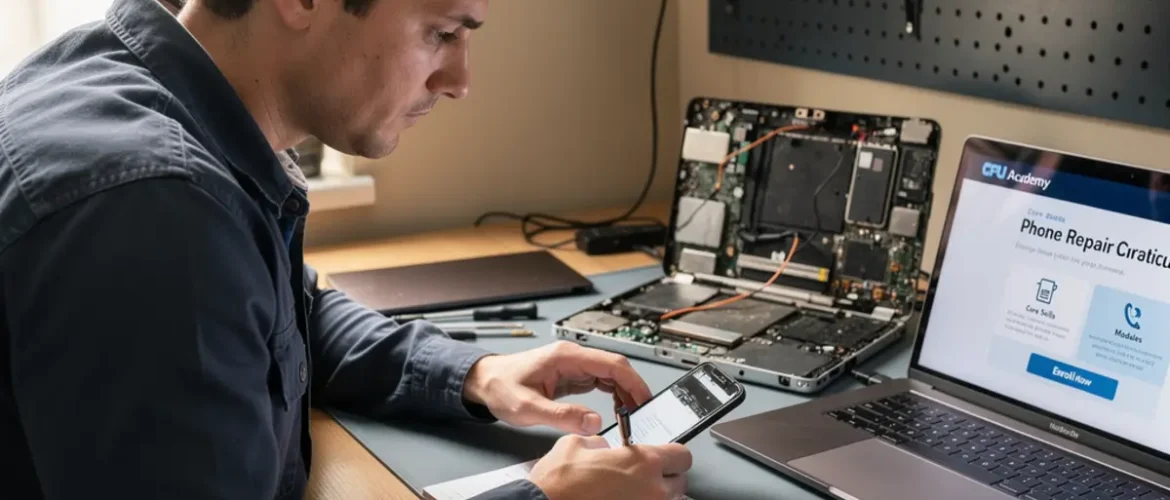
You want income and independence — not another 9-to-5. A phone repair business can give you both, but only if you pick the right model from the start. Choose the wrong one and you’re either drowning in rent or stuck driving circles around a town that doesn’t know you exist.
This guide is built for people in the comparison stage — you know repair is the goal, but you’re not sure whether a mobile cell phone repair business or a brick-and-mortar shop makes more sense for your situation. We’ll use real cost ranges, honest trade-offs, and a simple decision framework to get you off the fence.
If your goal is income, not just theory, open CPU Academy’s Starting a Mobile Phone Repair Business: The Complete Course to see the business training, templates, and next practical step.

Quick answer: cost, margin, and which model to choose when you start a phone repair business
The two models have fundamentally different financial shapes. A mobile operation trades low startup cost for limited daily capacity. A storefront trades higher fixed cost for higher volume and better walk-in visibility.
Here’s a side-by-side view of what each model typically involves:
| Factor | Mobile Van | Storefront |
|---|---|---|
| Typical startup cost | $5,000–$15,000 | $20,000–$50,000+ |
| Monthly fixed overhead | Low (fuel, insurance, tools) | High (rent, utilities, signage) |
| Daily job capacity | 3–8 jobs (solo operator) | 8–20+ jobs (with staff) |
| Gross margin potential | High per job (low overhead) | High volume (more revenue ceiling) |
| Customer trust signals | Moderate — requires strong reviews | Strong — physical presence helps |
| Speed to first paid job | Days to weeks | Weeks to months |
| Scalability | Limited without adding drivers | Easier to add staff and revenue |
| Best for | Tight budget, solo start, side income | Growth focus, brand building, investors |
| Not ideal for | People wanting walk-in volume | Bootstrappers with under $15,000 |
Most beginners get this wrong: They see the storefront as “more legit” and overcommit to rent before they have a single customer. The mobile model lets you prove the market, build your reviews, and create cash flow — then upgrade to a location if the numbers support it.
If you want the option built for practical, real-device learning rather than scattered theory, start here: Starting a Mobile Phone Repair Business: The Complete Course.

What this looks like in the real world
Startup costs broken down honestly
A mobile setup typically needs a reliable vehicle, a basic tool kit, a parts inventory for common repairs (screens, batteries, charging ports), and a booking system. You can often run from a cargo van, SUV, or even a personal car at first.
A storefront adds lease deposits, build-out costs, signage, point-of-sale hardware, and a waiting area. Even a modest strip-mall location in a mid-size US city will eat $1,500–$3,000 per month in rent before you fix a single phone.
Gross margin vs. net margin — know the difference
Gross margin is the profit after parts cost. On a screen replacement that bills at $80 with a $20 OEM-quality part, your gross margin is $60 — roughly 75%. That sounds great until you subtract fuel, insurance, your time driving, and any advertising you paid for.
Net margin is what’s left after every expense. Mobile operators often see strong gross margins but narrower nets because each job requires travel time. Storefronts have heavier fixed costs but can stack jobs efficiently during peak hours.
Parts sourcing and your phone repair pricing menu
Your parts costs directly control profitability. Buying in bulk from reputable wholesale suppliers lowers per-unit cost. Your phone repair pricing menu should reflect the true cost of parts, your labor time, and a fair profit margin — not just what you see competitors charging on Google.
A common mistake is pricing too low to “compete,” then discovering you’re making $12 an hour after expenses. Price for profit from day one.
Customer trust and the mobile challenge
Walking up to a stranger’s home or office to fix their phone requires real trust. A well-branded van, a clean uniform, a professional invoice, and strong online reviews go a long way. Without those signals, customers will hesitate — even if your repair skills are excellent.
Storefronts get walk-in trust by default. But you still need a solid phone repair marketing plan to fill that shop with customers, especially in your first 90 days.
Step-by-step action plan
Your first 30 days — whether mobile or storefront
The path forward is similar for both models in the beginning. The difference is in what you spend and where customers find you.
- Choose your model based on your budget and lifestyle. Under $10,000 to start? Go mobile. Have capital and want a brand anchor? Plan for a storefront, but start marketing before you sign a lease.
- Build a basic cell phone repair business plan. One page is fine. Include your target market, startup costs, pricing, and a 90-day revenue goal. The SBA market research and competitive analysis guide is a solid free resource for understanding your local competition.
- Set your phone repair pricing menu. List every service you’ll offer with parts cost, labor time, and your final price. Don’t copy competitors blindly — know your numbers first.
- Source your first parts inventory. Start lean — focus on the top 5–10 most common repairs in your area (iPhone and Samsung screen replacements, battery swaps, charging port fixes).
- Create a simple booking system. Even a Google Form or a free scheduling tool works at first. Make it easy for customers to find and contact you.
- Build your phone repair marketing plan. At minimum: a Google Business Profile, a Facebook page, and a NextDoor post. Reviews matter more than paid ads in the early stage.
- Do your first 10 jobs and document everything. Track repair time, parts cost, revenue, and customer feedback. This data tells you whether your pricing and model are working.
Simple SOP for first repairs
Before you meet any customer, have a basic standard operating procedure: confirm the device model and fault before arrival, bring the right parts, get a signed repair authorization, complete the job, test before handing back, and issue a receipt. This protects you legally and builds customer confidence fast.
Mistakes that kill profit or trust
These are the most common beginner errors — and almost all of them are avoidable with a little preparation.
- Underpricing from day one. Setting prices too low attracts price-shoppers and trains your market to expect bargains. Raise prices later and you’ll face pushback.
- Skipping a written repair authorization. Without a signed consent form, a customer can dispute a repair outcome with no paper trail. Use a simple form for every job.
- Buying too much inventory upfront. Parts for 40 different models sitting on a shelf is cash you can’t use. Start with your top 5 repairs and reorder as needed.
- Ignoring the phone repair marketing plan. Great repair skills don’t automatically attract customers. You need a consistent presence on Google, social media, and local community platforms.
- Signing a lease before validating demand. The biggest financial mistake for storefront hopefuls. Run the mobile model for 60–90 days first, then use real revenue to justify a fixed location.
- No tracking system. If you don’t know your monthly revenue, parts cost, and net profit, you can’t improve. Even a simple spreadsheet is better than guessing.
- Confusing gross and net margin. A 70% gross margin can still leave you broke if overhead is high. Know your real take-home per job, not just the markup on parts.
Simple template, checklist, and numbers table
Launch-ready checklist for either model
- ☐ Business entity registered (LLC or sole proprietor — check your state)
- ☐ Business bank account open
- ☐ Basic tool kit ready (opening tools, spudgers, suction cups, heat gun, soldering iron)
- ☐ Parts inventory for top 5 most common repairs
- ☐ Repair authorization form drafted
- ☐ Phone repair pricing menu finalized with cost + margin visible to you
- ☐ Google Business Profile created and verified
- ☐ Booking method in place (phone, form, or app)
- ☐ Liability and business insurance checked
- ☐ Simple revenue tracking spreadsheet ready
- ☐ First 10 potential customers identified (friends, family, social groups)
Simple revenue projection template
| Scenario | Jobs/Day | Avg Revenue/Job | Monthly Gross (22 days) | Est. Monthly Overhead | Est. Net |
|---|---|---|---|---|---|
| Mobile — early stage | 3 | $65 | ~$4,290 | ~$800–$1,200 | ~$3,000–$3,500 |
| Mobile — established | 6 | $75 | ~$9,900 | ~$1,500–$2,000 | ~$7,900–$8,400 |
| Storefront — early stage | 6 | $75 | ~$9,900 | ~$3,500–$5,000 | ~$4,900–$6,400 |
| Storefront — with staff | 15+ | $80 | ~$26,400+ | ~$8,000–$12,000 | ~$14,000–$18,000 |
These figures are illustrative ranges only. Your actual results depend on your market, pricing, parts cost, and overhead. Use them as a planning baseline, not a guarantee.
- Tight startup budget
- Solo operators wanting fast income
- Testing a market before committing to rent
- People with scheduling flexibility
- Side-income alongside a day job
- High walk-in volume goals
- Building a recognizable local brand fast
- Multi-technician operations
- Complex repairs needing a full bench setup
- Operators with $20,000+ available
- High-traffic retail or strip-mall locations
- Long-term brand building
- Adding accessories or device sales
- Bootstrappers with under $15,000
- People still building repair skill
- Markets where demand is unproven
Where CPU Academy fits into this decision:
CPU Academy is a smart fit for readers who want to turn repair skill into a small business with fewer costly beginner mistakes. If you’re building a cell phone repair business plan and need practical training on both the technical and business side, the Starting a Mobile Phone Repair Business: The Complete Course is designed for exactly that use case — not scattered YouTube theory, but a structured path from zero to first paid jobs.
Want to sharpen the technical side alongside the business skills? The Phone Repair Course covers hands-on device repair at a practical level. And if you plan to expand into laptop work, the Laptop Repairing Course gives you a second service line that raises your average ticket value.
FAQ + next step
Which is better for beginners — mobile or storefront?
Mobile is generally better for beginners. It requires less capital, lets you build skills and reviews at low risk, and gets you to your first paid job much faster. You can always open a storefront once your income and local reputation support it.
What is the real difference between the two models?
The core difference is fixed cost vs. flexibility. A storefront has higher fixed monthly costs but enables more volume and passive walk-in traffic. A mobile setup keeps overhead low but limits daily job capacity and requires active marketing to find every customer.
How much does it cost to start a mobile cell phone repair business?
A basic mobile setup commonly ranges from $5,000 to $15,000, depending on your vehicle situation, tool needs, and starting parts inventory. If you already own a vehicle, your cash outlay can be significantly lower.
Do I need a business plan before I start?
Yes — but it doesn’t need to be long. A one-page cell phone repair business plan covering your target customer, startup costs, pricing, and a 90-day revenue goal is enough to get started and make smarter decisions.
What should I include in a phone repair pricing menu?
List every service you offer — screen replacements, battery swaps, charging ports, camera repairs, water damage assessments — with a customer-facing price for each. Internally, track your parts cost and labor time per repair so you always know your actual margin.
Which model gives better long-term ROI?
Neither model is universally better for ROI. Mobile returns investment faster due to lower startup cost. Storefronts have a higher revenue ceiling if the location is strong and overhead is managed. Many successful operators start mobile and transition to a storefront when the numbers justify it.