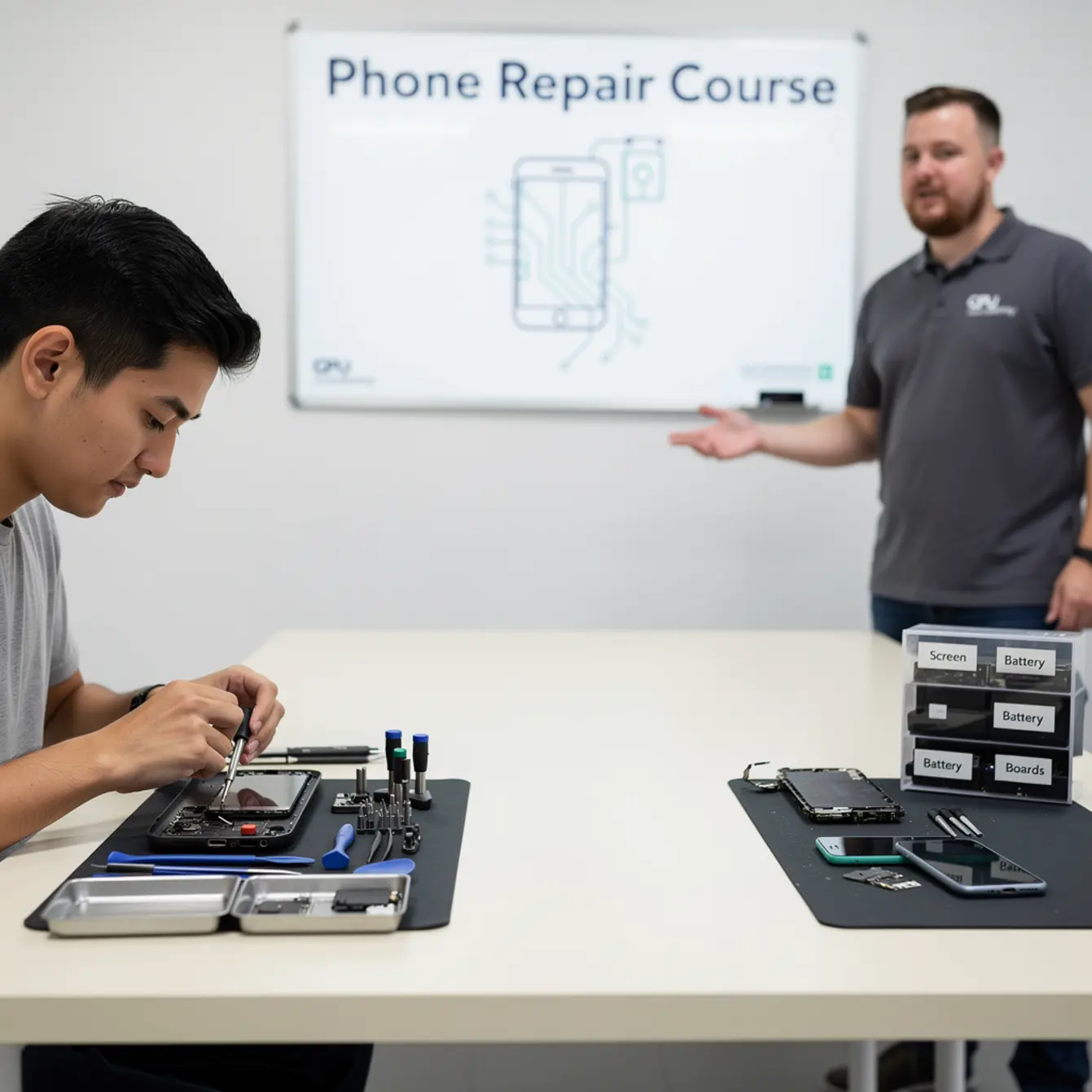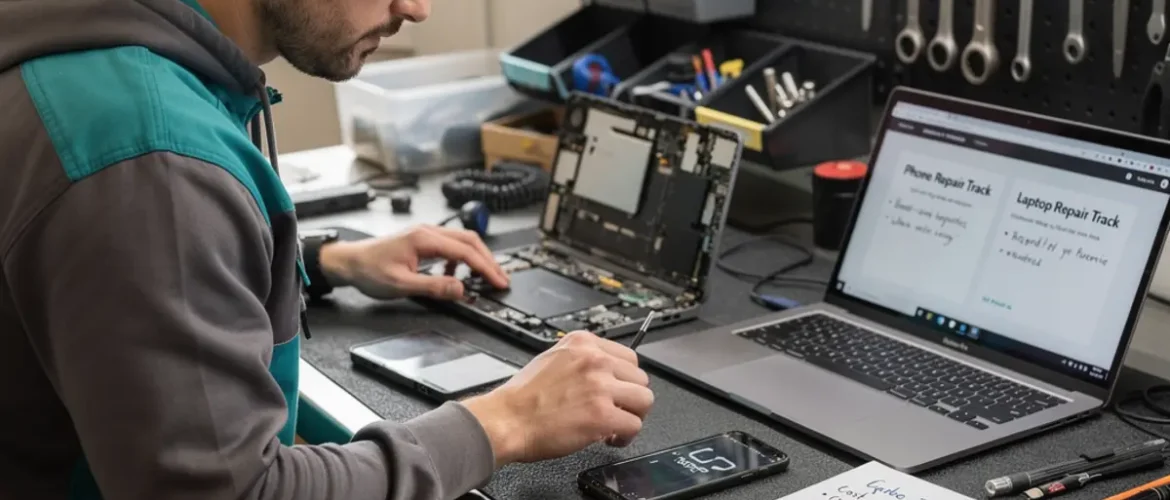
Quick verdict: A focused phone repair course typically runs 6 to 8 weeks when it’s built around hands-on labs and the repair types that actually come through the door. Broader programs that layer in diagnostics, schematics, and business skills stretch to 3 months. If you want to take paid repair jobs as fast as possible, the 6-to-8-week track usually wins. If you want a fuller foundation before going independent, 3 months gives you room to make mistakes safely and come out the other side with real confidence.
By CPU Academy Editorial Team | Updated 2025
You’re probably here because scattered YouTube videos have gotten you nowhere, you’re not sure which training is worth paying for, or you’re worried you’ll crack a customer’s phone on day one. That fear is completely reasonable. Picking the wrong cell phone repair course costs you more than money — it costs you weeks of your life you won’t get back.
This article gives you a straight, honest look at the two most common program lengths: 6-8 weeks and 3 months. We’ll cover who each one actually suits, what to check before you spend anything, and where CPU Academy fits in. By the end, you’ll know exactly which path makes sense for your situation.

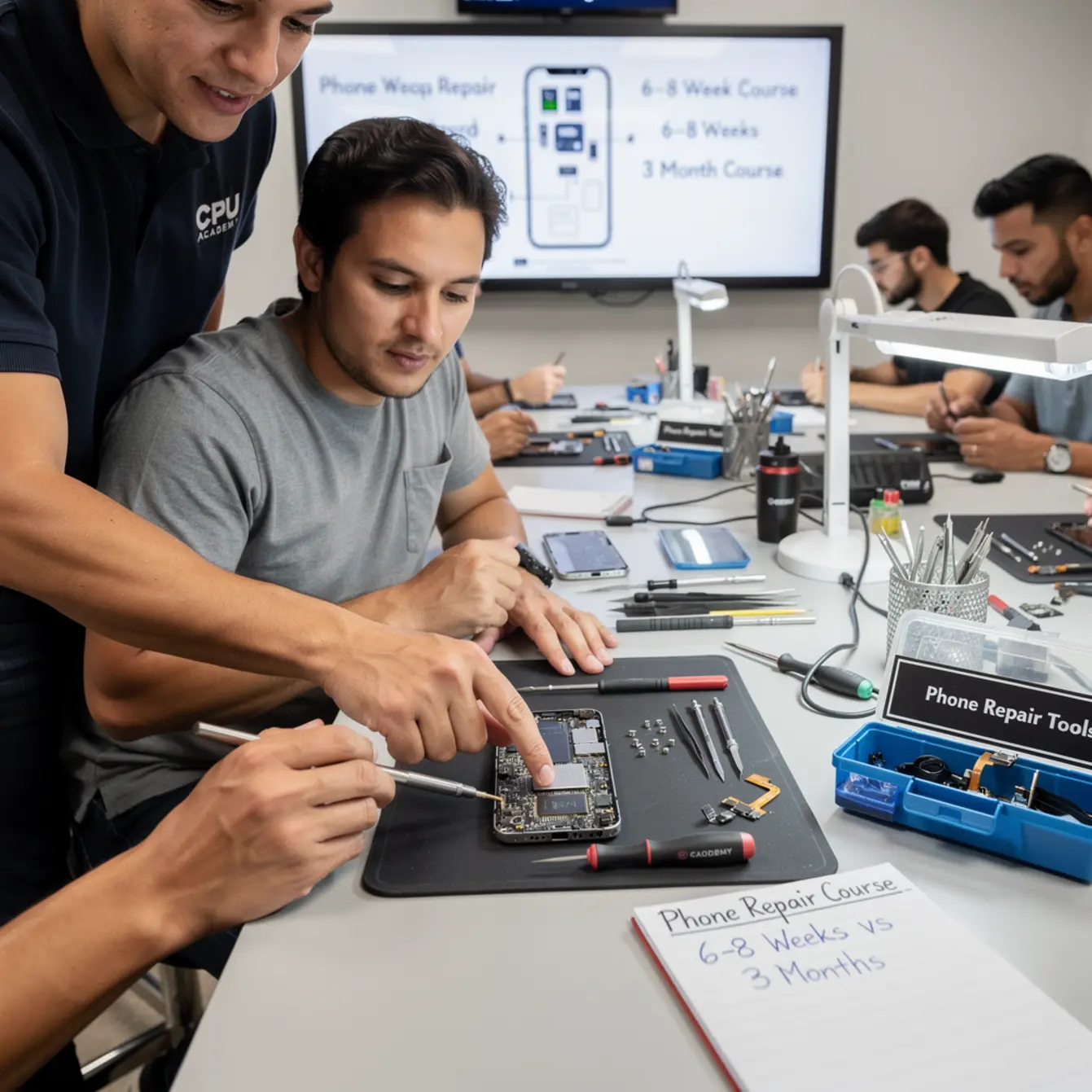
Quick Answer: How Long Does a Phone Repair Course Take? 6-8 Weeks vs 3 Months
Here’s the honest answer: it depends on what the program actually teaches, not just how long it runs. A well-structured 6-to-8-week cell phone repair training program can have you ready for your first paid screen replacement or battery swap — but only if the curriculum is focused and built around real practice, not just watching someone else work.
A 3-month mobile phone repair course usually adds schematic reading, board-level diagnosis, and sometimes a business-launch section. That depth matters if you plan to open your own shop or tackle complex motherboard repairs. It’s overkill, though, if your first goal is simply to start taking jobs.
The table below maps out the real differences so you can make a call before reading another word.
| Criteria | 6-8 Week Track | 3-Month Track |
|---|---|---|
| Time to first paid repair | Faster — often within weeks of finishing | Slightly longer — but with broader confidence |
| Repair depth covered | Screens, batteries, ports, cameras | Adds schematics, board-level diagnosis |
| Best fit | Side hustle starters, part-timers | Full-time shop owners, deep-skill seekers |
| Support structure | Varies — check before enrolling | Usually more instructor touchpoints |
| Real-device practice | Depends on program — verify this | More hours logged on actual devices |
| Certification path | Sometimes included | More likely to include formal recognition |
| Online availability | Many cell phone repair course online options | Available but less common in full-online format |
Still comparing options? See exactly what CPU Academy includes inside the Online Phone Repair Course & Certification and decide with the real curriculum, support details, and enrollment information right in front of you.
Who This Is Best For (and Who Should Skip It)
Most buyers fall into one of three groups. Knowing which one you are saves you from grabbing the wrong program length and regretting it later.
You’ll do well in a 6-8 week track if:
- You want to start taking repair jobs on the side while keeping your current work
- You’re comfortable learning at your own pace online
- Your goal is screen replacements, batteries, charging ports, cameras — the high-volume repairs
- You’re self-motivated and don’t need a rigid classroom schedule to stay on track
- You already know which device brands you want to focus on
A 3-month program fits better if:
- You want to open a brick-and-mortar repair shop within the next 12 months
- You want to read schematics and diagnose board-level faults, not just swap parts
- You have more time to invest upfront and want a fuller skill set before your first client
- You’re the type who needs structured milestones to stay accountable
Who should probably skip a structured course entirely (for now):
- Someone who just wants to fix their own phone once — honestly, one YouTube tutorial is enough for that
- A professional engineer looking for advanced microsoldering only — that’s a separate specialty
Real scenario: Meet Jay
Jay works retail full-time. He’d been watching repair clips for months, sitting at his kitchen bench with a cracked phone and a set of tools he wasn’t sure how to use. He kept getting stuck — not because the information wasn’t out there, but because there’s a real difference between watching random clips and following a structured lab path that tells you exactly what to do next and why.
He signed up for a focused 6-to-8-week online phone repair course with a proper lab sequence. By week four, he completed his first successful repair on a practice phone without hesitating once. By week eight, he took his first paid job through a local Facebook group. The course length wasn’t the main thing. What mattered was that the labs made him repeat each repair on multiple device types until his hands knew what to do without thinking about it.
What to Compare Before You Buy or Enroll
Most buyers look at price first and regret it. These are the criteria that actually predict whether you’ll finish the course and land your first paid repair. And here’s the one most people get wrong: criterion three, support, gets skipped more than anything else, and it’s often what separates students who make it from ones who stall out at week two.
Real-Device Practice
Theory without hands-on work is almost useless in repair training. Ask the provider directly: does the curriculum include step-by-step labs on real devices, or is it mostly slides and explanations? If you can’t answer that question from the course page alone, that’s a red flag worth paying attention to.
Time-to-Skill
How many hours does a typical student need before they feel ready to take a paying job? A good program gives you a realistic estimate. Vague answers like “it depends” aren’t useful when you’re planning around this skill.
Support
Can you ask a question and get a real answer, or are you left alone with pre-recorded videos? Community forums, instructor Q&A, and responsive support channels matter a lot for beginners. One unanswered question at a critical moment can stall your progress for days.
Certification
A phone repair certification can help you look credible to early customers who don’t know you yet. Check what it actually represents. Is it tied to a skill assessment, or is it just a completion badge? Both have value, but they’re not the same thing.
Refund Policy
A provider who believes in their material usually offers a clear refund window. If the policy is buried or vague, factor that into your risk calculation before you hand over any money.
Job and Income Path
Does the program help you figure out what happens after you finish? A solid cell phone repair course gives you at least a basic framework for pricing jobs, sourcing parts, and finding your first customers. That’s especially important if you’re aiming to go independent rather than work for a shop. For context on how structured training connects to real employability, the Apprenticeship.gov overview of structured job-skill training is worth a quick read.
Cost
Price matters, but cost-per-outcome matters more. A cheaper course that leaves you stuck by week two is more expensive in the long run than a pricier one that gets you to your first paid repair. Always check what’s included: tools guide, support access, lab exercises, and phone repair certification are often sold separately and can add up fast.
Common Mistakes Beginners Make
Most of these are easy to avoid once you know to look for them. We see them regularly from people who already wasted money somewhere else before finding a structured path.
⚠️ Beginner Mistake Checklist — Check Before You Enroll
- ☐ Choosing a course based on price alone without checking lab content
- ☐ Skipping courses that include schematics, assuming it’s “too advanced”
- ☐ Buying tools before knowing which repair types the course covers
- ☐ Expecting certification alone to build a client base — you need practice reps too
- ☐ Enrolling in a course with no support channel or community
- ☐ Practicing only on one device model and being unprepared for variety
- ☐ Rushing past fundamentals because they “seem too easy”
- ☐ Not checking whether the course includes a business or income path section
The biggest trap is skipping schematic basics. A lot of beginners assume reading a schematic is only for advanced technicians. In practice, even a basic understanding of a phone’s layout helps you diagnose faster and damage fewer components along the way. Our phone schematic diagram course is built specifically to make that skill accessible for beginners and intermediate learners — not just people who already know what they’re doing.
Another mistake that comes up constantly: treating screen replacement as a “starter skill” you can rush through. Screens are the highest-volume repair in any shop. Getting clean, consistent results matters for your reputation more than almost anything else in your first year. If you want to build that skill the right way, the phone screen replacement course walks you through the process on multiple device types until it sticks.
CPU Academy Fit: When Our Course Is the Smarter Choice
We’ll be direct. CPU Academy is not the right fit for everyone. If you need a 12-month, in-person apprenticeship with a physical shop mentor, that’s not what we offer. If you want a fully employer-sponsored classroom program, look elsewhere.
But if you’re a beginner or intermediate learner who wants to build a real, practical repair skill on your own schedule — and you want the training built around actual device labs rather than theory-heavy lectures — CPU Academy was designed for exactly that outcome.
CPU Academy is the stronger fit when you want practical labs, schematic-based diagnosis, and a clearer beginner-to-income path than a more generic or theory-heavy alternative can offer.
Here’s specifically when our approach makes sense:
- You want to learn online, on your own schedule, without commuting to a classroom
- You want repair skills — not just repair theory — so you can actually open a phone and fix it
- You’re serious enough to want schematic knowledge built into the curriculum, not tacked on later
- You want a clear path from first repair to first paid job, not just a certificate on your wall
- You want structured progression, not a random playlist of videos with no connection between them
For students who also want help thinking through the business side — pricing, tools, finding first customers — there’s a separate Phone Repair Business Launch Kit as a companion path. That’s the 30-day track for people who want to start taking jobs almost right away after building the core repair skill.
If you want the option built for practical, real-device learning rather than scattered theory, start here: Online Phone Repair Course & Certification.
FAQ + Next Step
Which program length is better for beginners?
For most beginners, a 6-to-8-week program is the better starting point. It gets you to a usable skill set faster, keeps the learning load manageable, and lets you start earning before committing to months more of study. If you already have some electronics background going in, a 3-month program lets you go deeper from day one.
What is the main difference between a 6-8 week and a 3-month course?
Length alone isn’t the real difference — content depth is. Shorter programs focus on high-frequency repairs: screens, batteries, charging ports, cameras. Longer programs add schematic reading, board-level fault diagnosis, and often a business or pricing component. Choose based on your end goal, not just how fast you want to finish.
Which option gives better instructor support?
This comes down to the provider, not the program length. Always check whether the course includes live Q&A, a community forum, or direct instructor access before you enroll. A short course with strong support beats a long course where your questions go unanswered every single time.
Is an online phone repair course as good as in-person training?
A well-designed online phone repair course can be just as effective as in-person training when it includes detailed step-by-step lab exercises, clear video demonstrations on real devices, and a way to get your questions answered when you’re stuck. What matters is whether the course builds hands-on repetition — not whether it happens in a physical classroom.
Is a phone repair certification worth it?
Phone repair certification helps you look credible to customers who don’t know you yet, especially in your first few months. It matters less as you build a track record of successful repairs people can point to. Look for certification tied to a real skill assessment rather than just a completion record. Either way, it shouldn’t be the main reason you choose a course.
Which one is worth the money?
The one that gets you to your first paid repair. Measure value by outcome, not by hours of video content. A focused 6-to-8-week program with strong lab exercises often delivers a better return than a longer course that moves slowly through theory without enough hands-on work to back it up.
Do I need to buy tools before starting a phone repair course?
Not right away. Check whether the course includes a tools guide or starter kit recommendation first. Buying the wrong tools before you know what repairs you’ll actually be doing is one of the most common and most avoidable beginner mistakes out there.
Ready to stop researching and start building the skill?
If your goal is a practical phone repair course that takes you from zero confidence to real paid repairs — with structured labs, schematic grounding, and a clear path forward — that’s exactly what CPU Academy is built for.
See the exact course page, curriculum, and enrollment details before you decide. No pressure — just the information you need to choose with confidence.