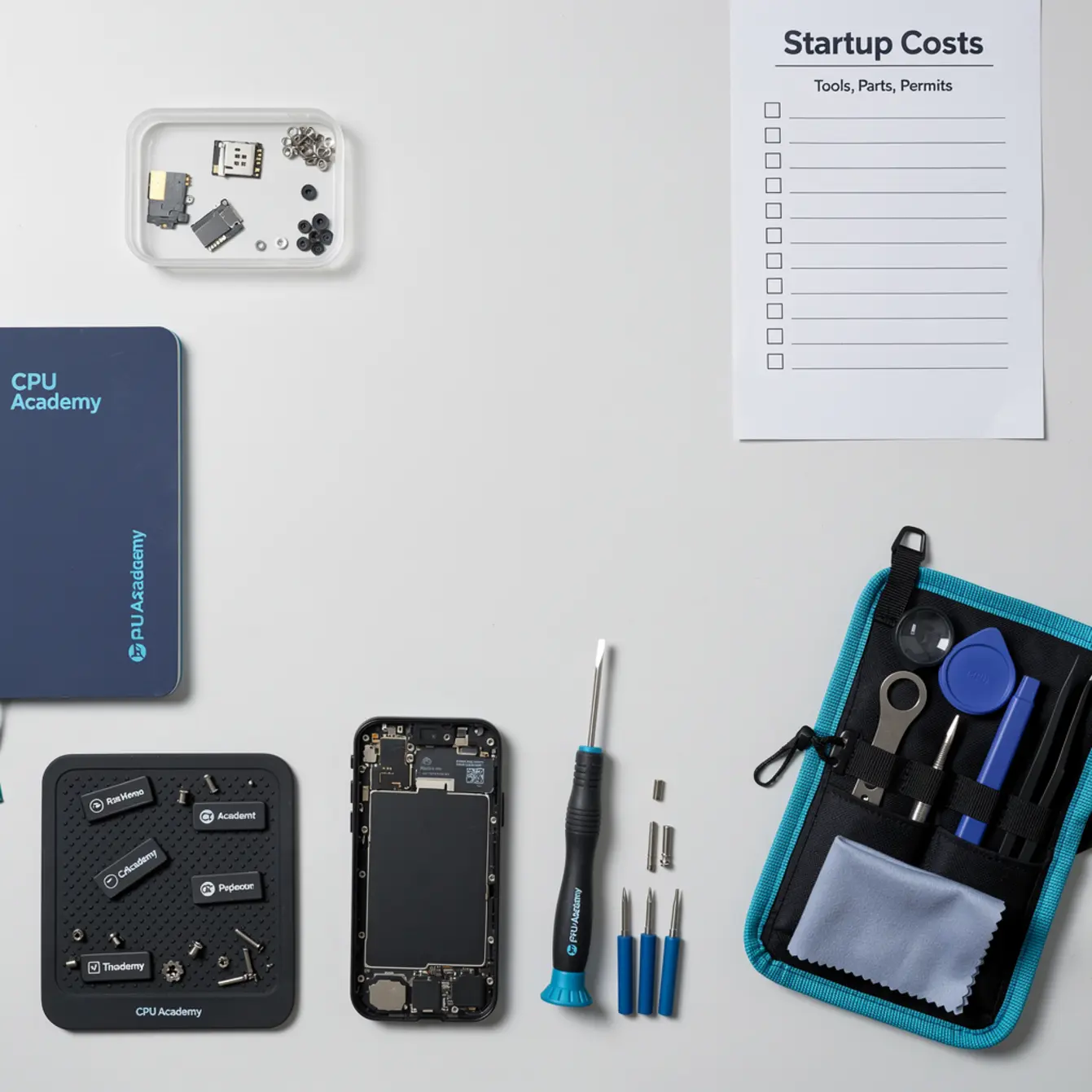
Quick answer: A realistic phone repair business can be launched for roughly $500–$2,000 depending on whether you start mobile, from home, or in a small shop. That range covers a solid phone repair toolkit for beginners, a starter parts inventory, and basic permits. Gross margins on common repairs routinely run 60–80%, which means recovering startup costs within the first few weeks of steady bookings is genuinely achievable.
If you want a side income that turns a real skill into real money, a phone repair business is one of the most accessible paths available in the US right now. People crack screens every single day, and most of them are willing to pay a fair price for a fast, trustworthy fix.
This guide is written for someone like Jay — a beginner or intermediate learner who wants the honest numbers before spending a dollar. You will get a breakdown of every startup cost category, a table you can actually use, and a clear action path so you are not guessing your next move. Building a strong phone repair toolkit for beginners is the foundation, and we cover that first.
CPU Academy is a smart fit for readers who want to turn repair skill into a small business with fewer costly beginner mistakes. If your goal is income, not just theory, open CPU Academy’s Starting a Mobile Phone Repair Business: The Complete Course to see the business training, templates, and next practical step.
Quick answer: cost, margin, and the decision upfront
How much does it actually cost to start?
Three realistic launch paths exist, and each one has a different cost floor. Here is a plain-English breakdown before we go deeper:
- Home-based or mobile setup: $500–$900. You go to customers or work from a spare room. Lower overhead, but your parts selection stays narrow at first.
- Kiosk or shared workspace: $1,000–$2,500. You share a retail space or rent a kiosk. You look more professional and can attract walk-in customers.
- Small storefront: $3,000–$8,000+. Rent, signage, and a more complete inventory add up fast. This path makes sense once you have validated demand.
Most beginners start with the home or mobile model and move up once cash flow is predictable. That is the path this guide focuses on.
Is it profitable?
Yes, but margins depend heavily on parts sourcing and pricing discipline. A screen replacement that costs you $20–$40 in parts can sell for $80–$150 depending on the device and your market. That is a healthy gross margin before you account for your time and overhead.
Net profit is tighter once you factor in parts waste, warranty replacements, and your own learning curve. Expect the first 30–60 days to be slower while you build your process and reputation.
What is the cheapest way to start?
Buy a focused tool set, stock only the most common parts (iPhone and Samsung screens cover a large share of real-world demand), register your business properly, and start with mobile or home service to avoid rent. Keep your cell phone repair business plan lean and add costs only when volume demands it.
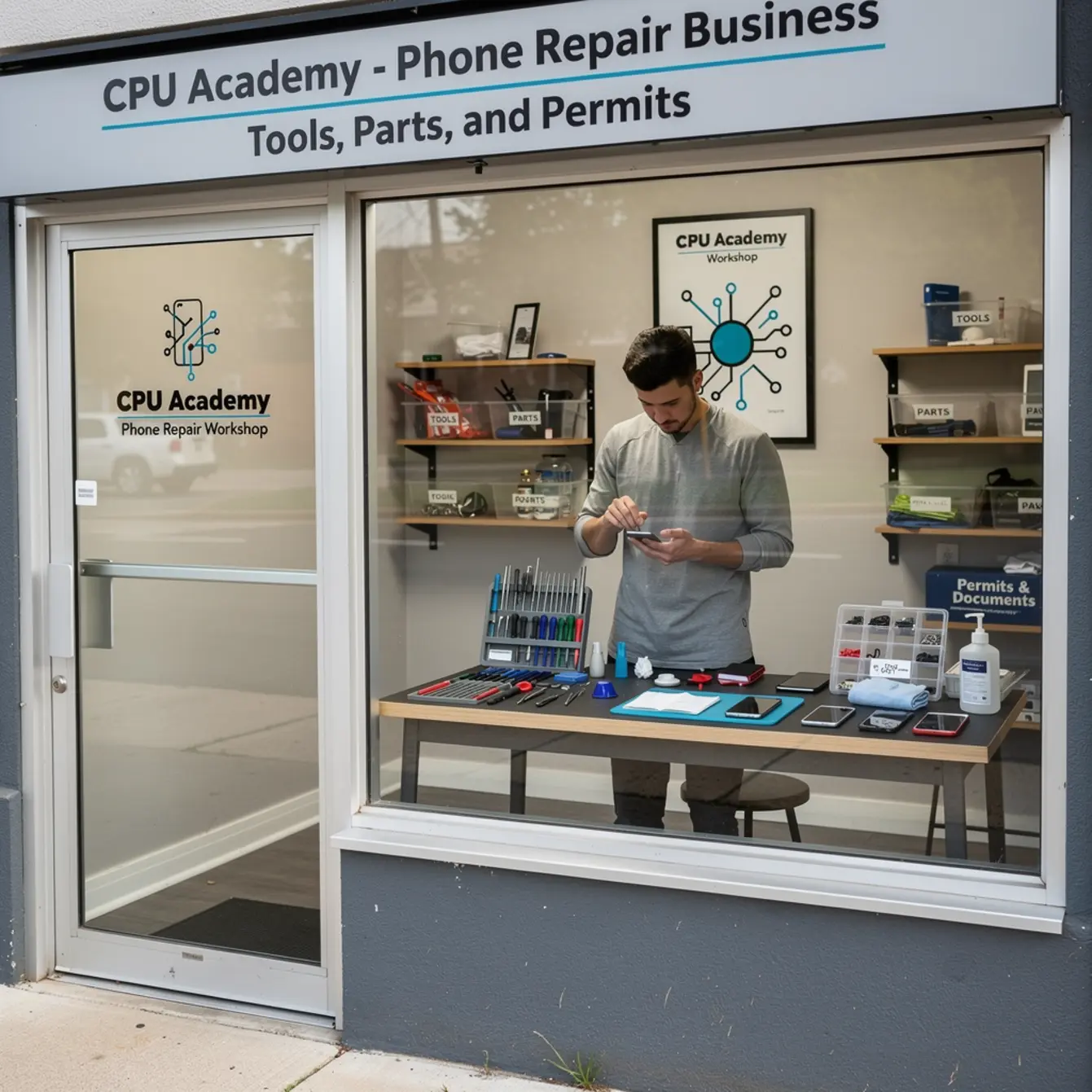
What this looks like in the real world
A case example: Marcus starts mobile, moves to a kiosk
Marcus is a hypothetical but representative beginner. He starts repairing phones at home on weekends. He spends roughly $650 in the first month: $200 on a core tool set, $300 on an opening parts inventory, $80 on his LLC registration, and $70 on basic marketing materials including a Google Business Profile and some printed flyers.
Within 60 days he has completed 18 repairs. At an average ticket of $90, that is $1,620 in gross revenue. After parts costs, his net is closer to $900–$1,000 for the period — not a full salary, but a solid proof of concept that recovers his startup spend and more.
By month four, Marcus rents a kiosk spot for $400 a month. Walk-ins push his volume to 35–45 repairs monthly. His mobile cell phone repair business is now a real part-time income, and he has a clear picture of what it takes to go full-time.
That kind of trajectory is normal for someone who starts lean, prices correctly, and does not skip the permit and registration steps that build customer trust.
Parts sourcing: where beginners lose money
The cheapest parts are not always the cheapest option. A $12 screen that fails in a week costs you a warranty replacement, a refund risk, and a bad review. Most experienced technicians use mid-tier OEM-compatible parts from established US distributors for everyday repairs and reserve aftermarket budget parts for low-stakes jobs.
You do not need a massive inventory on day one. Start with the 10–15 part numbers that cover the most common repairs in your market, then expand based on what you actually see come through your door.
Permits and registration: what you actually need
Requirements vary by state and city, but most US phone repair businesses need at minimum:
- A registered business entity (LLC is the most common for solo operators — it separates personal liability from business liability)
- A local business license or home occupation permit if you work from home
- A seller’s permit or sales tax ID if your state taxes repair services (check your state revenue department)
- A fictitious business name (DBA) if you operate under a trade name
The SBA provides a straightforward resource to help you estimate what you owe before you open: see the SBA calculator guide for startup costs. It is free and takes about 15 minutes.
Step-by-step action plan
Your first 30 days: the foundation
Step 1 — Write a one-page cell phone repair business plan. You do not need a 40-page document. You need your target market, your three core services, your pricing, and your break-even number. One page is enough to keep you focused.
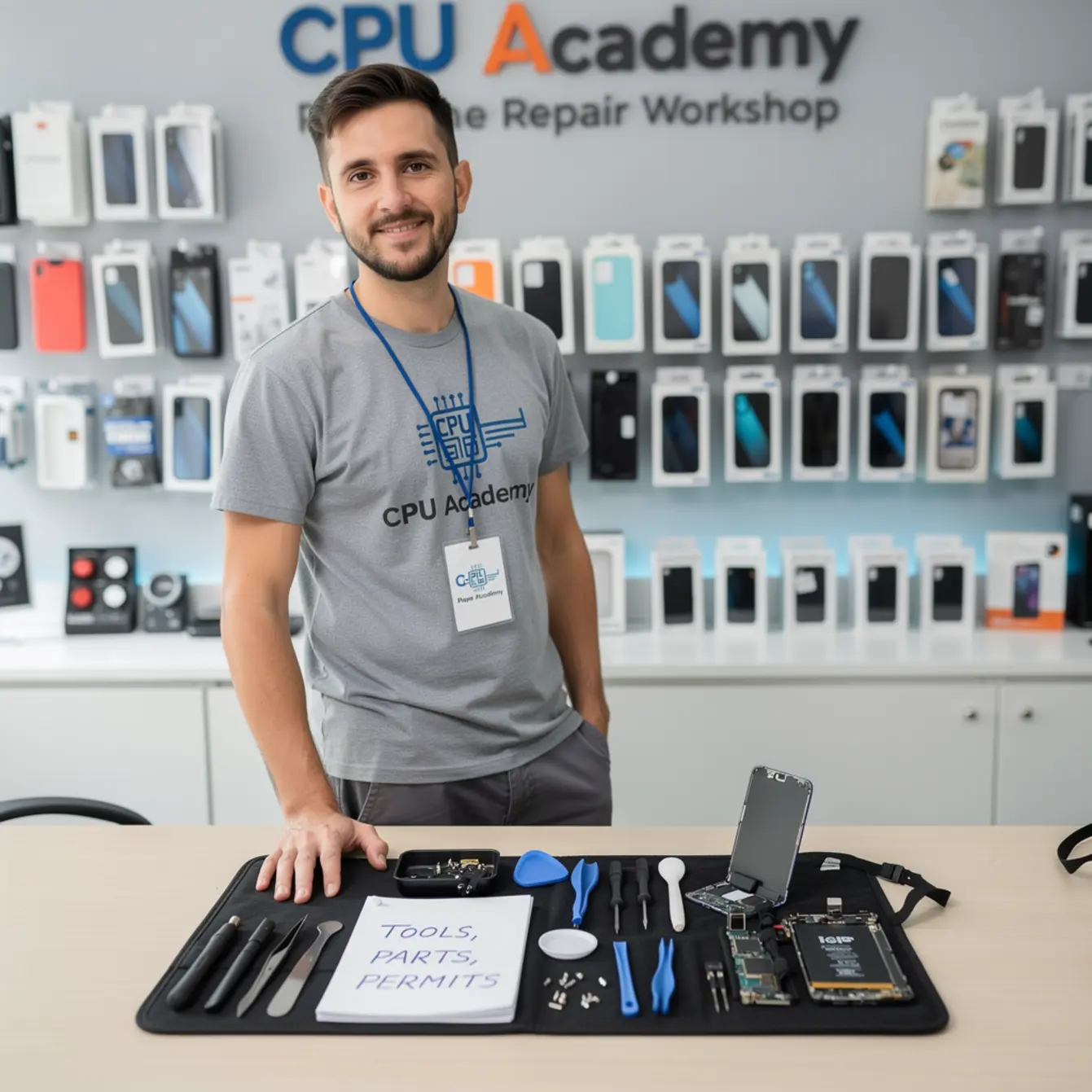
Step 2 — Buy your core tool set. A solid phone repair toolkit for beginners includes: precision screwdriver set (Phillips, Pentalobe, Torx), plastic pry tools and spudgers, suction cup screen lifters, heat gun or heat mat, tweezers (straight and curved), opening picks, and an ESD-safe anti-static mat. Budget $100–$200 for a quality starter set. Cheap tools damage parts — that costs more than the savings.
Step 3 — Register your business. File your LLC or sole proprietorship before you take your first paid customer. In most states, an LLC costs $50–$150 to file. Add a local business license ($20–$100 depending on your city). This is not optional — operating without proper registration can cost you far more later.
Step 4 — Build your opening parts inventory. Start with screens and batteries for the top 5 devices you see most in your area. Check local classified ads and repair forums to see what people are asking about. A $200–$350 opening inventory gives you enough to handle early volume without tying up too much cash.
Step 5 — Set your pricing menu. Look at what local shops charge for common repairs, then decide whether you compete on price, speed, or convenience. A phone repair pricing menu posted publicly builds trust and reduces back-and-forth with customers. Flat-rate pricing is easiest to manage when you are starting out.
Step 6 — Create your phone repair marketing plan. At the start, free channels do the most work: a Google Business Profile, a Facebook page, and word-of-mouth referrals from family and friends. Ask every satisfied customer for a Google review. That review history becomes your most valuable marketing asset within 90 days.
Step 7 — Write one simple SOP per repair type. A standard operating procedure does not need to be fancy. It is just a written checklist of every step for a screen replacement or battery swap. SOPs reduce mistakes, speed up your work, and make it easier to train a helper later.
If you want the option that makes the cost easier to justify because you can actually use it, see Starting a Mobile Phone Repair Business: The Complete Course — it covers business setup, pricing systems, and marketing in a structured format built for beginners.
Mistakes that kill profit or trust
⚠️ Watch out for these common beginner traps
- Buying the cheapest tools available and damaging parts during repair
- Skipping business registration and getting hit with fines or tax problems later
- Stocking too many part numbers before you know your local demand
- Underpricing to win jobs, then losing money when a part fails under warranty
- Skipping a written intake form — no intake form means no paper trail when a dispute happens
- Ignoring a phone repair marketing plan and relying entirely on word of mouth in the early months
The gross vs. net trap
High gross margins look great on paper. But if you price too low, carry excess inventory, or absorb too many warranty repairs, your net income can be thin. Price your work to cover parts, your time, a parts failure buffer, and business overhead — then add your profit margin on top. Do this from day one, not after you have burned through your opening cash.
Customer trust: the asset you cannot buy
A customer who trusts you comes back, refers friends, and leaves reviews. That trust is earned through clean communication, a written repair estimate, and following through on your quoted turnaround time. The simplest trust-builder is a one-page intake form that captures the device condition before you touch it. It protects you and reassures the customer.
Simple template, checklist, and numbers table
Startup cost breakdown: what a beginner needs to budget
The table below reflects realistic ranges for a home-based or mobile launch in the US. Your actual numbers will vary by state and supplier. Use this as a starting template, not a guarantee.
| Cost Category | What Is Included | Estimated Range (US) | Where Beginners Overspend |
|---|---|---|---|
| Phone repair toolkit for beginners | Screwdrivers, pry tools, suction cups, heat mat, tweezers, ESD mat | $100–$200 | Buying the cheapest set and damaging parts |
| Opening parts inventory | Screens, batteries, charging ports for top 5 devices | $200–$350 | Stocking too many SKUs before knowing local demand |
| Business registration | LLC filing, local business license, DBA if needed | $70–$250 | Paying an attorney when a self-filed LLC is straightforward in most states |
| Basic marketing | Google Business Profile (free), flyers, basic social media setup | $0–$100 | Paying for ads before building any organic reputation |
| Workspace setup (home or mobile) | Workbench, lighting, organizer trays, storage | $50–$150 | Over-engineering the workspace before proving demand |
| Training / business course | Repair techniques, business systems, pricing, marketing | Varies | Skipping training and making expensive mistakes on customer devices |
| Total (home/mobile launch) | All of the above combined | ~$500–$1,050+ | Adding kiosk or storefront costs too early |
Start phone repair business checklist: before you take your first paid job
- ☐ Core tool set purchased and tested
- ☐ Opening parts inventory stocked for top 5 devices
- ☐ LLC or sole proprietorship registered
- ☐ Local business license obtained
- ☐ Sales tax / seller’s permit confirmed (check your state)
- ☐ Pricing menu written and posted
- ☐ Customer intake form created
- ☐ Google Business Profile live with accurate hours and services
- ☐ Simple SOP written for your first three repair types
- ☐ Basic phone repair marketing plan documented (even one page)
- ☐ Break-even number calculated (how many repairs to cover monthly costs)
Cheap vs. smart: a quick comparison
There is a real difference between cutting smart costs and cutting costs that hurt you. Here is how to tell them apart:
- Smart cut: Start at home instead of renting a storefront. You can always move up.
- Dangerous cut: Skip business registration to save $100. That can become a $1,000+ problem.
- Smart cut: Buy a focused tool set instead of every specialty tool available.
- Dangerous cut: Buy the cheapest possible tools. Broken tools damage parts and create refund situations.
- Smart cut: Use a free Google Business Profile before paying for ads.
- Dangerous cut: Skip the intake form to save time. No documentation means no protection in a dispute.
Also worth noting: if you want to expand beyond phone repair as your business grows, CPU Academy offers related training in phone repair fundamentals and laptop repair, which can open up higher-ticket repair services once your core business is running smoothly.
FAQ + next step
How much does it cost to start a phone repair business from scratch?
A home-based or mobile launch typically runs $500–$1,050 for tools, an opening parts inventory, and basic business registration. A kiosk or shared space adds $400–$1,500 more per month in location costs. A full storefront raises the entry point to $3,000–$8,000 or more. Start lean, validate demand, and scale up when your volume justifies it.
Is a phone repair business profitable?
Gross margins on common repairs frequently run 60–80%. Net profitability depends on your pricing discipline, parts quality, warranty rate, and how efficiently you work. Most beginners who price correctly and manage parts waste carefully can recover their startup costs within the first 30–60 days of consistent volume.
What permits do I need to start a phone repair business?
At minimum, most US operators need a registered business entity (LLC is common), a local business license, and a sales tax permit if your state taxes repair services. Home-based operators may also need a home occupation permit. Requirements vary by state and city — check your city clerk and state revenue department before you open.
What tools do I need to start?
A beginner toolkit needs: a precision screwdriver set (Phillips, Pentalobe, Torx), plastic pry tools, spudgers, suction cups, opening picks, tweezers, a heat gun or mat, and an ESD-safe anti-static mat. Budget $100–$200 for a set that will not damage parts. Avoid the cheapest options — they will cost you more in broken components.
Do I need a formal business plan?
You do not need a 40-page document. A one-page cell phone repair business plan covering your target customer, three core services, your pricing, and your break-even number is enough to keep you focused and avoid wasted spending. Expand it as your business grows.
Where should I source parts?
Most experienced US technicians use established distributors that carry OEM-compatible parts with clear return policies. Avoid the absolute cheapest supplier for screen and battery jobs — a part failure under warranty costs more than the savings. Start with a narrow inventory of proven part numbers and expand based on real repair volume.
What is the best way to market a new phone repair business?
Start with free channels: claim and complete your Google Business Profile, create a Facebook Business page, and ask every satisfied customer for a Google review. A phone repair marketing plan does not need a big budget in the first 90 days. Organic reputation and referrals are your most powerful tools early on. Paid ads become worthwhile once you have reviews and a consistent service record to back them up.