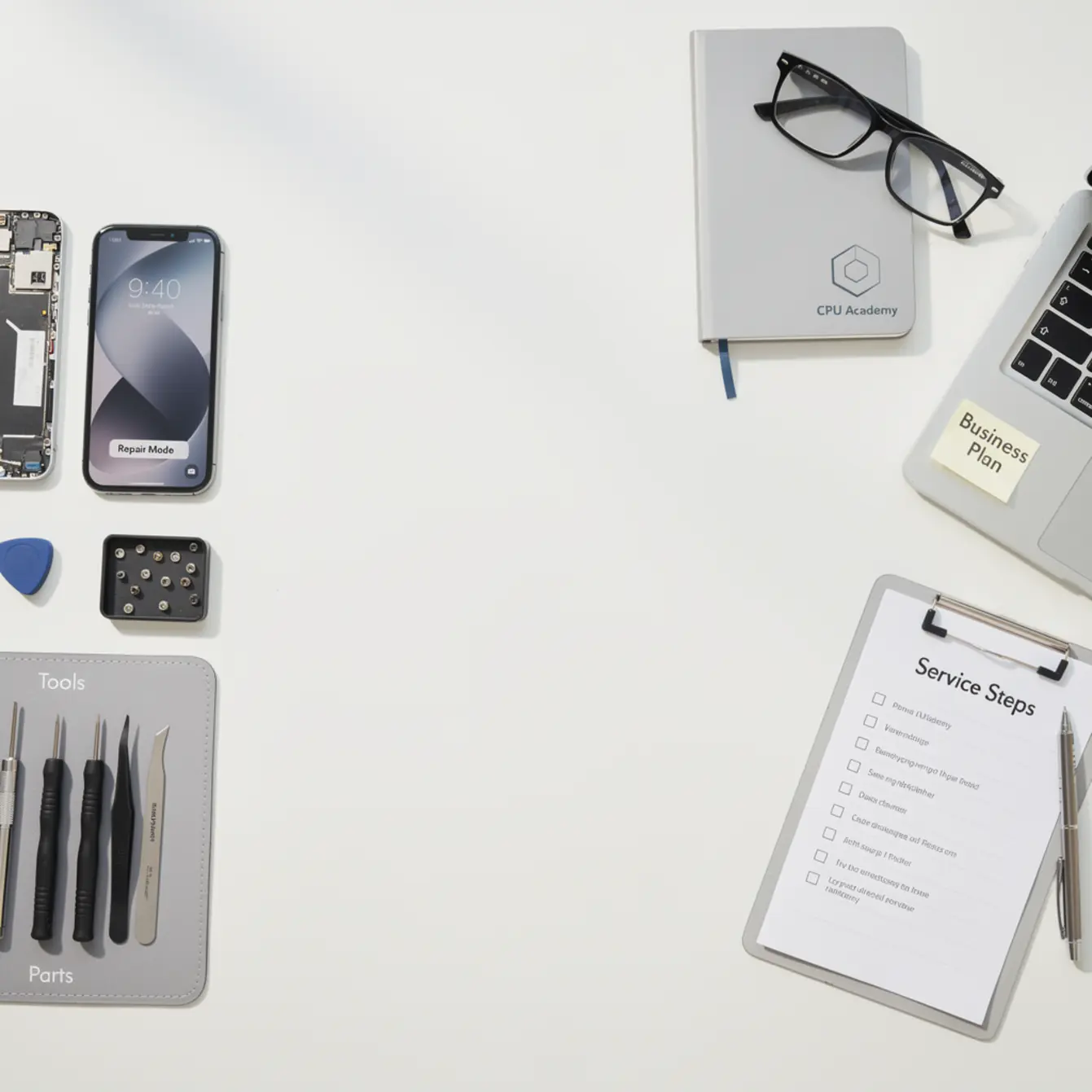
A cell phone repair business plan covers your repair service menu, startup costs, pricing model, target customers, and monthly revenue targets. Most solo shops need $1,500–$5,000 to open, can break even within 60–90 days, and profit most on screen replacements and battery swaps. This template walks you through each section in order.
Updated for current learners · Written by the CPU Academy Curriculum Team
The tool list and workflow below mirror the starter system taught inside CPU Academy’s Starting a Mobile Phone Repair Business course — built for future shop owners who want fewer rookie mistakes and a faster path to real revenue.
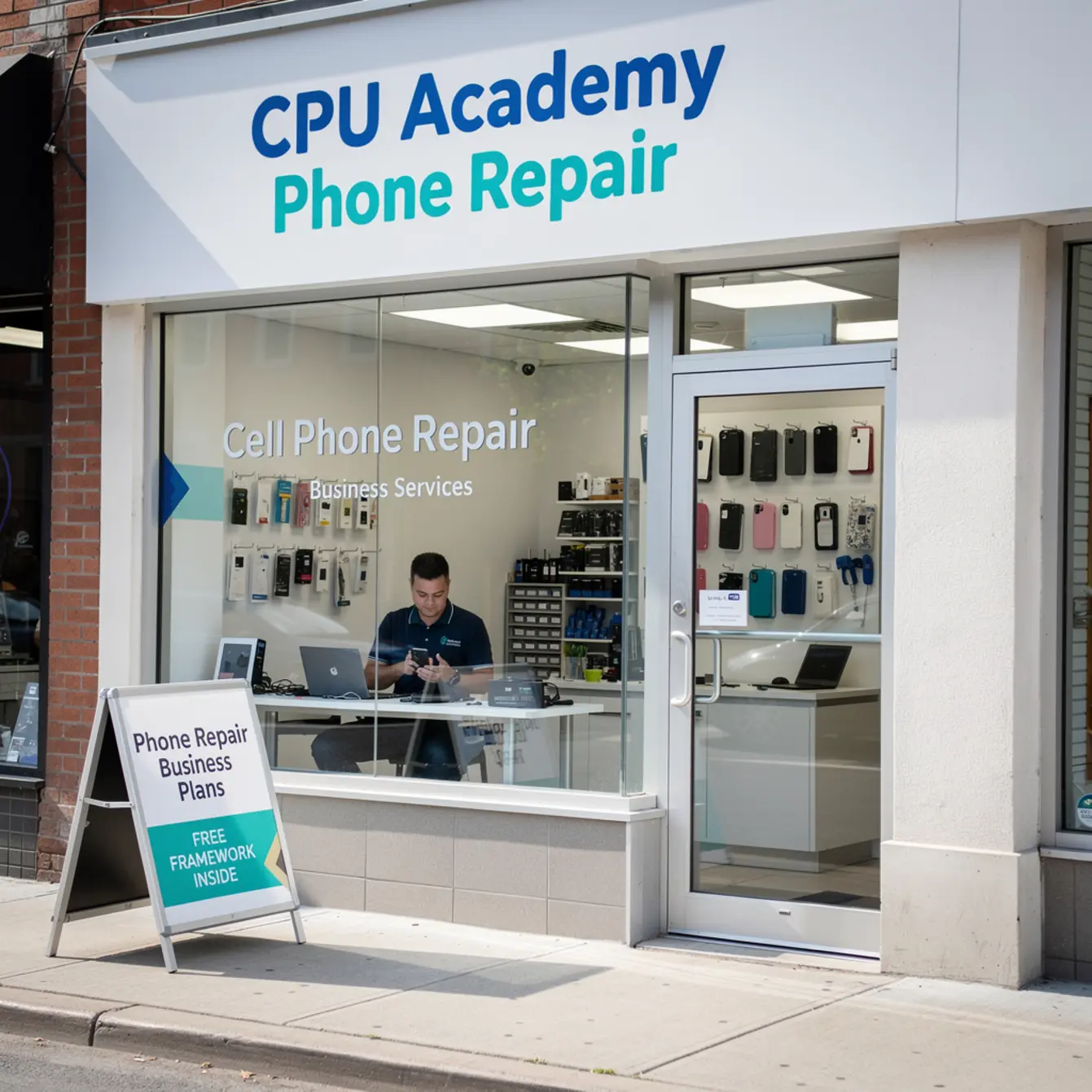
What a Cell Phone Repair Business Plan Actually Is
A cell phone repair business plan is a one-page to five-page document that maps your services, costs, prices, and first-90-day revenue targets. It is not a formal bank document unless you are seeking a loan.
Think of it as your decisions-made-in-advance sheet. Before your first customer walks through the door, you already know what you charge, what parts you keep on hand, and exactly how many jobs per week it takes to cover your costs. That clarity matters more than most people realize early on.
This guide is written for three kinds of people. Side-hustlers who want repair income without quitting their day job. Career-changers who want to build a real small business. Working techs who are finally going independent. What this page does differently from the usual generic templates is give you a usable framework with real numbers, not business-school theory.

The 8-Step Cell Phone Repair Business Plan (Template)
The fastest way to write a phone repair business plan is to fill in these eight sections in order. Each one feeds directly into the next, so skipping ahead tends to create gaps you will patch later under pressure.
- Define your repair service menu. Start with screens, batteries, charging ports, and basic software fixes. Add more once you have those down cold.
- Choose your business model. Home-based keeps overhead low. A kiosk or storefront brings walk-in traffic. A mobile van lets you go to the customer.
- Estimate your startup costs. Tools, starting parts inventory, workspace setup, and any local business licences.
- Set your pricing per repair type. Use the formula in the pricing section below — parts cost plus labour plus a warranty buffer. One bad quote can wipe out a whole day’s profit if you skip this step.
- Identify your target customer. Individual consumers are the easiest starting point. Schools and small businesses with device fleets come later once you have the reviews to back you up.
- Map your first-90-day revenue target. Know how many repairs per week you need to break even, then how many to actually profit.
- Outline your marketing channels. Google Business Profile, Facebook Marketplace, local Facebook groups, and a sign on your door or van.
- Write your contingency plan. What do you do during a slow week? What is your warranty policy when a repair fails? What happens when a part is backordered and a customer is waiting?
Simple Template: Fill In This Table for Each Repair You Offer
| Service | Parts Cost (Est.) | Labour Time | Sale Price | Gross Margin per Job |
|---|---|---|---|---|
| Screen replacement (iPhone) | $___ | ___ min | $___ | $___ |
| Battery swap (Samsung) | $___ | ___ min | $___ | $___ |
| Charging port repair | $___ | ___ min | $___ | $___ |
| Software fix / restore | $___ | ___ min | $___ | $___ |
| Water damage assessment | $___ | ___ min | $___ | $___ |
Copy this table, plug in your real numbers, and you have the core of your phone repair pricing menu. The blank fields are intentional. Your numbers will differ from anyone else’s based on where you source parts and what your local market will support.
One practical habit worth building early: keep a simple intake form for every device that comes in. Write down the model, the reported problem, any existing damage, and the quoted price before you touch anything. That one piece of paper protects you from he-said-she-said disputes and keeps your part margins honest.
If you want a guided version of this instead of doing it alone, the next move is Starting a Mobile Phone Repair Business: The Complete Course — it walks through each step with instructor support and ready-to-use business tools.
Startup Costs — What You Actually Need to Spend
Most people can start a phone repair business for between $1,500 and $5,000. The biggest variables are your workspace model and your starting parts inventory. Neither one has to be expensive if you plan it right.
Here is a realistic breakdown by category. Treat these as planning ranges, not guarantees. Your local market and supplier choices will move these numbers in both directions.
| Cost Category | Low End | High End | Notes |
|---|---|---|---|
| Tools & equipment | $200 | $600 | Precision kit, heat gun, anti-static mat |
| Starting parts inventory | $400 | $1,500 | Stock fast-movers first — popular models only |
| Workspace setup | $0 | $1,500 | $0 if home-based; more for a kiosk deposit |
| Business licence & insurance | $50 | $400 | Varies by state and city |
| Basic marketing setup | $0 | $300 | Google Business Profile is free; signage and cards cost more |
| Total range | $650 | $4,300 | Always add a buffer for unexpected costs |
Home-Based vs. Storefront: The Real Trade-Off
Home-based shops keep your overhead near zero. The downside is that you rely entirely on word-of-mouth and online reach to pull customers in. A storefront or kiosk brings walk-in traffic without you chasing it, but adds rent, utilities, and a longer ramp before you see real profit.
Most beginners start at home and move to a physical location once revenue is steady and predictable. That sequence is not a compromise. It is just smart cash management.
Tools and Parts Checklist for a Phone Repair Business
The minimum tool kit for a mobile cell phone repair business covers precision screwdrivers, spudgers, suction cups, a heat gun or hot plate, and an anti-static mat. Budget $200–$600 for a solid starter set that will actually hold up to daily use.
- ☐ Precision screwdriver set (Phillips, Pentalobe, Torx)
- ☐ Plastic spudgers and opening picks
- ☐ Suction cup tool (screen removal)
- ☐ Heat gun or hot plate (adhesive loosening)
- ☐ Anti-static mat and wrist strap
- ☐ Tweezers (angled and flat tip)
- ☐ Magnification lamp or loupe
- ☐ Isopropyl alcohol (90%+) and swabs for cleaning
- ☐ Soldering iron and solder (for port-level work)
- ☐ Parts organiser tray
- ☐ UV curing light (if using UV adhesive)
- ☐ Phone testing jig or test cables (optional but saves real time)
Parts Sourcing: Stock Smart, Not Wide
Do not buy parts for every device model on day one. That is how beginners end up with $800 worth of inventory that barely moves. Stock screens and batteries for the top two or three iPhone generations and the top Samsung models in your area. Those cover the majority of walk-in jobs in most US markets.
Watch what actually comes through your door in the first few weeks, then expand your inventory to match real demand. Not what you assume will show up, but what actually does. Part margins on fast-moving stock are much healthier than on parts sitting in a drawer for three months.
Hands-on tool training and a guided parts workflow are covered in the CPU Academy Phone Repair Course — worth checking out if you are still building your technical foundation alongside your business plan.
Pricing Strategy for Your Phone Repair Business
Price each repair by adding your parts cost, a labour rate for your time, and a small buffer for warranty callbacks. Then check that the total is competitive with what local shops charge. If you skip any one of those three steps, you will either lose money or lose customers.
The Floor Price Formula
Floor Price = Parts Cost + (Hourly Rate × Time in Hours) + 15% warranty buffer
Here is a concrete example. A screen replacement where your part costs $35, takes 45 minutes at a $40/hour labour rate, with a 15% warranty buffer added on top: $35 + $30 + $9.75 = roughly $75 floor price. Charge at or above that number. Anything below it and you are subsidizing the repair out of your own pocket.
Illustrative Price Ranges (Region-Dependent)
These are planning ranges only. Verify against your local competition before you lock in your final phone repair pricing menu.
- Screen replacement: approximately $60–$150 depending on device model
- Battery swap: approximately $30–$80
- Charging port repair: approximately $40–$100
- Software fix or restore: approximately $30–$70
Upsell Add-Ons That Boost Average Ticket
Offer a tempered glass screen protector at the counter for $10–$20 after every screen repair. Mention a phone case while the customer is already happy with the result. Offer a paid data backup before any software restore. These small additions improve your average ticket without any extra marketing cost, and they feel helpful rather than pushy when you frame them right.
What Beginners Usually Do Wrong
- Underpricing because they forget labour cost. Your time has a dollar value. Charge only for the part and you are effectively working for free. One bad quote can wipe out a full day’s profit.
- Buying too wide a parts inventory too early. Dead stock ties up cash you need for parts that actually sell. Start narrow with the fast-movers.
- Skipping a written warranty and returns policy. Without one in writing, every dispute turns into a negotiation and sometimes a chargeback. Put it on your intake form so customers sign off before you start.
- Not setting up Google Business Profile before opening. It is free and it is how local customers find you. Set it up on day one, not month three.
- Trying to fix every device model from day one. Get fast and confident on a handful of common repairs first. Build reviews. Then expand your menu.
Your First 90-Day Revenue Plan
A realistic first-90-day target for a home-based phone repair business is 3–5 repairs per day at an average ticket of $70–$100. That puts monthly gross revenue between $6,300 and $15,000 before parts and overhead costs come out.
These are illustrative targets based on moderate demand. Your actual results depend on your location, how hard you market, and how fast you turn repairs around. Use them as a planning benchmark, not a promise.
| Period | Priority Actions | Target Outcome |
|---|---|---|
| Week 1–2 | Set up workspace, list on Google Business Profile, tell your network, complete your first 5 paid jobs | First revenue, first reviews |
| Month 1 | Complete 10–20 jobs, actively collect Google reviews, post before/after photos on social media | Consistent weekly bookings |
| Month 2–3 | Launch a simple referral programme, show up in local Facebook groups, assess inventory gaps based on real demand | Break-even or early profit, repeat customers coming back |
Your phone repair marketing plan in the first 90 days does not need to be complicated. Google Business Profile plus word-of-mouth plus one active social channel is enough to fill a home-based schedule. Add paid ads only after you have consistent organic demand coming in first.
Real-World Example: Jay’s First Month
Jay is a fictional composite of the beginner this article is written for. The numbers are grounded in realistic planning assumptions, not wishful thinking.
Jay starts a home-based mobile cell phone repair business with a $2,200 total investment. He puts $450 toward tools, $900 into a starting parts inventory focused on iPhone 12 and 13 screens and batteries plus Samsung Galaxy screens, $200 on a folding work table and decent lighting, and keeps the rest as a cash buffer for the unexpected.
He sets his pricing using the floor price formula. His screen replacement floor comes out to $72. Local shops charge $89–$110 for the same job. Jay prices at $85 — competitive without racing anyone to the bottom.
In week one, Jay posts in his local Facebook group and tells 40 people he offers same-day phone repair. Three jobs come in. He finishes each one, sends a callback text when the phone is ready, and collects three Google reviews. Small start. By end of month one he is averaging four repairs a day on weekdays and hitting break-even. By month two, screen and battery work alone is putting him in the green.
The specifics in Jay’s story will differ from yours. But the sequence — set up your systems, price it correctly from day one, market locally, collect reviews fast, then scale from that base — works the same way for almost every successful starter shop.
Your Next Move
You now have the full framework. Service menu, cost planning, pricing formula, tool checklist, 90-day revenue targets, and the most common mistakes to dodge. That is a solid foundation for any future shop owner who is serious about this.
What a template cannot do is give you instructor feedback, fill-in-ready business documents, or a structured sequence that catches the gaps most beginners miss entirely. That is where CPU Academy fits in — especially for readers who want to turn repair skill into a real small business without the expensive trial-and-error phase.
If your goal is income, not just theory, open CPU Academy’s Starting a Mobile Phone Repair Business: The Complete Course to see the business training, templates, and next practical step waiting for you there.
These related resources are also worth bookmarking as you build your skill base alongside your business plan:
- Phone Repair Course — hands-on technical training for the repairs that drive your revenue
- Mobile Phone Software Repair Course — add software fixes to your service menu and charge for them
Frequently Asked Questions
How do I start a phone repair business?
Define your service menu, choose a workspace model (home, kiosk, or storefront), budget your startup costs, set your prices using a parts-plus-labour formula, and get your Google Business Profile live before your first job. Start with the repairs you can do confidently and expand your menu as you build speed and reviews.
What tools do I need to start a phone repair business?
At minimum: a precision screwdriver set (Phillips, Pentalobe, Torx), plastic spudgers and opening picks, a suction cup, a heat gun or hot plate, and an anti-static mat. A soldering iron is needed for port-level repairs. Budget $200–$600 for a solid starter kit that will hold up to regular use.
What comes first in a phone repair business plan?
Your repair service menu comes first. Every other section — pricing, startup costs, revenue targets — depends on knowing which repairs you will actually offer. Start with the three or four highest-demand jobs (screen replacement, battery swap, charging port repair) and build from there once you have those dialed in.
How much does it cost to start a phone repair business?
Most home-based shops get started for $1,500–$5,000. That range covers tools ($200–$600), a starting parts inventory ($400–$1,500), workspace setup (free if home-based), and basic business and marketing costs. A storefront or kiosk adds lease and deposit costs on top of that range, so most people start at home first.
What mistakes should I avoid when starting a phone repair business?
The five most common beginner mistakes are: underpricing by ignoring your labour cost, buying too wide a parts inventory before you know local demand, skipping a written warranty policy, not setting up Google Business Profile early, and trying to repair every device model instead of specialising first. Any one of these can slow your path to profit significantly.
Do I need a formal business plan to start a phone repair shop?
Not a formal one unless you are applying for a loan. A one-to-five-page working document that covers your services, pricing, startup costs, and 90-day revenue targets is enough to get moving. The goal is to make key decisions before your first customer arrives, not to produce a polished document for a bank.
If your goal is to turn repair skills into money, open CPU Academy’s Starting a Mobile Phone Repair Business: The Complete Course now and use the full business path instead of guessing your next move. Your cell phone repair business plan is step one. The course is what turns it into an actual income.