
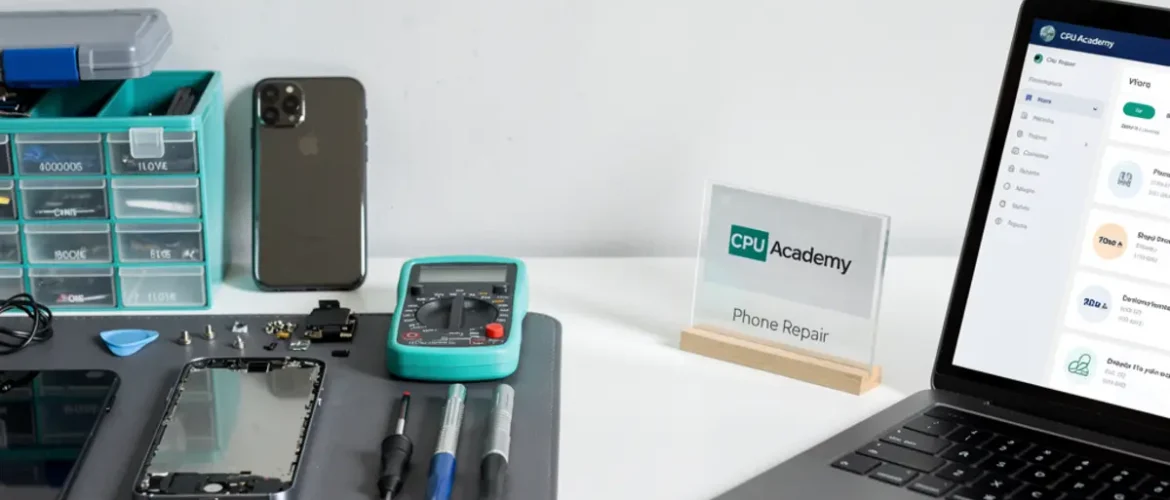
If you want a realistic side income or a full-time shop, this guide is for you. We cover startup cost, parts sourcing, pricing, trust-building, and your first 30 days — all focused on one goal: turning repair skills into money. If you’re looking to start a phone repair business without guessing at every step, you’re in the right place.
If your goal is income, not just theory, open CPU Academy’s Starting a Mobile Phone Repair Business: The Complete Course to see the business training, templates, and next practical step.
Quick answer: cost, margin, and first decision
The first question most people ask is: “How much does this actually cost me to start?” Here is the honest short version.
Startup cost
A home-based or mobile setup typically runs $500–$2,000 to get started. That covers a basic tool kit, a small parts inventory, and your first marketing spend. A physical shop adds rent, security deposit, and signage on top — plan for $3,000–$8,000 or more depending on your city.
Neither number is fixed. It depends on which repairs you offer first and whether you buy parts in bulk or per job.
Gross vs. net: the number that actually matters
A screen replacement can carry a gross margin of 50–70% once you know your supplier. But gross margin is not take-home money. After tool wear, marketing, time, and any space costs, net profit per job is lower. Tracking both numbers from day one keeps you from feeling busy but earning little.
The first decision
Before you buy tools, decide: home setup, mobile service, or physical shop? Each has different startup costs, different risk, and different customer trust challenges. Most beginners do better starting small and upgrading only when cash flow supports it.
What this looks like in the real world
Meet Jay. He works a day job and wants $1,000–$1,500 extra per month without quitting yet. He already knows how to replace screens and batteries from watching tutorials. His city has a few repair shops but no one doing same-day mobile visits.
Jay starts with a $700 home bench setup, a Facebook Business page, and a Google Business Profile. In his first month he does 14 jobs — mostly screen replacements for friends, family, and two customers from Google. By month three he’s booked on weekends and considering whether to cut back his day job.
Jay’s story is common. The deciding factor is not talent — it’s having a clear system for pricing, intake, parts ordering, and customer follow-up. Without that system, good technicians stay busy but undercharge and burn out.
CPU Academy is a smart fit for readers who want to turn repair skill into a small business with fewer costly beginner mistakes. The training covers the business side — pricing, marketing, customer handling — not just the bench skills.
Step-by-step action plan to start a phone repair business
Work through these steps in order. Each one builds on the last. Skip one and you’ll likely have to come back to fix it later.
Step 1 — Decide your service model
Choose: home bench, mobile (you go to the customer), kiosk/booth, or full shop. Start with what your budget supports. You can always add a location later.
Step 2 — Build your repair skills first
You need to be confident before you charge customers. If you’re still learning screen replacements or battery swaps, practice on donor phones before taking paid work. CPU Academy’s Phone Repair Course covers hands-on repair techniques from the ground up — a solid foundation before you open your doors.
Step 3 — Build your cell phone repair business plan
A cell phone repair business plan does not need to be 30 pages. You need five things in writing:
- Which repairs you offer (and which you don’t — yet)
- Your pricing for each service
- Your target customers (students, families, small businesses)
- How you’ll get your first 10–20 customers
- A simple monthly budget: parts, tools, marketing, and your time
Writing it down forces clarity. It also helps if you ever apply for a small business loan or want a co-signer on a retail lease.
Step 4 — Register your business and cover the basics
File an LLC or sole proprietorship in your state (most repair shops start as sole props). Get a basic business bank account and keep personal and business money separate from day one. Check if your city or county requires a business license for repair services.
This step feels slow, but mixing money is one of the top reasons small shops fail their first tax season.
Step 5 — Source your parts and tools
Parts sourcing is where beginners lose money fast. Low-quality parts = callbacks, refunds, and damaged reputation. Start with one reliable supplier and test quality before buying in volume.
Your starter tool kit should cover: precision screwdrivers, spudgers, suction cups, a heat gun or hot plate, and a good light source. Total cost for a basic kit can stay under $150 if you shop carefully.
Step 6 — Set your phone repair pricing menu
A clear phone repair pricing menu does three things: it saves you time quoting every job, it signals professionalism to customers, and it helps you spot which jobs are most profitable.
Price each service based on: cost of part + your labor time + a margin that covers tool wear and occasional callbacks. Do not price based on what feels fair in the moment. That is how most beginners underprice and burn out.
Post your pricing menu on your website, Google Business Profile, and social pages. Transparency builds trust before a customer ever calls.
Step 7 — Build your phone repair marketing plan
Your phone repair marketing plan for the first 90 days should focus on three low-cost channels:
- Google Business Profile — free, local, and high intent. Fill it out completely and ask every happy customer for a review.
- Facebook and Nextdoor — community groups are where local repair jobs get recommended. Post before-and-after photos with permission.
- Word of mouth — your first 10 customers come from people you know. Tell everyone. Offer a small referral discount for the first month.
You do not need a big ad budget to start. You need consistent, visible presence in the places your local customers already look.
Step 8 — Create a simple standard operating procedure (SOP)
Even as a solo operator, a simple SOP saves time and protects you legally. It covers: how you intake a device (note existing damage), how you communicate repair status, and what your warranty policy is.
A one-page intake form and a short checklist for each job type is enough to start. It also shows customers you run a real operation, not a side hustle.
Step 9 — Plan your first 30 days
Week 1: Set up your workspace, order starter parts, and create your business profiles. Week 2: Tell your network you’re open and start posting content. Week 3: Complete your first 3–5 paid jobs and ask for reviews. Week 4: Review your numbers — what worked, what broke even, what lost money.
Thirty days of honest data is worth more than a month of planning.
If you want a guided version of this instead of doing it alone, the next move is Starting a Mobile Phone Repair Business: The Complete Course — it walks you through the business side step by step, with templates and tools included.
Mistakes that kill profit or trust
- Underpricing to get customers — Sets a ceiling you can’t raise later without losing regulars.
- Skipping the intake form — Leads to blame and refund arguments over pre-existing damage.
- Buying cheap parts to save money — Callbacks and refunds cost more than the savings.
- No written warranty policy — Customers assume unlimited free fixes if you don’t state otherwise.
- Working without tracking jobs or money — You can’t know if you’re profitable without records.
- Trying to fix everything from day one — Start with 3–5 high-demand repairs. Add more as volume grows.
The most expensive mistake is not a bad repair. It is not knowing your numbers. Track every job, every part cost, and every hour. Even a simple spreadsheet beats guessing.
If you want to add more to your skill set as your shop grows — like software-level faults — CPU Academy’s Mobile Phone Software Repair Course covers that territory and lets you offer services most small shops don’t.
Simple checklist and numbers table
Phone repair startup cost table (estimated ranges, US market)
| Item | Home/Mobile Setup | Small Retail Shop | Notes |
|---|---|---|---|
| Basic tool kit | $80–$150 | $150–$400 | Start lean; add specialized tools per job type |
| Starter parts inventory | $200–$600 | $600–$2,000 | Focus on 2–3 top phone models first |
| Business registration | $50–$200 | $50–$200 | Varies by state; check your state’s SOS website |
| Website / Google profile | $0–$100 | $100–$500 | Google Business Profile is free; basic site builder is enough |
| First-month marketing | $0–$150 | $100–$400 | Flyers, local Facebook ads, referral discounts |
| Rent / lease deposit | $0 | $1,500–$5,000+ | Biggest variable; location matters for walk-in traffic |
| Estimated total | $330–$1,200 | $2,500–$8,500+ | Ranges are estimates; your local market will vary |
These are estimated ranges only. Your actual costs depend on your location, the repairs you offer, and supplier pricing at the time you buy.
Pre-launch checklist
- ☐ Chosen service model (home, mobile, kiosk, shop)
- ☐ Repair skills practiced on donor phones
- ☐ Written cell phone repair business plan (even 1 page)
- ☐ Business registered with your state
- ☐ Separate business bank account opened
- ☐ Parts supplier selected and test order placed
- ☐ Tool kit assembled
- ☐ Phone repair pricing menu written and posted publicly
- ☐ Google Business Profile created and verified
- ☐ Social pages created (Facebook minimum)
- ☐ Intake form built (even a paper version)
- ☐ Warranty policy written (even 2–3 sentences)
- ☐ First 30-day outreach plan ready
FAQ + next step
How do I start a phone repair business with no money?
The lowest-cost path is a home bench setup. Start with a basic tool kit (under $150 in many cases), source parts per job rather than in bulk, and market through free channels like Google Business Profile and Facebook community groups. Your first jobs from friends and family cost almost nothing to acquire. The goal is to generate early revenue that funds your next purchase — not to launch with every tool and part on hand.
What tools do I need to start a phone repair business?
At minimum: a precision screwdriver set (Phillips and Pentalobe), plastic spudgers and opening picks, a suction cup, a heat gun or hot plate, a magnifying lamp, and anti-static tweezers. Add model-specific tools as demand comes in — don’t buy for every phone type on day one.
What mistakes should I avoid when starting a mobile cell phone repair business?
The biggest ones: underpricing to win jobs (hard to raise later), buying the cheapest parts available (leads to callbacks), skipping an intake form (opens you to blame disputes), and trying to repair every device type before you’re confident in core repairs. Start narrow, do great work, then expand.
What comes first — skills or business setup?
Skills come first. You can have a perfect business plan and a beautiful Google profile, but one botched repair on a paying customer’s phone can end your reputation before it starts. Practice on donor phones until the repairs you plan to offer feel repeatable and confident. Then set up your business structure.
Do I need a certification to repair phones legally in the US?
There is no national certification requirement to operate an independent phone repair business in the US. However, some cities or counties require a general business license. Check your local government’s requirements before you start taking paid work. A business license is different from a repair certification — one is legal, one is optional.
How does a phone repair business make money beyond screen replacements?
Battery replacements, charging port repairs, camera fixes, water damage diagnostics, and data recovery are all common service lines. Software-level repairs — like bootloop fixes, IMEI issues, and unlock services — command higher prices and have less local competition. If you want to add those skills, CPU Academy’s Mobile Phone Software Repair Course covers that area in depth.
Should I also offer laptop repair?
Many successful small repair shops do both. It increases your average customer value and gives you something to offer when a phone job isn’t available. If you want to add laptop work to your service menu, CPU Academy’s Laptop Repairing Course is a practical next step once your phone repair business is running.
Ready to turn repair skills into a real income?
You now have the full picture — from startup cost to your first 30 days. The one thing a written guide can’t replace is a structured system that walks you through every business decision with templates you can use immediately.
If your goal is to start a phone repair business and turn those skills into money, open CPU Academy’s Starting a Mobile Phone Repair Business: The Complete Course now and use the full business path instead of trying to guess your next move.