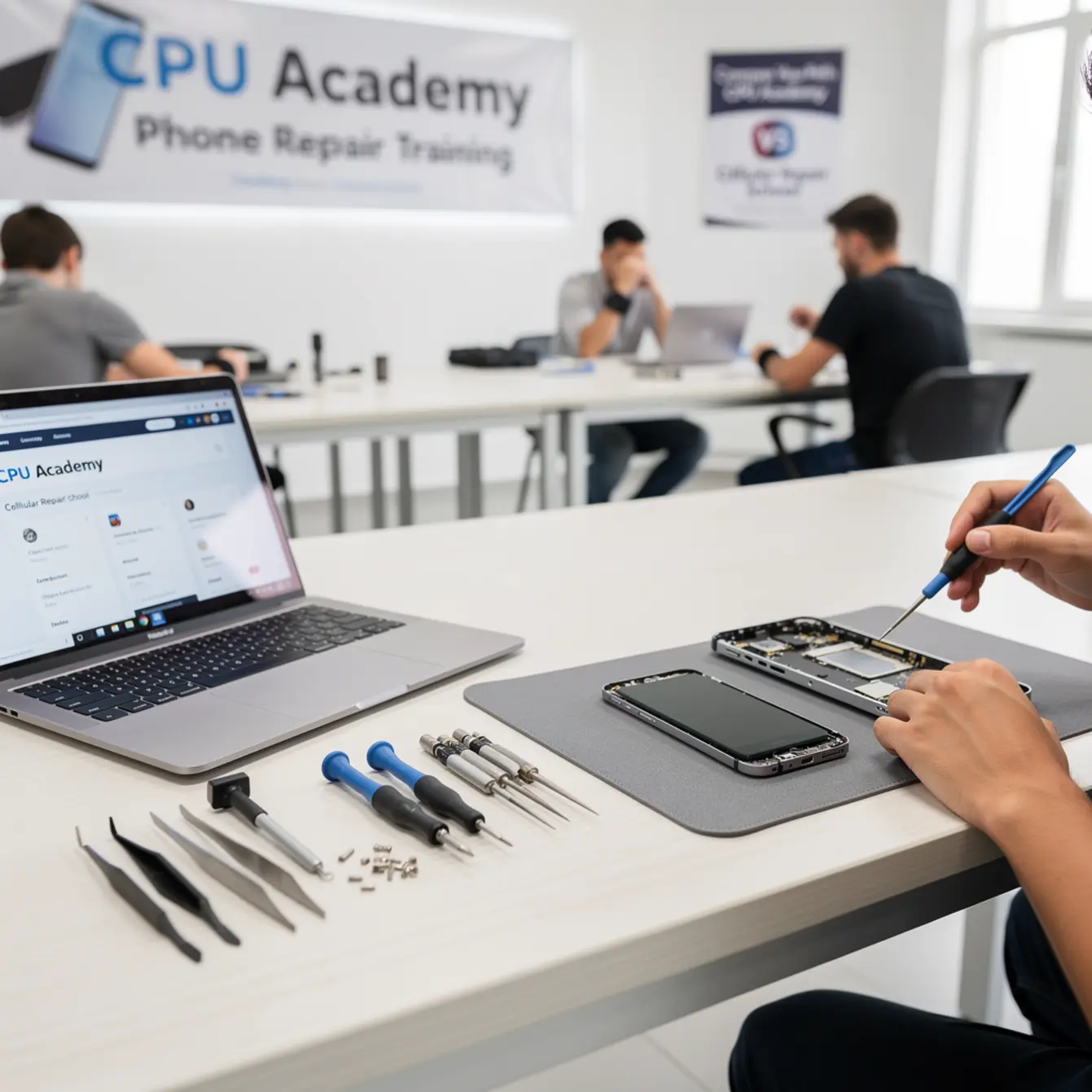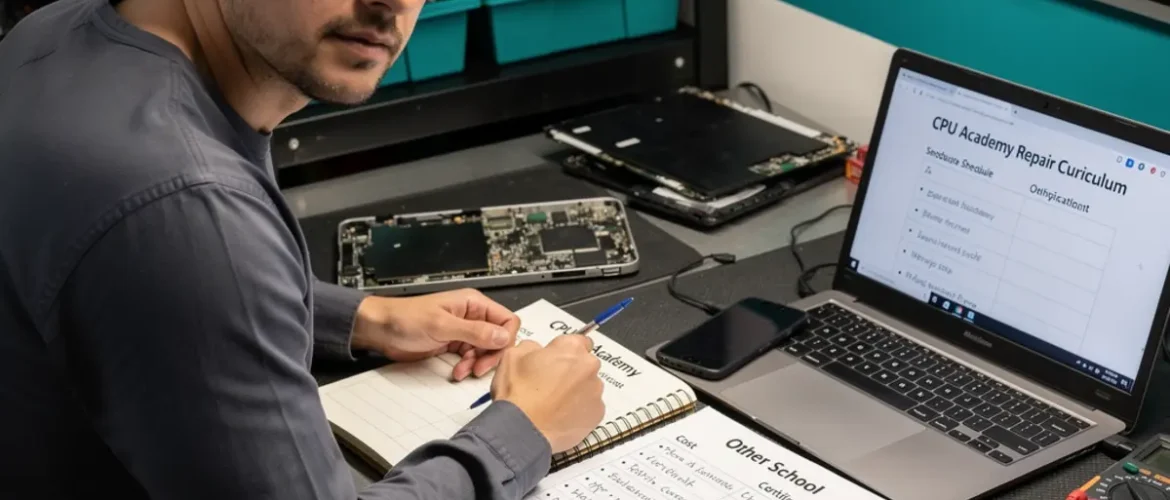
Quick verdict (40 words): CPU Academy vs Cellular Repair School comes down to how you learn best. CPU Academy suits beginners who want structured, real-device labs and schematic-based diagnosis. Cellular Repair School suits learners who prefer a different delivery format. Neither is universally better — the right one matches your learning style and goals.
You’ve burned time watching free YouTube videos that contradict each other. You’ve Googled “best phone repair course” at midnight with seventeen tabs open. And now you’re sitting between two real options — CPU Academy and Cellular Repair School — trying to figure out which one is actually worth your money.
That hesitation makes sense. Pick the wrong phone repair course and you spend weeks absorbing theory that evaporates the moment a real device hits your mat. Pick the right one and you’re taking paid repair jobs in weeks, not months.
This page is here to help you cut through it. We’ll cover what each type of program usually offers, which criteria actually predict your success, and exactly when the CPU Academy vs Cellular Repair School decision tips one direction or the other.
No invented reviews. No filler. Just the stuff that matters when you’re trying to go from zero to confident repairer.

Quick Answer: Who Should Choose This CPU Academy vs Cellular Repair School?
Honestly, there’s no automatic winner here. It depends on what you actually need from a cell phone repair course — flexibility, depth, support, or a fast path to your first paid job.
The table below gives you a side-by-side look at the key factors. Scan it first, then keep reading for the detail behind each row.
| Decision Factor | CPU Academy | Cellular Repair School |
|---|---|---|
| Learning format | Online, self-paced video + structured modules | Varies by provider; in-person or online options |
| Schematic / diagnosis training | Yes — dedicated schematic diagram course included | Varies by provider |
| Real-device practice focus | Strong emphasis on hands-on repair scenarios | Depends on the specific school and program |
| Business launch support | Launch Kit available as add-on module | Typically not included |
| Beginner friendliness | Designed for zero-experience starters | Varies widely |
| Location requirement | None — fully online | May require travel for in-person sessions |
| Path to first paid repair | Structured beginner-to-income curriculum | Less consistent across providers |
Still comparing options? See exactly what CPU Academy includes inside the Online Phone Repair Course & Certification and decide with the real curriculum, support, and enrollment details in front of you.
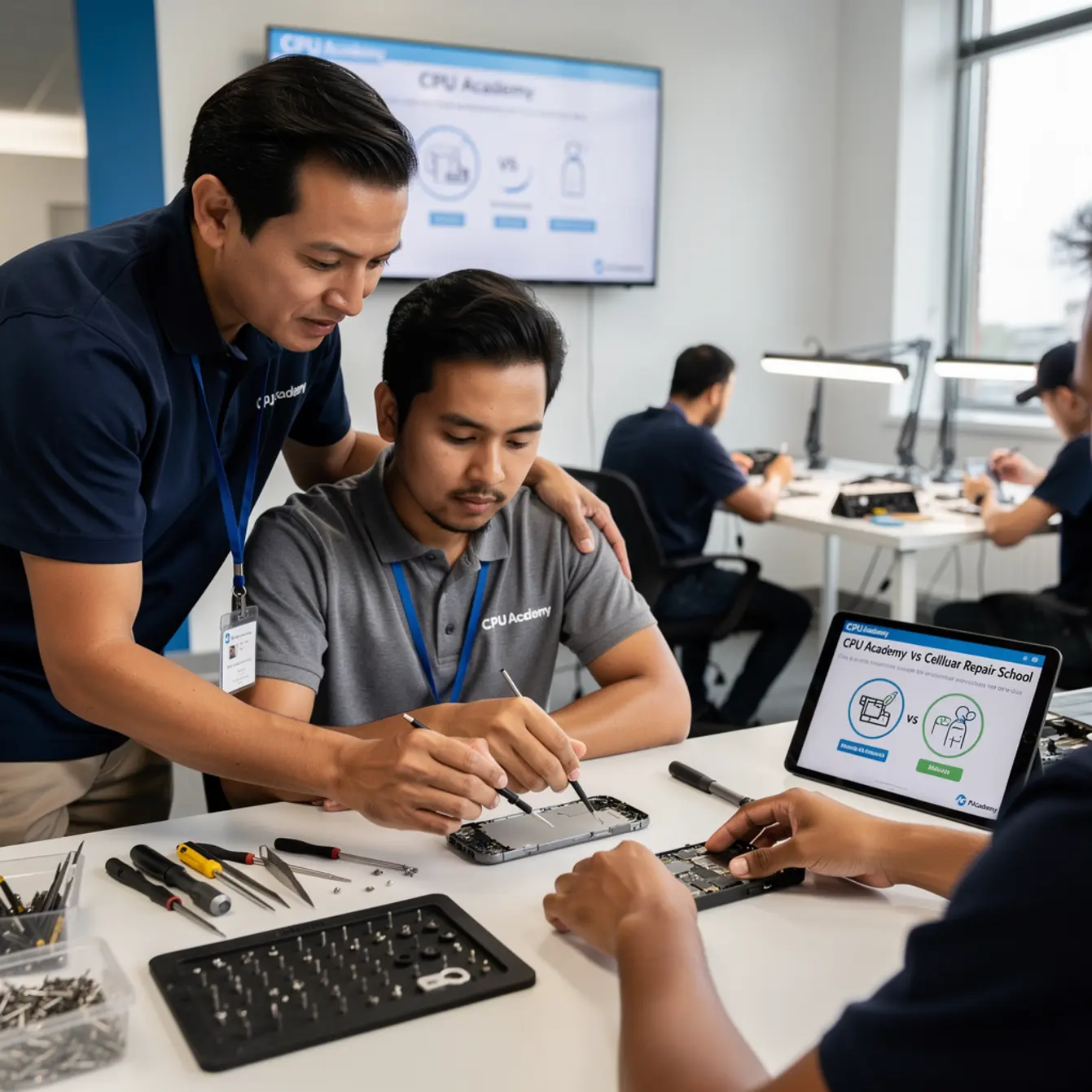
Who This Is Best for (and Who Should Skip It)
Before you spend a dollar on anything, be honest about where you are right now and where you want to be in 90 days. That gap is the whole ballgame.
CPU Academy is likely the right fit if you:
- Are starting from zero — no repair experience, no electronics background
- Want to learn at your own pace without commuting to a classroom
- Need a structured path, not a pile of random video modules
- Want to understand why a repair works, not just copy the steps
- Are thinking about taking paid jobs or starting a side business
- Want schematic-reading skills built in, not bolted on as an afterthought
You might want a different option if you:
- Learn best in a live, face-to-face classroom where you can physically ask an instructor questions
- Already have intermediate repair skills and only need one narrow topic covered
- Prefer a short workshop format over a full course
That’s not a knock on any school. It’s just honest buyer guidance. If a live classroom suits the way your brain works, chase that. But if flexibility and depth matter more to you, a good online phone repair course gives you something a weekend workshop rarely can.
What to Compare Before You Buy or Enroll
Most beginners compare price first. That’s almost always the wrong move. Here are the criteria that actually predict whether you’ll walk away confident and capable — in order of real importance.
1. Real-Device Practice
Does the course show actual repairs on real phones? Or is it mostly slides and bullet points? A mobile phone repair course that never puts a real device in your hands will leave you frozen when your first customer walks in with a cracked screen on the mat in front of you.
Look for step-by-step teardown videos, tools explained in context, and repair walkthroughs you can follow along with — not just a glossary you skim once and forget.
2. Schematic and Diagnosis Training
Here’s the criterion most buyers get wrong. Screen replacements are pretty straightforward once you’ve done a few. But what happens when the phone powers on and the screen stays black? Or it charges, but only to 40 percent and stops?
That’s where schematic reading separates techs who can actually diagnose from techs who just swap parts and hope. CPU Academy addresses this directly with a standalone Phone Schematic Diagram course — a skill most beginners don’t know they need until their first mystery fault stops them cold and they have no idea where to look.
3. Structured Learning Path vs. Random Modules
Random feels comfortable at first. You pick the topic you want, watch a video, move on. But random learning creates random skill gaps that show up at the worst times.
A well-built cell phone repair course online takes you through skills in the right order, so each new concept builds on the last. That structure is what gives a beginner the quiet confidence you feel after the first clean repair — when everything went the way it was supposed to and you realize you actually know what you’re doing.
4. Support After Enrollment
What happens when you get stuck on a fault you can’t diagnose? Can you ask a question and get a real answer? Or are you staring at a course forum that hasn’t had a reply in eight months?
Support quality is hard to judge from a sales page. Look for community access, Q&A features, or any visible sign that the team behind the course is still active and paying attention.
5. Path to Paid Work
A course that ends at “congratulations, you finished” isn’t really finished. The best cell phone repair training gives you enough confidence and practical context to take your first paid job or launch a basic repair side hustle.
CPU Academy’s 30-Day Launch Kit is built specifically for that bridge between skill-building and actual income. It’s the part most courses skip entirely.
6. Cost vs. Total Value
Don’t compare sticker prices alone. A cheaper course that leaves you stranded costs more in the long run — in wasted hours, botched customer devices, and lost confidence that’s hard to rebuild. Measure value by what you can actually do when you’re done.
7. Refund or Satisfaction Policy
Any credible course should have a clear refund policy you can read before you pay. If you can’t find it, ask before you enroll. It’s not a dealbreaker on its own, but it tells you a lot about how much the provider trusts their own product.
Common Mistakes Beginners Make
These show up constantly when people are choosing their first repair training. Avoid them and you’re already ahead of most new starters.
Mistake #1: Choosing based on price alone.
The cheapest course is rarely the one that gets you to paid work fastest. Factor in what you’d spend recovering from gaps in your training — including the cost of a device you accidentally made worse.
Mistake #2: Skipping schematic training because it looks hard.
Schematic reading feels intimidating early on. But every technician who can diagnose a tricky fault — the kind customers pay a real premium to solve — knows how to read one. Don’t skip it just because it looks like a wall of lines.
Mistake #3: Picking a course because the marketing looks good.
A slick website doesn’t mean a practical course. Look for actual curriculum details, real repair content, and clear information about what you’ll be able to do when you finish. If the sales page is vague, the course probably is too.
Mistake #4: Starting with advanced content.
Jumping straight to motherboard-level repair before you’ve mastered screen replacement is like learning to drive by starting on the highway. Structured courses exist for a reason. Use the structure.
Mistake #5: Treating an online course like passive entertainment.
Watch, pause, do. The learners who get results fast treat every module like a practice session, not a Netflix episode. Keep your tools nearby, even if you’re just watching. Sorted screws in a tray, phone on the mat, ready to follow along — that habit alone puts you miles ahead.
A Real-World Learner Scenario: Meet Jay
Jay is 27, works a full-time job, and wants to build a side income fixing phones for friends and neighbors. He has zero repair experience. He spent a few evenings on YouTube, but every video had a different format and left him with more questions than when he started.
His priorities were simple: flexible schedule, beginner-friendly, practical enough to fix real phones, and a clear path to a first paid job within 60 days.
His concern with a traditional school was real. He’d need to take time off work for in-person sessions, and the curriculum he found leaned heavier on theory than he expected for the price.
When Jay found a structured cell phone repair course online that combined hands-on repair walkthroughs, schematic training, and a launch kit for his first repair business, the decision simplified. He wasn’t buying a certificate to frame. He was buying the ability to say yes the next time a neighbor showed up with a cracked screen and asked if he could help.
That’s the real question every good repair course should answer before you finish it.
CPU Academy Fit: When Our Course Is the Smarter Choice
CPU Academy is the stronger fit when you want practical labs, schematic-based diagnosis, and a clearer beginner-to-income path than a generic or theory-heavy program offers.
Here’s exactly when that’s you:
- You want to learn on your own schedule without sacrificing depth
- You want schematic reading built into your training, not hunted down separately
- You want to practice real repair scenarios — screen replacements, charging faults, water damage — not just watch someone else work through them
- You want a course that acknowledges you’ll eventually have paying customers, and actually prepares you for that moment
- You want to know what you’ll be able to do after finishing, before you enroll
If you want the option built for practical, real-device learning rather than scattered theory, start here: Online Phone Repair Course & Certification.
If you want to go deeper on a specific skill alongside the core course, the Phone Screen Replacement course is a natural companion. It focuses entirely on the repair type you’ll handle most often as a new technician — and getting fast and clean at it is what builds your reputation early on.
When a Different Option Might Fit Better
To be straight about it: if you genuinely learn best in a live classroom with a physical instructor nearby, and you have the schedule flexibility to attend in-person sessions regularly, a local school format could work well for you. Some people need that human presence to stay motivated and accountable.
The honest guidance is this. Don’t choose a learning format because it’s geographically closer or looks cheaper on day one. Choose the one that matches how your brain actually processes new skills when things get confusing. That’s the only thing that matters at 10 p.m. when you’re troubleshooting a fault you haven’t seen before.
CPU Academy is likely right for you if: You want a complete, structured path from zero to paid repairs — online, at your pace, with schematic training included.
Consider another route if: You need live, face-to-face instruction or only need one narrow topic covered in a short workshop format.
FAQ + Next Step
Which is better for beginners: CPU Academy or Cellular Repair School?
For most beginners in the US, an online course with structured modules and real-device practice tends to outperform a generalist school format. CPU Academy is built specifically for zero-experience starters — the curriculum assumes you know nothing and builds your skill in a logical order. If your main goal is to go from complete beginner to first paid repair as efficiently as possible, the structured online path typically wins.
What is the main difference between CPU Academy and Cellular Repair School?
The core difference is format and depth. CPU Academy is a fully online, self-paced course built around real repair scenarios and schematic-based diagnosis — with a specific path to income. Cellular Repair School offerings vary by provider and location, and some work better for learners who want a classroom setting. The right pick depends on how you learn and what outcome you’re actually after.
Which one gives better support to learners?
Support quality varies across any provider. What to look for: Is there an active community? Can you ask questions and actually get a response? Is the content updated when new phone models come out? Before enrolling anywhere, check for visible Q&A features, community access, and evidence that the team behind the course is still engaged. Don’t assume a live classroom automatically means better support — plenty of in-person courses end the moment class is dismissed.
Which one is worth the money for someone who wants to earn from repairs?
Value is determined by outcome, not price tag. A course worth the money gives you skills you can use on real devices, the confidence to say yes to paying customers, and ideally some guidance on how to find those first customers. If a course ends at “you completed the modules” without any bridge to income, that’s a real gap. CPU Academy’s curriculum and the optional Launch Kit are both designed with that income path in mind from the start.
Do I need any experience before starting a phone repair course?
No. A well-designed beginner course assumes zero prior knowledge. You should be able to start with nothing more than curiosity and a willingness to practice. If a course lists prerequisites you don’t have, ask whether there’s a foundation module or starter path before you pay full price for something you’re not ready for yet.
How long does it take to complete a phone repair course and start taking paid jobs?
This varies by the course and how much time you put in each week. Some learners work through the core modules in a few weeks if they treat it like a part-time commitment. Others go slower and that’s fine too. What matters more than speed is whether the course leaves you confident enough to handle a real customer’s device — not just score well on a quiz. That practical confidence is what leads to the first paid job.
For an additional repair reference while comparing a CPU Academy vs Cellular Repair School, review Cellular Repair School; then use this guide to choose the structured training path that fits your goals.
Ready to stop researching and start building the skill?
The CPU Academy vs Cellular Repair School decision doesn’t need to drag on. If structured, hands-on, beginner-to-income training is what you’re after, you already know where to go.
Go to CPU Academy’s Online Phone Repair Course & Certification and see the exact course page, curriculum, and enrollment details now.